

Nightmare Eclipse Drops LegacyHive Zero-Day Hours After Patch Tuesday
Nightmare Eclipse just published a proof-of-concept exploit called LegacyHive, and the timing is about as subtle as a sledgehammer. It dropped hours after Microsoft shipped its July 2026 Patch Tuesday updates — the same patch cycle that was supposed to leave organizations feeling secure heading into the weekend.
The exploit abuses a vulnerability in the Windows User Profile Service (ProfSvc), the core component that manages user accounts and environments on every Windows machine. What makes this particularly gnarly is that it works on all supported desktop and server versions of Windows, including systems running the latest patched updates. There's no CVE assigned yet. No Microsoft advisory. No patch.
The researcher, also known by the alias Chaotic Eclipse, has been locked in a public dispute with Microsoft since at least April 2026. This isn't the first time they've released exploits without coordinated disclosure — LegacyHive is actually their ninth Windows vulnerability published this way in roughly three months. The pattern reads less like responsible security research and more like someone building a toolkit aimed directly at features Microsoft tells customers to trust.
"NightmareEclipse has shipped nine tools in three months, every one aimed at a feature Microsoft tells customers to trust: Defender, BitLocker, CTFMON," Brian Hussey, senior vice president of Howler Cell Services at Cyderes, told The Hacker News. "That pattern reads like an operator building a toolkit, not a researcher publishing bug reports."
The broader context here matters. We're watching artificial intelligence cybersecurity threats evolve in real time — not just the AI-powered attacks themselves, but also how AI accelerates vulnerability discovery at a pace that's breaking traditional patch management. Adam Barnett, lead software engineer at Rapid7, noted that "after years of relative stability, the Patch Tuesday process has experienced significant turbulence so far in 2026," citing both AI-fuelled exponential growth of vulnerability reporting and a series of vulnerabilities disclosed in ways designed to maximize discomfort for Redmond. Learn more about how AI is accelerating vulnerability discovery on Patch Tuesday.
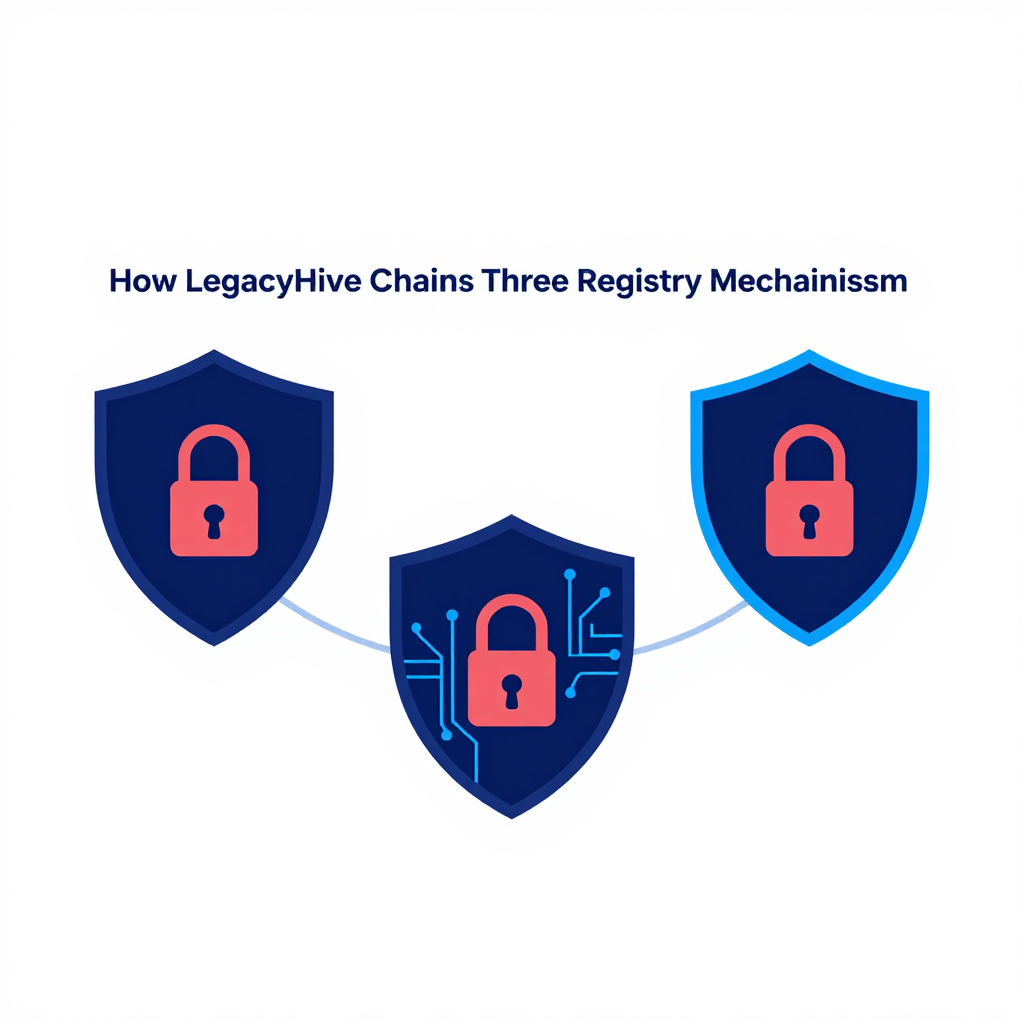
How LegacyHive Chains Three Registry Mechanisms
Here's where the exploit gets clever. LegacyHive doesn't break in from outside — it's built for someone already sitting at the machine next to yours. That makes it a different threat class than the typical remote privilege escalation bugs we see.
The Windows User Profile Service handles loading and managing user profile data, including registry hives like NTUSER.DAT and UsrClass.dat. These files store configuration data for Windows, services, applications, and user profiles. Registry hives contain values that affect how Windows launches software, resolves COM objects, handles file types, and applies user-specific settings.
LegacyHive chains three mechanisms together to abuse this profile loading logic:
Offline registry hive modification. The attacker modifies an offline NTUSER.dat file to redirect the Local AppData path to a location they control.
Object Manager symbolic link redirection. The exploit sets up work directories and symbolic links in the Object Manager namespace to redirect Windows profile paths.
Synchronized profile load. A race condition is triggered to synchronize profile loading while a helper thread starts the target user process, steering the profile load path toward a hive the attacker controls.
The result is cross-user hive redirection. A target user's UsrClass.dat ends up mounted inside a low-privileged user's registry namespace — specifically under HKU<SID>_Classes. This gives that low-privilege user access to registry data that should be completely out of reach.
The publicly released PoC has been intentionally stripped down to prevent easy public exploitation. It requires credentials for a second standard user account plus the username of a third account (which can be an administrator). The researcher explained: "The PoC was stripped down as an attempt to prevent public exploitation, the original PoC did not require additional user credential and was not limited to usrclass.dat hive, any hive could be loaded using this vulnerability but you would need some brain cells to make the PoC do it."
The unrestricted original technique could load arbitrary hives without requiring any additional user credentials. That's a significantly more dangerous primitive.
Real-World Impact: What LegacyHive Actually Lets Attackers Do
Will Dormann, principal vulnerability analyst at Tharros, tested the LegacyHive exploit and confirmed it grants non-admin users the ability to modify the classes registry hive of an administrator account. His assessment: "pretty powerful primitive."
The immediate demonstration was almost comically simple — Dormann associated .txt files to open with calc.exe. But as he noted, "Clever attackers or people who want to accomplish something will easily be able to figure out how to do things that are more interesting and/or don't even require user interaction."
That's the real threat here. Once an attacker can modify a privileged user's registry hive, they're looking at:
- Automatic code execution when the admin account logs into the compromised system — no user interaction required
- Access to application data stored in the target user's profile
- Windows Explorer history and other forensic artifacts that could reveal sensitive information
- File association manipulation to redirect how the system opens documents, executables, and other file types
- COM configuration changes that could affect how applications launch and interact
ThreatLocker confirmed the PoC mounts a target user's UsrClass.dat hive with read access into another user account, providing access to application data, Windows Explorer history, and forensic artifacts. They emphasized that while the final impact of this PoC is not immediately exploitable and does not directly reveal password hashes or allow privileged code execution in itself, it highlights a critical vulnerability: path resolution through Object Manager can be abused to load administrator hives as a non-privileged user.
Brian Hussey put it bluntly: "LegacyHive doesn't break in from outside. It's built for the person already sitting at the machine next to yours, and that makes it a different kind of problem than the privilege escalation bugs we usually see. There's no patch for LegacyHive today. Detection is the defense."
The distinction matters. This isn't a remote zero-click exploit you can hit from anywhere on the internet. It requires local physical access — someone who's already inside your perimeter, sitting at an unattended workstation. But in an era where remote work, shared devices, and insider threats are all real concerns, that physical access requirement doesn't make this a non-issue. It just changes the attack surface.
Detection and Interim Mitigation Strategies
With no CVE, no Microsoft advisory, and no patch on the horizon, detection becomes your only line of defense. And that's exactly what security teams are racing to build right now.
Kevin Beaumont, a well-known cybersecurity expert, confirmed the exploit works and published LegacyHive exploitation detection queries for Microsoft Defender for Endpoint (MDE). His work gives security teams something concrete to start with — monitoring for unusual profile-loading activity and unexpected accesses to user profile registry files including NTUSER.DAT and UsrClass.dat.
The PoC follows a specific sequence that should be detectable with the right telemetry:
- Command-line argument validation — checking for suspicious username and password parameters
- Work directory setup — creating temporary directories and Object Manager namespace entries
- Symbolic link creation — establishing redirects in the Windows profile path resolution
- Offline hive modification — altering NTUSER.dat to redirect Local AppData paths
- Target hive copying — moving the target user's UsrClass.dat to an attacker-controlled location
- Race condition triggering — synchronizing profile loading with a helper thread
- Hive validation — confirming the redirected UsrClass.dat loaded into HKU<SID>_Classes
Security teams should also be monitoring for:
- Unusual profile-loading activity from standard user accounts
- Unexpected accesses to NTUSER.DAT and UsrClass.dat files outside normal patterns
- Symbolic link creation in the Object Manager namespace by non-system processes
- Registry modifications to file associations and COM configurations on admin accounts
On the mitigation side, there's no official workaround yet — Microsoft is actively investigating the validity and potential applicability of these claims. A spokesperson stated: "Microsoft is committed to investigating security issues and updating impacted products to protect customers as soon as possible."
In the meantime, organizations should:
- Restrict local physical access to trusted users only — this is the single most effective control against LegacyHive
- Run critical systems as standard users rather than administrators where possible
- Disable unnecessary services that could be leveraged in the attack chain
- Isolate critical systems from general-use workstations
- Review endpoint telemetry regularly for the detection indicators above
- Validate the PoC only within isolated, authorized test environments — don't test this on production systems
The compatibility with July 2026 patched systems means organizations cannot assume routine monthly updates resolve this issue. That's a hard lesson for any security team that's been relying on Patch Tuesday as their primary defense mechanism.
The Nightmare Eclipse vs. Microsoft Standoff
The GitHub repository for LegacyHive was created approximately 11 hours before the PoC became publicly accessible, with source code and README documentation made available under the MIT License. But this release is just the latest chapter in a brewing conflict between Nightmare Eclipse (also known as Chaotic Eclipse) and Microsoft that's been escalating since at least April 2026.
The researcher has released nine Windows exploits with no coordinated disclosure:
- BlueHammer — Windows Defender vulnerability
- UnDefend — Microsoft Defender flaw
- RedSun — Windows component vulnerability
- RoguePlanet — Microsoft Defender zero-day (patched in July 2026 updates)
- YellowKey — Windows vulnerability (patched in June 2026 Patch Tuesday)
- GreatXML — Windows component flaw
- GreenPlasma — Windows vulnerability (patched in June 2026 Patch Tuesday)
- MiniPlasma — Windows vulnerability (patched in June 2026 Patch Tuesday)
- LegacyHive — User Profile Service arbitrary hive load (unpatched as of July 2026)
What makes this pattern particularly concerning is that three of the vulnerabilities previously disclosed by Chaotic Eclipse in Microsoft Defender came under active exploitation shortly after public disclosure. That's not hypothetical risk — it's happening right now.
Microsoft responded to Nightmare Eclipse's disclosures with warnings of legal action against people engaging in "malicious activity causing real harm to our customers," prompting cybersecurity experts to believe the company was directly threatening the security researcher. The dispute centers on a breakdown in communication — the researcher cites Microsoft's failure to address vulnerabilities in a timely manner and their approach to coordinated disclosure. Read more about the ongoing standoff between Microsoft and Nightmare Eclipse.
The timing of LegacyHive's release — hours after Patch Tuesday — feels deliberate. It's a statement about the inadequacy of Microsoft's current patch cycle in addressing vulnerabilities disclosed by independent researchers operating outside the coordinated disclosure framework.
Brian Hussey's assessment captures the broader implications: "That pattern reads like an operator building a toolkit, not a researcher publishing bug reports." Whether you view Nightmare Eclipse as a responsible disclosure advocate or a threat actor depends on your perspective, but the impact on Microsoft customers is clear — they're left without patches for vulnerabilities that have already been weaponized in the wild. See how RoguePlanet, another Nightmare Eclipse exploit, grants SYSTEM access.
This standoff highlights a fundamental tension in cybersecurity: how do we balance responsible disclosure with timely patching when the r