The Intelligent Tutor’s Dilemma: Finding the Balance of Feedback
We have this intuitive belief that if a tutor—human or robotic—just gave us more feedback, we would learn faster. If they could just explain why we're wrong, referencing every mistake we've ever made on this task, everything would click into place, right?
Not quite.
A recent study from the Cluster of Excellence Science of Intelligence (SCIoI) at Technische Universität Berlin has turned that assumption on its head. It turns out that feedback is not a straightforward "more is better" equation. Instead, there's a delicate temporal trade-off that designers of AI tutors and educational systems need to reckon with.
The Experiment: Deciphering the Robot
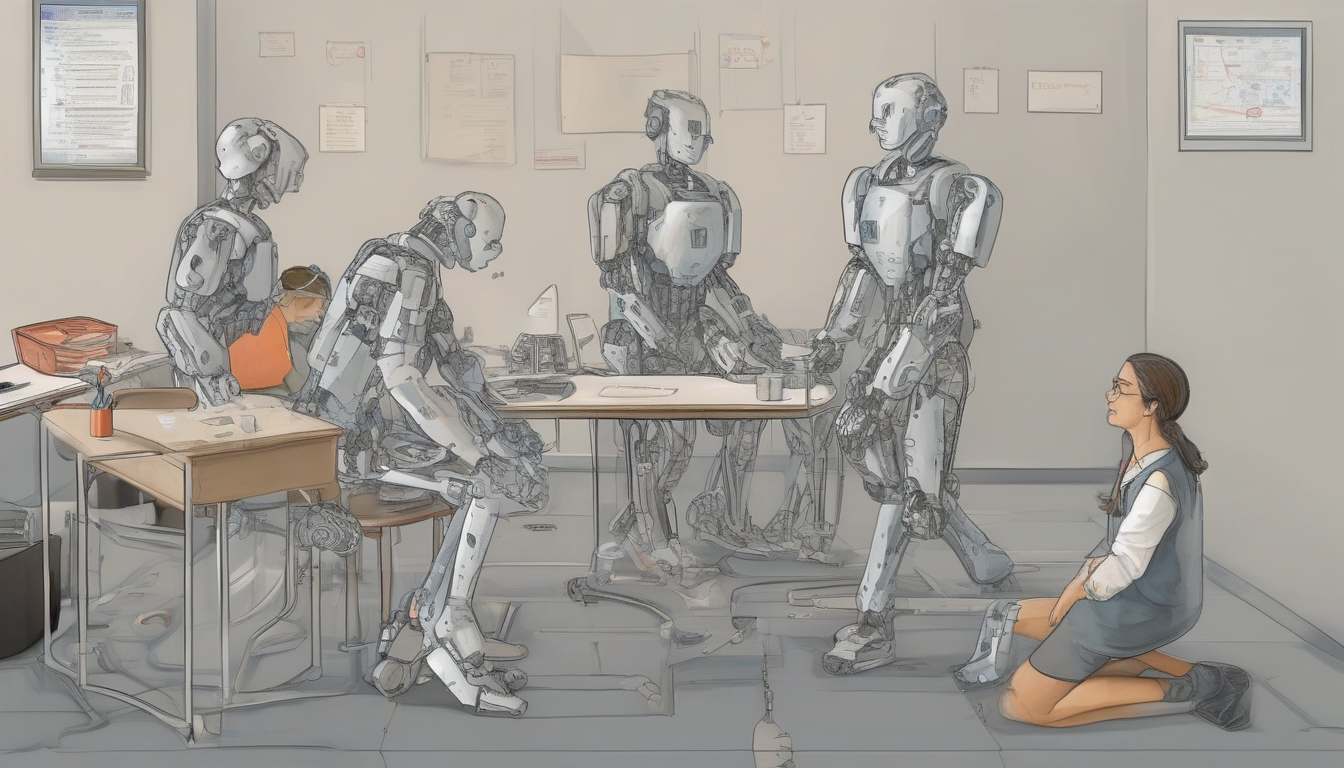
To understand these dynamics, researchers tracked 90 adults as they learned to place household objects—a book, a cup, a bottle—in a room. The challenge? They had to follow instructions provided by a humanoid robot in Swahili, a language none of them spoke.
It’s effectively a spatial puzzle where the learner has to reverse-engineer the meaning of the robot's instructions based on where the robot told them to put the object and whether they got the "right" or "wrong" signal in return.
The researchers tested three different feedback scenarios:
- Fixed Feedback: Non-adaptive, the same robotic response after a mistake.
- Adapted Feedback: Feedback tailored to the learner’s recent performance and their reported enjoyment levels.
- Highly Personalized Feedback: A system that actively referenced the learner’s specific error history and previous attempts.
At first glance, that last option sounds like the gold standard. It sounds smart. It sounds helpful. But the results? They were significantly more nuanced.
The Temporal Trade-off
While the fully personalized feedback was the champion for long-term task mastery, it came with a striking cost in the immediate sense.
Think about it this way: when a learner makes a mistake, they are already dealing with a bit of frustration. Then, they receive a highly personalized, detailed explanation of exactly why they failed, connecting that error to a previous attempt they made three minutes prior.
This takes time to process.
The study showed this extra detail triggered a brief, acute spike in cognitive overload. It was "too much, too soon." Instead of helping the learner pivot and fix the mistake on the next try, the sheer volume of information actually slowed them down in the immediate aftermath.
This is the temporal trade-off. Personalized feedback builds a better, deeper understanding across the entire task, but it hampers performance in the moment right after an error. This dynamic highlights the importance of understanding the cost of convenience in learning environments where some struggle is necessary for true mastery.
The Human Factor: Cognitive Capacity and Boredom
The study also revealed that this feedback wasn't a one-size-fits-all solution—even when it was personalized.
Learners with high cognitive capacity found the detailed, personalized feedback to be a bit cumbersome. They were often able to troubleshoot the puzzle on their own, and for them, all that extra, detailed commentary was essentially distracting noise. They were able to deduce the instructions faster without the robot’s heavy-handed explanations.
Conversely, the feedback helped redirect learners who reported feeling bored. For those individuals, even though the personalized feedback increased their overall cognitive load, it successfully re-engaged their attention with the task. The robot’s hint became a tool for focus rather than overwhelming detail.
Toward Responsive AI Tutoring
What does this mean for the future of AI in classrooms or workplaces?
It highlights that the real goal of an intelligent tutor isn’t just to be "smarter" in terms of how much data it can analyze. It’s to be more sensitive.
The findings emphasize that educational technology should strive to be dynamically responsive. A truly intelligent, effective robotic tutor shouldn’t just track the accuracy of the learner’s response. It should also be assessing the learner’s cognitive and emotional state in real time.
Reclaiming the sovereign mind requires that AI tutors learn to be sensitive to the human factor, offering brief, task-focused hints to guide learners to the next step without over-explaining.
Less Is Sometimes More
The most striking lesson from the Berlin study? The most intelligent tutor might not be the one that gives the most comprehensive, detailed explanation every single time. It might be the one that knows, in a split second, when giving less information is actually the smartest piece of advice it can offer.
As we continue to develop AI for teaching and guidance, we need to design these interactions to be sensitive to the dynamics of the learner. It's about finding that razor-thin line between helping a user build a deeper understanding and overwhelming their ability to function in the moment.
Ultimately, the future of AI tools isn't just about how much they "know," but how well they can read the human on the other side of the screen or table—and how well they can respect the limits of our cognitive capacity in the heat of the moment. We need to stop designing robots that talk more, and start designing robots that actually understand the rhythm of learning itself.