
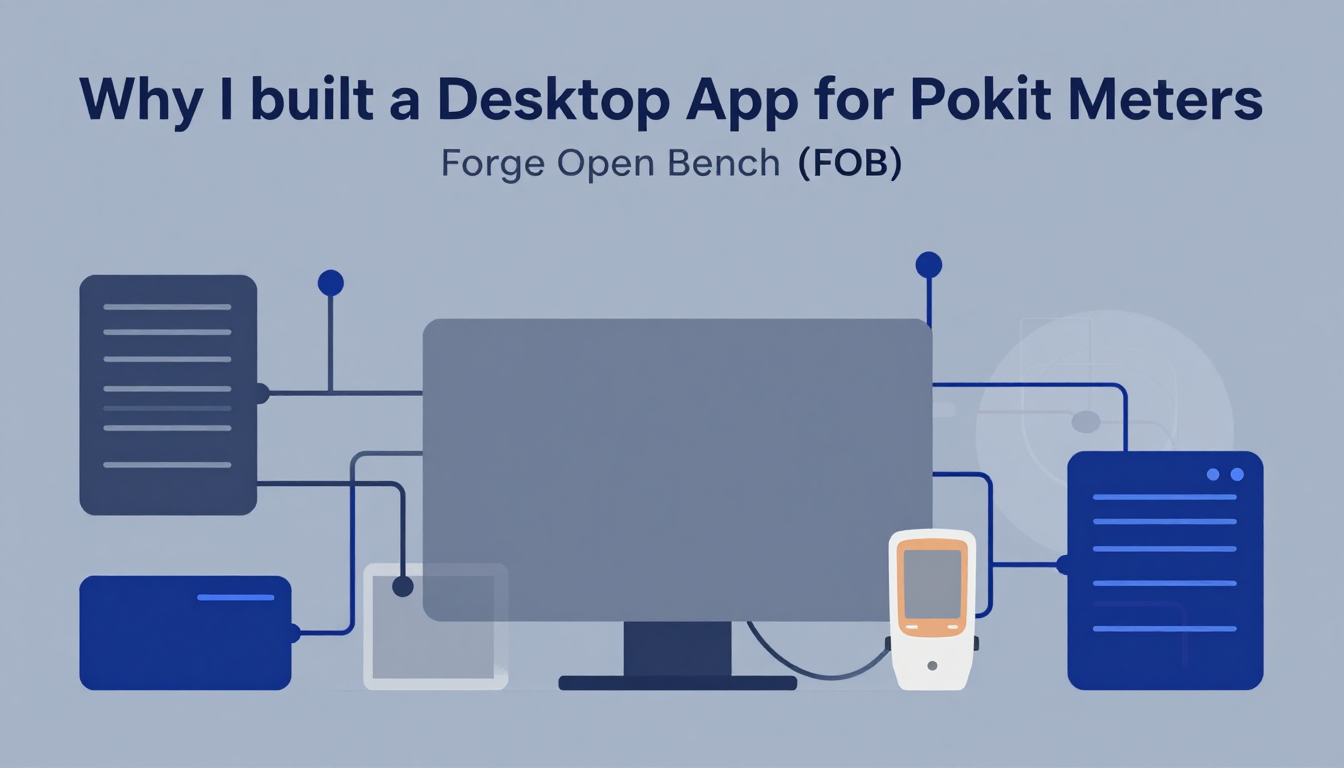
I needed a bigger screen for my oscilloscope
Here's the thing about working with electrical measurement hardware on a phone: it works fine until it doesn't. You're holding test leads in one hand, squinting at a six-inch screen with the other, and suddenly you realize you've been guessing at waveform edges for twenty minutes because the oscilloscope trace got clipped off-screen. Happened to me last Tuesday in a cramped server closet. I was reading voltage on what I thought was a clean 120V sine wave, but the phone display just showed a flat line because I'd zoomed out too far trying to fit everything in view.
That's the moment I started thinking about Forge Open Bench. Not as some grand architectural statement — just a practical response to a real workflow problem.
FOB is an independent open-source desktop application built specifically for Pokit meters, including the Pokit Pro. It's local-first by design, meaning your measurements stay on your machine. No cloud dependency. No account required to take a reading. And right now, it's tested on Linux with macOS and Windows builds coming.
I've been following the development thread over at Ars Technica, and honestly? The approach feels right.
What makes FOB different from the Pokit App
The official Pokit App — available on iOS, Android, and even Apple Watch — is solid for quick checks. It pairs via Bluetooth, supports up to four devices simultaneously, and covers the core measurement modes: multimeter, oscilloscope, data logger, and spectrum analyzer. The whole thing runs on a $228 device that fits in your palm.
But here's where mobile falls short for serious work. The oscilloscope on Pokit Pro offers 200kHz analog bandwidth and 1 million samples per second at 12-bit resolution. That's real measurement capability. Displaying that on a phone means either cramming everything into a tiny viewport or constantly pinching and dragging to find the signal detail you actually need.
FOB flips that. Desktop real estate matters more than most people admit until they're trying to read a 200kHz waveform on something the size of a business card. On a monitor, you see the whole picture — literally. Rise times, ringing, noise floors. The kind of detail that separates "I think it's working" from "I know exactly what's happening."
And the data logger? Pokit Pro can store 14,000 samples over six months at twenty-minute intervals. That's not phone storage. That's persistent, local-first logging that doesn't care whether your battery died three hours ago.
The Pokit Pro hardware you're actually measuring with
Let's ground this in what the meter can do, because FOB's value proposition depends on it. The Pokit Pro is CAT III rated at 600V — that's the safety standard that matters when you're working on live circuits in commercial or industrial settings. It measures AC/DC voltage from 1mV to 600V (True RMS), current from 1µA to 10A, resistance up to 1MΩ with a 3MΩ extended range, capacitance from 1nF to 1000µF, and temperature across multiple ranges.
The oscilloscope mode adds freerun, force, one-time, continuous, rising edge, and falling edge trigger modes — all accessible through the app interface that FOB is replacing with a desktop-native experience. Input impedance sits at 10MΩ DC, which matches what you'd expect from a proper bench instrument.
What's interesting for FOB specifically is the multi-channel architecture. You can connect up to four Pokit devices simultaneously, each with customizable channel names and color coding. The official app handles this fine on mobile, but try doing a four-channel power analysis on a phone while also referencing documentation on another screen. It gets awkward fast.
There's also the Pokit Clamp to consider — when paired with Pokit Pro, it unlocks watts, VA, and VAr readings plus precise power waveforms. Up to four clamps and four Pros for multi-phase measurements. That's a desktop workflow waiting to happen.
Why local-first actually matters here
I keep coming back to this because it's not just a buzzword for FOB — it's the design constraint that shapes everything else.
When you're measuring electrical systems, your data is your data. Maybe you're diagnosing a client's HVAC system. Maybe you're documenting power quality issues for a facility manager. Maybe you're just keeping records of your own lab work. None of that requires a server in the middle.
The local-first approach means FOB stores measurements on your machine. Period. No sync prompts. No "sign in to export" walls. You take a reading, you save it locally, you export when you need to. The Pokit App already supports saving readings and exporting via share functions, but doing that through a desktop OS means you get proper file management, batch exports, and integration with whatever analysis tools you already use.
There's also the offline angle. I've worked in basements and server rooms where Bluetooth range is fine but internet connectivity is nonexistent. FOB doesn't need either to function. You pair the meter, you measure, you log. The data sits there when you get back to a networked environment.
This matters more than people realize. Every cloud dependency is a single point of failure in the field.
Who this is actually for
Let me be specific, because "engineers and hobbyists" is too broad to be useful.
Field technicians doing HVAC diagnostics benefit most from the desktop logger interface. You're setting up multi-hour temperature or voltage logs, walking away, coming back to data that's already organized on a screen you can actually read. The Pokit Pro's 14k sample capacity over six months becomes genuinely useful when you're tracking seasonal patterns or intermittent faults.
Automotive diagnostics folks will appreciate the oscilloscope expansion. Engine timing, sensor waveforms, CAN bus analysis — all of this benefits from the larger display and the ability to keep multiple measurement channels visible simultaneously. The Pokit Pro's 200kHz bandwidth covers most automotive signal analysis needs.
Education is another natural fit. Teaching electrical measurement concepts on a phone screen means everyone's huddled around one device. On desktop, the instructor can project FOB and students see exactly what you're seeing — no squinting, no passing the phone around.
Even hobbyists building home automation or working on audio projects will find the desktop workflow more sustainable for extended sessions. Your eyes thank you after hour two.
The roadmap and what's coming
FOB is Linux-first right now, which tells you something about who's building it. The developer community on Linux tends to be the most demanding when it comes to open-source tooling, and that's a good filter.
macOS and Windows builds are in development. That's significant because it means the architecture is being designed for cross-platform compatibility from the start, not bolted on later. For an open-source project, that kind of planning usually means a solid abstraction layer between the UI and the hardware communication protocol.
The Pokit ecosystem itself is expanding too. The Power Analyser expansion module is available for pre-order, and the Range Tester is already live. These add measurement capabilities that FOB will need to integrate — power analysis across multiple phases, for instance, is a desktop-native use case that would be genuinely painful on mobile.
The developer's thread on Ars Technica suggests active development. That's the kind of signal that matters for an open-source project you might depend on professionally.
My honest take after reading through the development thread
I'll be straight with you: I wasn't going to write this. The Pokit ecosystem already has a working app, and most people's measurement needs are covered by their phone. I picked up the topic because someone asked me to look at it, and I kept reading.
What struck me isn't the feature list — though it's comprehensive. It's the philosophy. Local-first. Open source. Desktop-native for tools that deal in precision. These aren't decisions you make when building a side project on weekends. They're decisions you make when you've actually been frustrated by the limitations of mobile measurement workflows.
Is it ready for production use? I can't say definitively — the Linux build is tested, but I haven't run it against live circuits myself. What I can say is that the design approach is sound, the source material is solid, and the developer community engagement looks genuine.
If you work with Pokit meters regularly and find yourself fighting with a phone screen, FOB is worth watching. If you're on Linux already, it might be worth trying today.