

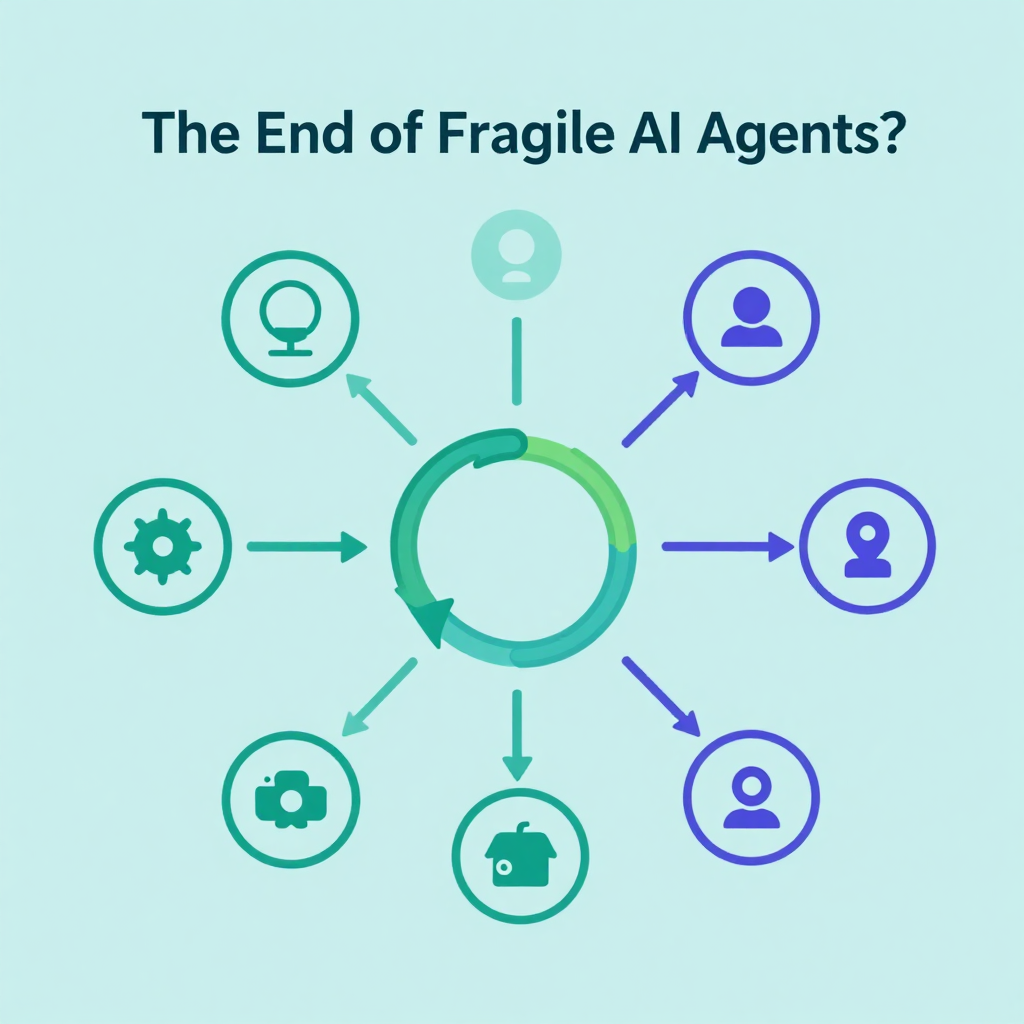
The End of Fragile AI Agents?
Let's be blunt: real-world environments are notoriously difficult to parallelize and scale for AI agent research. Ask any engineer attempting to run thousands of reinforcement learning (RL) trajectories simultaneously in Docker containers, Android emulators, or against live Web APIs, and you’ll hear the same story—it's a fragile, compute-heavy bottleneck.
The core challenge isn't just scaling—it's unpredictability. Injecting specific, rare, or adversarial edge cases—like bizarre network latency, complex permission errors, or server time-outs—is nearly impossible to do on demand in a live environment. This limitation has historically crippled our ability to train agents to be robust, generalizable, and truly resilient.
Enter Qwen-AgentWorld. Alibaba’s latest release represents a fundamental shift: instead of training agents in live sandboxes, it simulates them. This native world model, trained as a bilingual native language model, is poised to reshape how we develop and optimize agentic systems.
Inside Qwen-AgentWorld: A Genuine World Model
Qwen-AgentWorld isn't just another post-hoc wrapper. It was built from the pre-training phase forward to predict environment states. The model, released in two sizes—Qwen-AgentWorld-35B-A3B (with 3B active parameters) and the more robust Qwen-AgentWorld-397B-A17B (17B active)—uses a Mixture of Experts (MoE) architecture to achieve impressive efficiency while handling a staggering 256K context window.
This model is designed to simulate seven core environments: Model Context Protocol (MCP), Search, Terminal (Linux Bash), SWE (Software Engineering), Android, Web, and OS. Instead of relying on heavy external software to execute actions, the language model predicts the terminal stdout/stderr, OS interface transitions, and search response content directly via long chain-of-thought (CoT) reasoning. The result is a unified simulation platform that runs entirely within the model’s token prediction framework.
The Three-Stage Training Pipeline
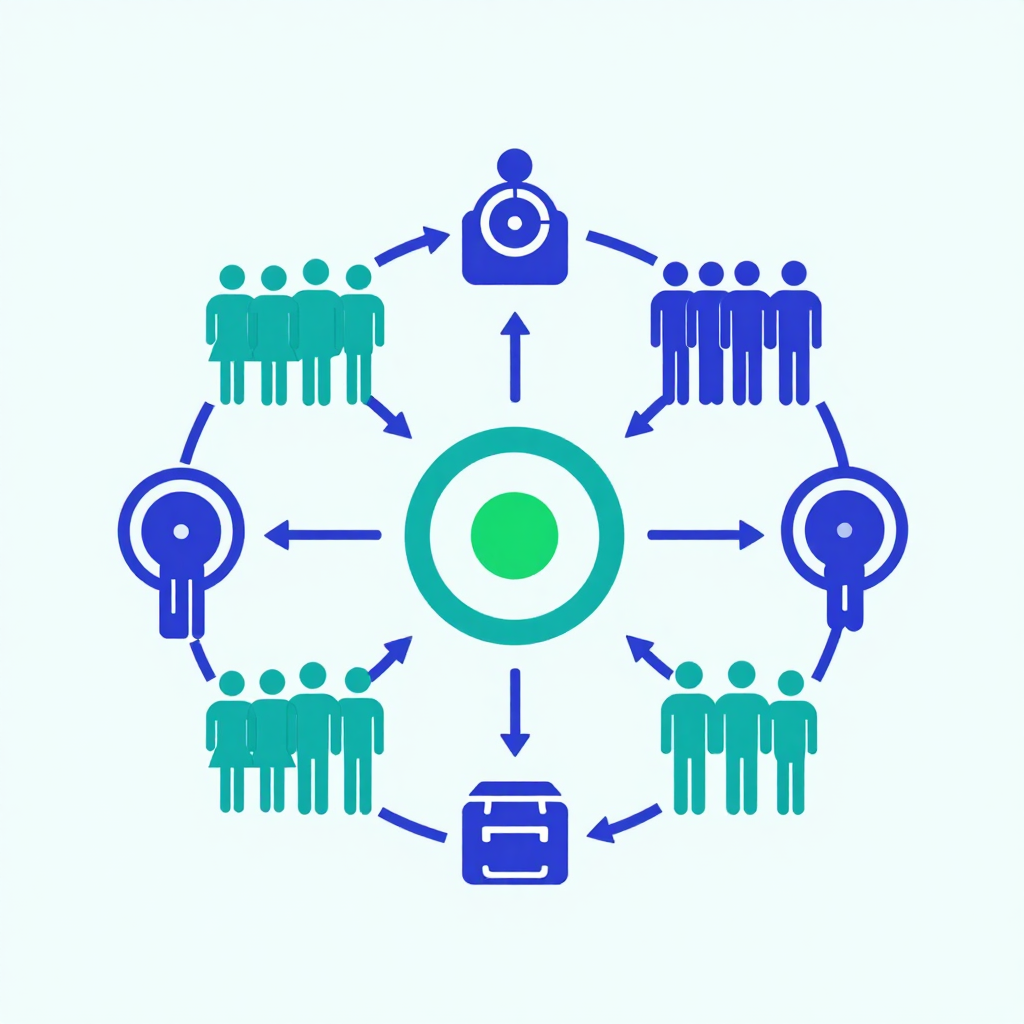
The effectiveness of Qwen-AgentWorld stems from a rigorous three-stage training pipeline.
- Continual Pre-Training (CPT): The model is first fed over 10 million real-world interaction trajectories. This isn't just raw text; it's designed to ingest environment dynamics and strictly defined state transition rules.
- Supervised Fine-Tuning (SFT): Here, the model activates "next-state-prediction" reasoning, essentially learning to "model" the consequences of specific actions in a variety of environments.
- Reinforcement Learning (RL): Finally, the simulation quality is polished using a hybrid reward function that combines rule-based checks with multi-dimensional LLM rubrics.
This pipeline produces a model that doesn’t just mimic behaviors; it understands the causal dynamics of the environments it simulates. That distinction is critical—it’s the difference between a parrot repeating terminal commands and an agent that understands why those commands lead to specific state changes.
Beating the Heavyweights: Evaluation Results
The performance of Qwen-AgentWorld-397B-A17B is, frankly, compelling. On AgentWorldBench, which measures model outputs across format, factuality, consistency, realism, and quality, it achieved an overall score of 58.71.
For context, this outperformed GPT-5.4 (58.25), Claude Opus 4.6 (57.80), and Gemini 3.1 Pro (54.57). More impressively, when developers used Qwen-AgentWorld to simulate environments for agentic RL training, the resulting agents showed far superior generalizability on downstream out-of-distribution benchmarks compared to agents trained in live environments.
The simulated environments aren't just faster; they seem to be better for learning. By providing a clean, consistent, and fully observable simulation, the agents can learn without the noisy, inconsistent feedback often found in live API sandboxes. It's a textbook example of "cleaner data producing smarter models."
The Edge Case Advantage: Controllable Stress Testing
This brings us to the killer feature: controllability.
In a real terminal, you can’t easily force a 502 Bad Gateway error on a specific API call in the middle of a complex script—not without building a ridiculously brittle mocking infrastructure. With Qwen-AgentWorld, you can inject these perturbations seamlessly.
Simulated RL with Qwen-AgentWorld on out-of-distribution setups boosted agent performance on Claw-Eval by +4.3 points and QwenClawBench by +7.1 points. Perhaps even more telling: injecting controllable MCP errors boosted performance from 31.5 to 36.1 on the Tool Decathlon benchmark.
This is the holy grail for robust agent development: the ability to stress-test your agents in a controlled, safe environment against scenarios that are either too expensive, too rare, or effectively impossible to replicate in real-time. We’re finally at the stage where we can train agents to handle failure, not just succeed in perfect conditions.
What This Means for Agent Pipelines
Ultimately, the Qwen-AgentWorld release shifts the paradigm. Training agents in live sandboxes is increasingly looking like an early-stage technique, something we’ll eventually move away from as simulators like this become more capable.
This model essentially offers a "Warm-Up" mode for general models. Even without fine-tuning on a specific task, pre-training a general-purpose agent model on the environment simulation task acts as a powerful warm-up, improving performance significantly across seven downstream benchmarks, including heavyweights like SWE-Bench Verified and BFCL v4.
We are watching the maturity of agent training pipelines unfold in real-time. As simulation quality rises, the need for brittle, live sandboxes—or the danger of letting agents wreak havoc in production environments—decreases. We aren't quite at the point where we can do all training in simulation, but Qwen-AgentWorld makes it clear that the tide is turning. For those of us building agentic systems, it’s time to start thinking about how to integrate environment simulation into our own training loops. The era of brittle agents might finally be coming to an end.