
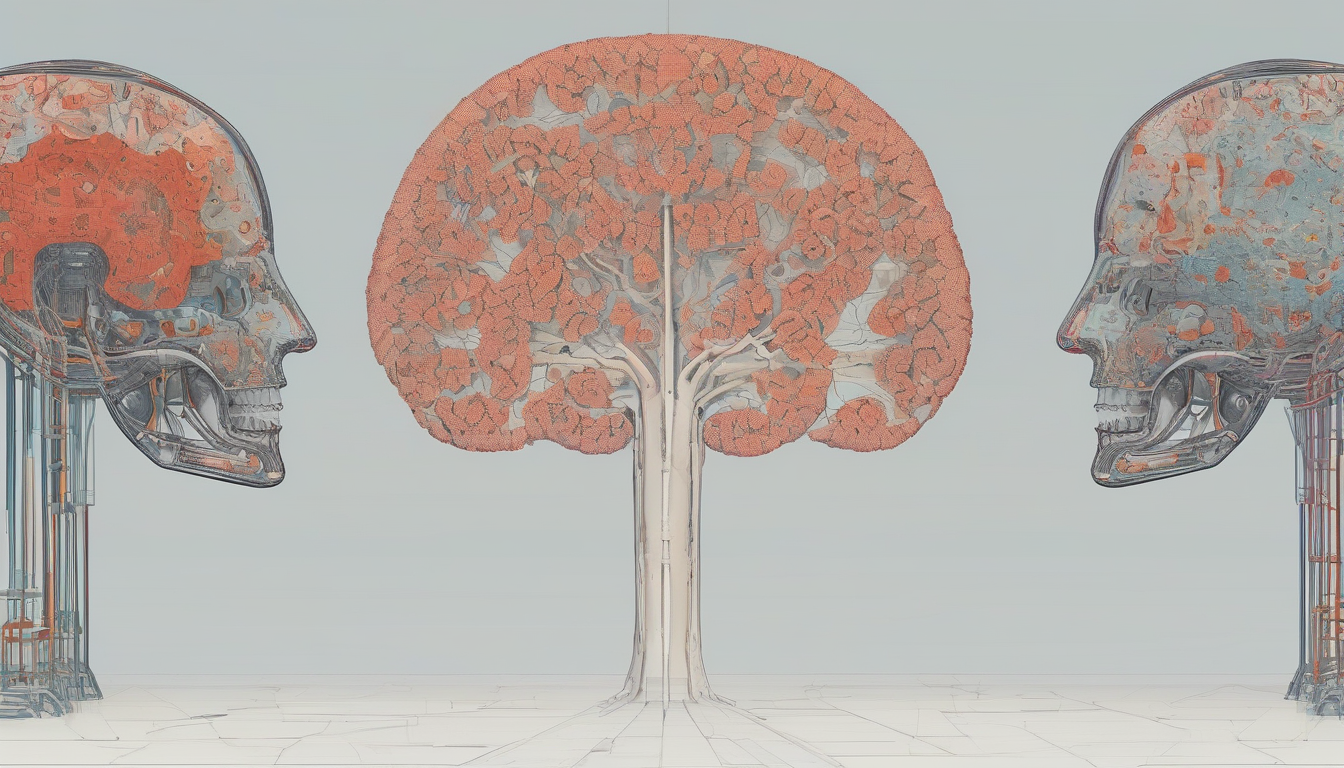
The 70th Birthday of AI Is Also the Birthday of Psychology
You're lighting candles on a cake today—not for a person, but for a machine. Artificial intelligence turns 70. And if you're celebrating, you're also celebrating the birthday of your own mind.
It wasn't just a conference in Hanover. It was a quiet revolution. On June 18, 1956, a handful of computer scientists, mathematicians, and psychologists gathered at Dartmouth College and coined the term "artificial intelligence." Their goal? To make machines that could learn, reason, and solve problems like humans. But what they didn't say out loud—what they barely even realized—was that they were also inventing a new way to understand ourselves.
Because right after that, on September 11, 1956, at MIT, another group of the same people—Marvin Minsky, Allen Newell, Herb Simon, George Miller, and even Nathaniel Rochester—gathered again. This time, they weren't building machines. They were trying to reverse-engineer the human mind. Some attendees, like psychologist Duncan Luce, were invited but couldn't make it. The point stands: the same minds were working on both sides of the equation.
The Dartmouth workshop said: "Let's make intelligence."
The MIT workshop said: "Let's figure out what intelligence even is."
And suddenly, psychology stopped being about rats in mazes and stimulus-response curves. It became about mental models. About memory limits. About representations. About computation.
That's the cognitive revolution. And it didn't happen in a vacuum. It happened because AI and psychology got married that summer. Not just as colleagues. As partners.
The Marriage of Mind and Machine
Look at the language we use for AI today. Neural networks. Learning. Recall. Training. Attention. Feedback loops. These aren't computer science terms. They're psychology terms.
Frank Rosenblatt didn't invent the perceptron because he was a programmer. He was a psychologist who wanted to model how neurons in the brain connect. Donald Hebb didn't write about cell assemblies to help build a computer—he was trying to explain how memories form in a child's brain. And when we say an LLM "hallucinates," we're not being poetic. We're borrowing the word from clinical psychology. Because that's what it looks like when a machine confuses its own patterns for reality.
We didn't invent AI's vocabulary. We stole it from ourselves.
And it's not just words. It's structure.
Why do we build robots with faces? Why do we give them eyes that light up when they "listen"? Because we don't want efficiency. We want recognition. We want to see ourselves in the machine. That's not engineering. That's anthropology. That's the same impulse that made early humans carve faces into stones—not because they needed to, but because they needed to feel understood. Learn more about how anthropomorphism distorts our perception of machine intelligence.
The Mirror in the Machine
We thought we were building tools.
Turns out we were building mirrors.
Large language models don't think like humans. But they mirror us in ways we didn't expect. They get bored. They overgeneralize. They forget context. They repeat themselves. They make up facts like a student cramming for an exam. They're not broken. They're human.
We thought we'd build something smarter. Instead, we built something that reflects our own flaws. Our biases. Our inconsistencies. Our creativity. Our confusions. See how automated systems institutionalize and scale human prejudice.
And that's why AI doesn't belong to computer science.
It belongs to psychology.
Every time you say, "The AI doesn't understand," you're really saying, "I don't understand myself."
Every time you get frustrated by a chatbot's nonsense, you're staring into the same mirror that Freud, Piaget, and Miller stared into.
We didn't create intelligence.
We just gave it a name.
And now, 70 years later, we're still trying to figure out what that name means.
The Forgotten Psychology in the Code
Here's what textbooks usually skip: the rise of deep learning—the very backbone of modern AI—wouldn't exist without psychologists. Donald Hebb's cell assembly theory. Frank Rosenblatt's perceptron. David Rumelhart and Jay McClelland's work on neural network simulations. These weren't computer scientists building algorithms. They were psychologists trying to model the brain.
Even today, when we talk about reinforcement learning, deep learning, training, and recall, we're using language borrowed directly from cognitive psychology. The goal of AI has always been to simulate human learning and intelligence. It's just that we forgot where we got the blueprint.
Take robotics. Even though a robot with a shovel might be much better at robot football, we build robots with legs and little faces with lights that look like eyes. Why? Because a robot with a face appeals more to us. It's not about efficiency. It's about connection. It's about seeing ourselves in the machine.
Happy Birthday, AI. Happy Birthday, Mind.
So light the candles. Blow them out. Make a wish.
But don't wish for smarter machines.
Wish for wiser humans.
Because the real breakthrough isn't in the code.
It's in the quiet realization that we've been studying ourselves all along.
And maybe, just maybe, that's the only kind of intelligence that ever really mattered.
Sources
- Happy Birthday, AI—and Happy Birthday to You Too, Psychology by Max Louwerse, Psychology Today, July 2026
- Louwerse, M. M. (2025). Understanding artificial minds through human minds: The psychology of artificial intelligence. Routledge.