
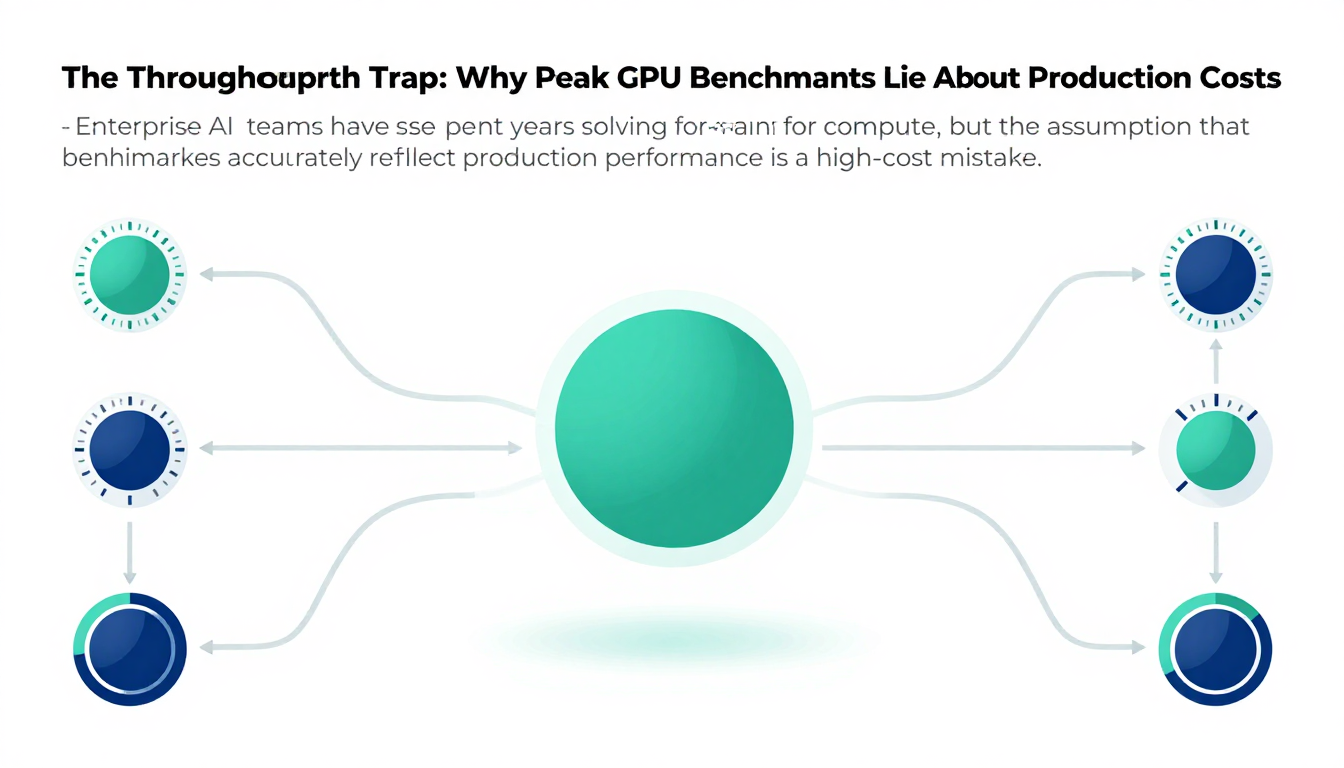
The Speed Trap: Why Enterprise AI Benchmarks Break in the Wild
We have been lied to. For the last three years, enterprise AI teams have spent their days fighting over GPU allocations, negotiating cloud capacity, and obsessing over synthetic training throughput. The assumption? If a model hits high tokens-per-second on a clean, isolated benchmark, it will run beautifully in production. It is a neat, comforting theory. It is also entirely wrong.
When you measure success purely through synthetic throughput, you are looking at a map and ignoring the mud. Real production environments do not look like sanitized test runs. They are chaotic, resource-constrained, and unpredictable. The delta between your lab benchmarks and real-world workloads is not a minor statistical error—it is a massive cost sink. According to VentureBeat, this mismatch between test suites and live deployments is the silent killer of enterprise AI budgets. If you are building models based on lab speed alone, you are playing a very expensive guessing game.

Latency Variability as a Financial Drain
Let's talk about the lie of the average. Your engineering team probably builds service-level objectives (SLOs) around average latency. Do not do this. Average latency hides the tail.
In production, the 99th percentile (p99) latency is where your budget goes to die. When a customer agent hits a complex reasoning task, response times do not just creep up—they spike. In a lab, you run a single prompt and get a clean number. In the wild, hundreds of concurrent users hit the system, causing KV cache eviction, queuing delays, and orchestrator bottlenecks. If your system cannot handle this latency variability, your servers will thrash. You will pay for idle GPU cycles while requests sit bottlenecked in queue. The math is simple: wild latency spikes lead to over-provisioning. Over-provisioning leads to wasted capital. To make systems efficient, we have to look past averages and design for tail latency behavior under load.
The Hidden Costs of Context Windows
Everyone loves boasting about million-token context windows. They act like long-context prompts are practically free. They are not.
When you pass a massive document query to an LLM, your billing does not scale linearly. Neither does your latency. Benchmarks usually test models using static, short prompts. They do not simulate memory exhaustion. In a live system, multi-turn conversations and database fetches swell your context window. As the context grows, key-value caches expand. The model spends more time reading preceding text, driving up time-to-first-token (TTFT) metrics. If your agents are running on a paid API, you are paying by the token. When agents waste thousands of tokens repeating context instructions, your operating costs explode. Instead of paying for massive contexts on frozen models, you should optimize text procedures. Tools like Microsoft SkillOpt show we can keep models frozen and train skills in small markdown documents, saving millions in compute waste. It is about being smart, not just big.
Multi-modal Reasoning Under Constraints
Text is only half the battle. Now, enterprise agents are forced to process audio, images, and structured spreadsheets simultaneously.
Benchmarks evaluate these modalities in neat, isolated bubbles. But in production, you are chaining them. Under real-world constraints, a vision model processes a chart, passes text to a reasoner, which then calls an external database. If the vision model slows down by two seconds, the entire chain stalls. This is not a simple linear delay. It compiles. A lag in step one creates a pile-up in step three. The cost of running multi-modal agents is not just the sum of their parts—it is the overhead of model-switching, data ingestion, and serialization. This is where standard benchmarks fall flat. They measure the raw speed of a single model, ignoring the latency of the glue holding your pipeline together. As Nitin Sharma noted in his analysis of Beyond Prompts: The Reality of 'Loop Engineering', optimization must target the entire loop, not just individual models.
Designing for Production Realities
So, how do we stop wasting money on the speed illusion?
First, dump synthetic benchmarks as your primary design metric. They are okay for a basic check, but they do not predict production behavior. Start run-testing with messy, randomized, multi-modal workloads. Simulating worst-case scenarios tells you more than a clean lab result ever will.
Second, protect your systems. Implement circuit breakers, strict timeouts, and aggressive caching. When tail latency spikes, degrade gracefully. Do not let one slow model call hang the entire user interface.
Third, instrument everything. If you cannot track the exact cost and latency of each reasoning step, you can never optimize it. Stop treating AI as a magical black box and start treating it like a distributed system. The goal isn't just raw speed. It is cost-efficiency, predictability, and resilience. Focus on keeping your systems lean. The labs will keep selling you bigger models, but your job is building a business that actually makes fiscal sense. Keep the footprint small, focus on text-space optimization, and design for the real world.