
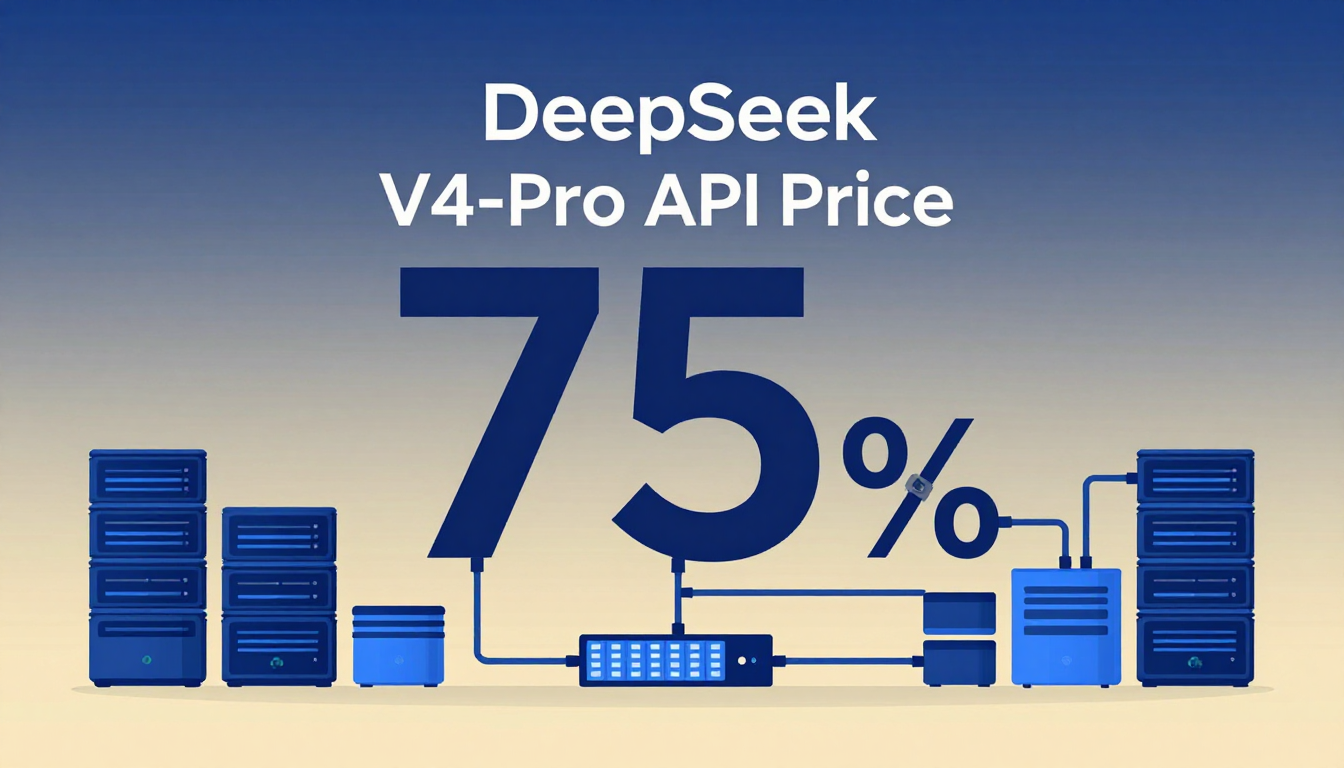
Here’s the part everyone’s skipping: DeepSeek didn’t just drop prices on V4-Pro—they dropped a reality check. That 75% cut sounds like a win for developers, but if you’re building production agentic systems on cloud infrastructure, it’s actually a warning shot across the bow.
The headlinegrabber is obvious. The subtext isn’t: deep down, the industry still can’t solve inference efficiency without burning cash. It’s not about how much you pay per token; it’s about whether that cost makes sense in context. The 100x efficiency gap remains stubborn, and DeepSeek’s pricing play is less about solving infrastructure and more about front-loading market share before someone else does.
If you’re wiring LLM agents to financial workflows, customer service stacks, or regulatory comms, those raw API fees compound fast. A cheaper endpoint only helps if your agent spends fewer tokens to get the same answer. And that’s where most projects stumble: they chase model scale instead of architectural efficiency, then wonder why their inference budget balloons before launch.
Let’s unpack what the price cut really means for agentic AI on cloud infrastructure—and why the 100x problem still rules the scoreboard.
Why price cuts don’t fix efficiency
The headline is hard to miss: DeepSeek cut V4-Pro API pricing by three quarters. On paper, that’s a developer-friendly gesture—a sign of fierce competition and shifting market power.
But look closer. That discount doesn’t shrink the computational footprint of each inference call. It doesn’t make the underlying model run faster on the same hardware. It doesn’t cut the energy or cooling required to serve another million tokens.
Instead, it shifts burden. DeepSeek is essentially subsidizing growth: you get to use more compute today because they’re betting that volume will let them optimize later. That’s a reasonable business strategy, sure—but it’s not infrastructure reform.
For agentic systems on cloud platforms, this matters more than you think. Agents tend to loop: they plan, execute tools, reflect, re-plan, and iterate. Each turn can cost dozens of tokens. Multiply that across hundreds of users or thousands of workflows, and your inference spend can spike faster than your user count.
A cheaper API doesn’t automatically reduce the number of turns it takes an agent to complete a task. In fact, cheaper inference often encourages wasteful loops—why abort early when the next round is only pennies? That’s a subtle but critical trap for teams building production agents.
The real win isn’t lower per-token cost. It’s fewer tokens per outcome—fewer planning steps, fewer retrials, fewer tool calls for the same deliverable. That’s where the 100x efficiency win lives, and it isn’t something pricing alone can deliver.
What is agentic AI? And why it’s different from plain LLMs
You’ll hear “agentic AI” thrown around like a buzzword, often blended with generic terms like AI automation or conversational interfaces. But those are not the same.
Agentic AI describes systems that can autonomously plan, execute actions (often via tool calls), and adapt based on feedback—without human in-the-loop approval. Think of it as moving from chatbots to doers: code generators that fix bugs, research assistants that build spreadsheets and cite sources, or workflow agents that submit forms across multiple services.
Crucially, agentic behavior implies composition: chaining LLM calls into loops where each step informs the next. That’s different from a singleprompt inference where you get one shot at an answer.
Google Cloud defines agentic AI as systems that “interact with environments (like APIs or codebases), make decisions, and learn from outcomes,” a definition that lines up nicely with IBM’s emphasis on autonomous action over passive response. It’s one thing for a model to answer “How do I deploy an AWS Lambda?”—it’s another for an agent to actually spin up the function, test it, and report back with logs.
Most enterprise projects don’t need this level of autonomy—yet. But for high-velocity workflows, where latency and human effort dominate cost, agentic systems unlock step-change gains. The tradeoff? Each autonomous loop multiplies your token usage, and that’s where the 100x efficiency challenge hits hardest.
If your agent needs three to five turns to resolve a customer query, and each turn costs $0.02 on an API that just dropped to $0.005, you’re still spending more than you expect once volume scales. The cheaper API doesn’t help unless your agent learns to finish faster.
That’s why agentic AI on cloud infrastructure can’t ignore inference efficiency. You need the right model and the right architecture—fewer round trips, smarter caching of tool results, and a structured plan-step loop rather than naive back-and-forth.
The 100x problem: why efficiency lags behind price
Google Cloud and IBM both point to the “100x problem” as the defining bottleneck: AI needs to be 100× more efficient than current baselines before it becomes truly普惠 (ubiquitous). This isn’t just about model size or quantization—it’s about inference, architecture, and runtime behavior combined.
Pricing is a surface-level lever. You can cut the cost per token to near-zero, but if your agent still runs 20 tool calls and three re-plans per user request, the infrastructure cost stays high. Efficiency comes from reducing tokens per task, not tokens per API call.
Here’s a real-world example: an agent tasked with building a customer support ticket might query a CRM, pull a history thread, draft the reply, and review it against tone guidelines. On a naive loop, that’s 3–5 LLM calls and multiple tool invocations—each adding latency and tokens.
A more efficient agent would cache the CRM lookup, reuse the history in a single reasoning pass, and apply tone rules as part of tool selection rather than post-processing. That’s architectural efficiency: rethinking how agents compose tools and memory, not just which model runs them.
DeepSeek’s V4-Pro is capable (and fast), but no amount of API discounting will compensate for an agent that doesn’t know when to stop. The 100x win isn’t about model price—it’s about reducing the number of steps needed to solve a problem.
That’s why many seasoned teams keep model selection tight: they prioritize consistency and low-latency responses over raw scale. A smaller, optimized agent that finishes in two calls often beats a larger model grinding through ten, especially when inference cost is amortized across tool usage and planning steps.
Agentic data platforms close the efficiency loop
If inference cost is just one piece of the puzzle, agentic data platforms are the glue that keeps efficiency in check. These platforms unify metadata, context catalogs, and tool registries so agents don’t reinvent the wheel—or ask for the same data twice.
An agentic AI workflow on an unoptimized stack might query “What are last month’s top refunds?” three times—once for raw SQL, once for a natural-language abstraction, and again to reconcile discrepancies. That’s three sets of tokens, three tool calls, and three latencies.
A well-orchestrated agentic data platform caches the question, reuses the context, and surfaces the latest verified answer directly—no extra round trips. That’s a compound save: fewer tokens per tool, faster overall resolution, and less chance of hallucinated or outdated answers slipping through.
Google Cloud’s emphasis on “context catalogs” and unified metadata aligns with IBM’s view that agentic systems need reliable grounding. Without a shared source of truth, agents spend tokens negotiating contradictions rather than delivering value.
For teams building production-grade agents, the play isn’t chasing the cheapest inference API—it’s building around a resilient data foundation. Cached context, shared tool definitions, and predictable metadata pipelines keep token counts down even when you switch pricing tiers.
Think of it like this: if inference cost is the fuel, your data architecture is the engine. A cheap tank of gas won’t help if your pistons are rusted.
The take-home: efficiency beats discounting
DeepSeek’s price cut is a notable milestone, but it’s not the finish line—it’s more like mile marker 17 in a marathon where every sprinter is pushing the same heavy load.
The real competitive edge belongs to teams that treat inference cost as a symptom, not the diagnosis. The symptoms change with pricing tiers. The underlying issue—wasteful loops, duplicated queries, unoptimized tool usage—doesn’t.
Here’s what to prioritize if you’re building agentic AI on cloud infrastructure:
- Start with the workflow, not the model: Document your agent’s steps. Count tool calls and re-plans per task. Only then pick a model that fits your step budget.
- Cache aggressively: The same prompt or context shouldn’t trigger multiple calls. Agentic data platforms excel here—leverage them.
- Optimize for step count, not tokens: A 75% API discount won’t help if your agent takes ten steps instead of three. Focus on the fewer-turns metric first.
- Tie cost to outcome: Track inference spend per resolved ticket, per completed workflow, or per hour of labor saved. That’s the only number that matters for ROI.
The “100x problem” remains unsolved not because models aren’t powerful, but because most deployments still operate at step inefficiency. DeepSeek’s cut is a great time to review your agent architecture—before the competition realizes the same.
Because in 2026, it’s not about who has the cheapest API. It’s about who finishes first with the fewest steps.