
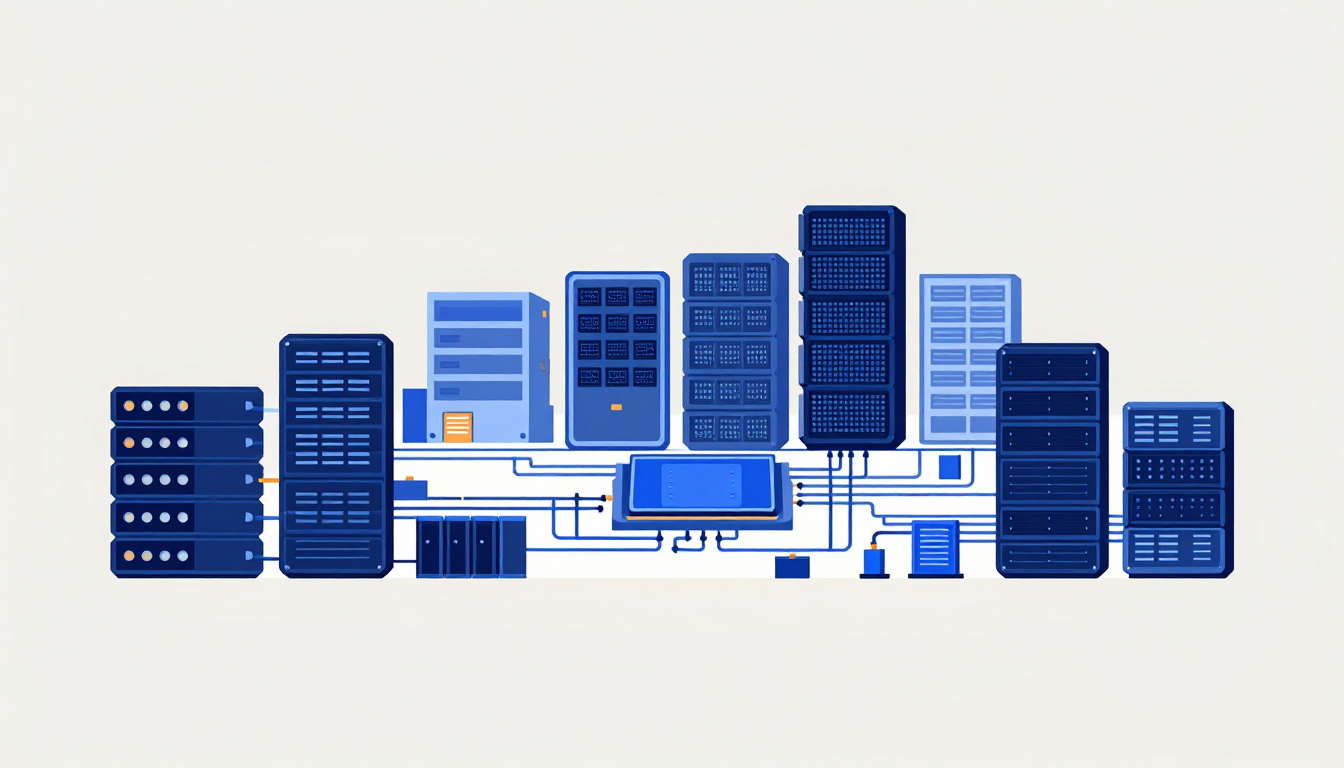
Let’s cut through the noise: AI infrastructure in 2026 isn’t about megamodels or flashy demos. It’s about how many tokens per second you can squeeze from aging GPUs, whether your interconnects will survive triple-digit rack density, and if you can afford a 20-year datacenter lease before your startup turns a profit. The hardware isn’t keeping up with the dreams, so we’re jury-rigging everything in sight—and somehow it’s working.
This article synthesizes key findings from The Register’s AI Infrastructure Month 2026, covering heterogeneous compute breakthroughs, sovereign localization, and speculative infrastructure like floating datacenters.
Heterogeneous Compute Isn’t a Trend—It’s a Lifeline
Remember when you bought an H200, thought it was the end state, and then realized training a 175B model would take three days? Yeah. SambaNova just handed the industry a lifeline: plug older GPUs into their Reconfigurable Data Units (RDU), and suddenly, those same chips deliver 763 tokens per second on MiniMax M2.7.
That’s not a theoretical benchmark—it’s a business decision. SambaNova isn’t selling new silicon; they’re patching the compute gap with software-defined flexibility. AMD fans will bristle, Intel loyalists might mutter about Xeon scaling, but the truth hits hard: you don’t need a brand-new H100 if your job can be distributed across SN50 RDUs and Gen 7.5 GPUs.
It’s heterogeneous compute in the truest sense—not a symphony of identical accelerators, but a motley crew of legacy hardware singing in (mostly) tune. For deeper context on how this reshapes enterprise training pipelines, see our coverage of agentic data platforms.
Europe Welcomes AI Accelerators—with Teeth
FuriosaAI didn’t roll into the European market with a flashy launch event. They quietly dropped RNGD accelerators inside Equinix’s Lisbon datacenters, signaling a quiet but seismic shift: localization isn’t about politics; it’s about latency and sovereign compliance.
European operators are no longer willing to wait for US-prioritized GPU allocations. They want hardware on their soil, close to where the workloads run—and Furiosa’s plug-and-play racks make that feasible without rewriting every inference pipeline.

The Memory Wall Has a Name—and It’s Not DRAM
You could run inference all day if memory weren’t constantly humming a song you can’t understand. Qualcomm’s approach? Bury the compute underneath the DRAM die.
Their Dragonfly architecture isn’t trying to out-benchmark everyone on spec; it’s solving a physical constraint: copper traces between GPU and HBM stack are hitting thermal and bandwidth plateaus. By co-locating AI accelerators directly on the DRAM package, Qualcomm sidesteps the memory wall without asking you to redesign your entire datacenter floor plan.
Interconnects Are the New Bottleneck
Nvidia and AMD can churn out GPUs all day, but without optical interconnects humming at 400Gbps+, those chips will sit idle most of the time. The Register’s coverage points to an often-overlooked truth: the biggest AI spend isn’t on GPUs anymore—it’s on copper and fiber.
Intel’s legacy Omni-Path tech is making a surprise resurgence at Lawrence Livermore, running at 400 Gbps per link on their supercomputing rig. Meanwhile, vendors linked to Nvidia are quadrupling wafer output for high-speed optics, because Jensen Huang knows a supply chain hiccup could derail the entire AI hype train.
Long-Term Leases for AI? Yes, and You’ll Sign Them
Anthropic’s 20-year lease with TeraWulf isn’t a marketing stunt—it’s the new normal. When AGI remains elusive, but capital markets are still betting big on compute scale, you lock in real estate for decades.
It’s an ironic twist: the company promising explainable AI ends up committing to infrastructure longer than most consumer leases. But the math works: building a datacenter on spec is cheaper than retrofitting one later, and climate-controlled floors with dedicated power feeds are as essential today as fiber optic backbones were in the 2000s dotcom rush.
Floating Datacenters Are Going Live—Soon
Samsung’s seaborne server farm concept sounds like a fever dream from 2010, but their internal timeline puts commercial launch at 2028. Why? Land acquisition is getting expensive, power availability is tightening in key regions—and offshore deployment offers cooling for free.
They’re not the first to try this, but they’re the first with credible packaging and high-density rack designs. If it works, floating AI towns could become a thing, anchored near undersea cables and offshore wind farms.
SoftBank’s Bet on Rent-a-GPU Is a Play for Global Scale
SoftBank doesn’t just want to lease GPUs; they want to own the AI rent-a-box market outside North America. The Japanese giant’s massive US server farm (reportedly sized for 10GW+) hints at a broader ambition: support global AI clients without getting tangled in export controls.
AMD’s $4,000 Local AI PC? Don’t Buy It—Yet
The Ryzen AI Halo spec sheet looks slick: 128GB of memory, on-device inference dreams. But at $4K, this isn’t for hobbyists or data scientists with expense accounts—it’s a statement of intent.
AMD is laying groundwork for the next generation of edge AI, where the cloud becomes optional. If they can bring that price down to $2K by late 2027, we’ll see a surge in local LLM experimentation.
The UK’s Tech Sovereignty Panic Is Real
UK Parliament committee warnings about Anthropic’s brief US export ban cut closer than expected: the UK’s AI ecosystem could get locked out if it doesn’t have its own compute backbone. It’s not paranoia—it’s procurement policy in disguise.
Europe and Asia already have their own AI hardware alliances. The UK’s scramble to build sovereign compute isn’t just about defense; it’s about keeping their research labs and startups from becoming vendor-locked tenants in someone else’s cloud.
Final Thought: It’s Not About the Model—It’s About the Rig
Everyone talks about LLaMA 4.1 or Claude 4.5, but no one’s talking about whether their network fabric can hold the gradients during a distributed all-gather. The infrastructure layer is now more complex than any previous computing transition—better networking, smarter memory stacking, and creative reuse of legacy hardware.
The real AI race isn’t between model weights. It’s between who can get the most bits moving, with the least latency, at the lowest power cost—and right now, that’s a scrappy mix of startups and datacenter operators pushing the edge. So slow down on the benchmark chasing, and start auditing your rack layout.