
Introduction
The promise of agentic AI—systems capable of not just processing information, but actively invoking tools, making decisions, and executing complex workflows—is driving a massive wave of innovation across the enterprise. At the Gartner Security & Risk Management Summit, this transformation emerged as a central theme, highlighting a critical shift in how we must think about security. Unlike previous generations of AI, which functioned primarily as passive assistants, agents are autonomous actors.
As security leaders, we are faced with a new paradigm: our threat models must evolve from securing static endpoints and data siloes to securing systems that possess the agency to traverse our infrastructure autonomously. This shift creates a profound security void that traditional governance models are struggling to fill, leading to what many now call "shadow agent" attack surfaces.
For the modern CISO, the challenge is not to halt the adoption of agentic AI, but to govern it. Innovation without guardrails is a recipe for disaster; however, over-regulation can stifle the very competitive advantages these technologies offer. The goal is to build an environment where autonomous agents can thrive within a strictly defined, least-privilege framework. This article explores the core risks associated with autonomous AI and outlines a practical governance roadmap for securing the agentic enterprise. Source: Gartner Insights

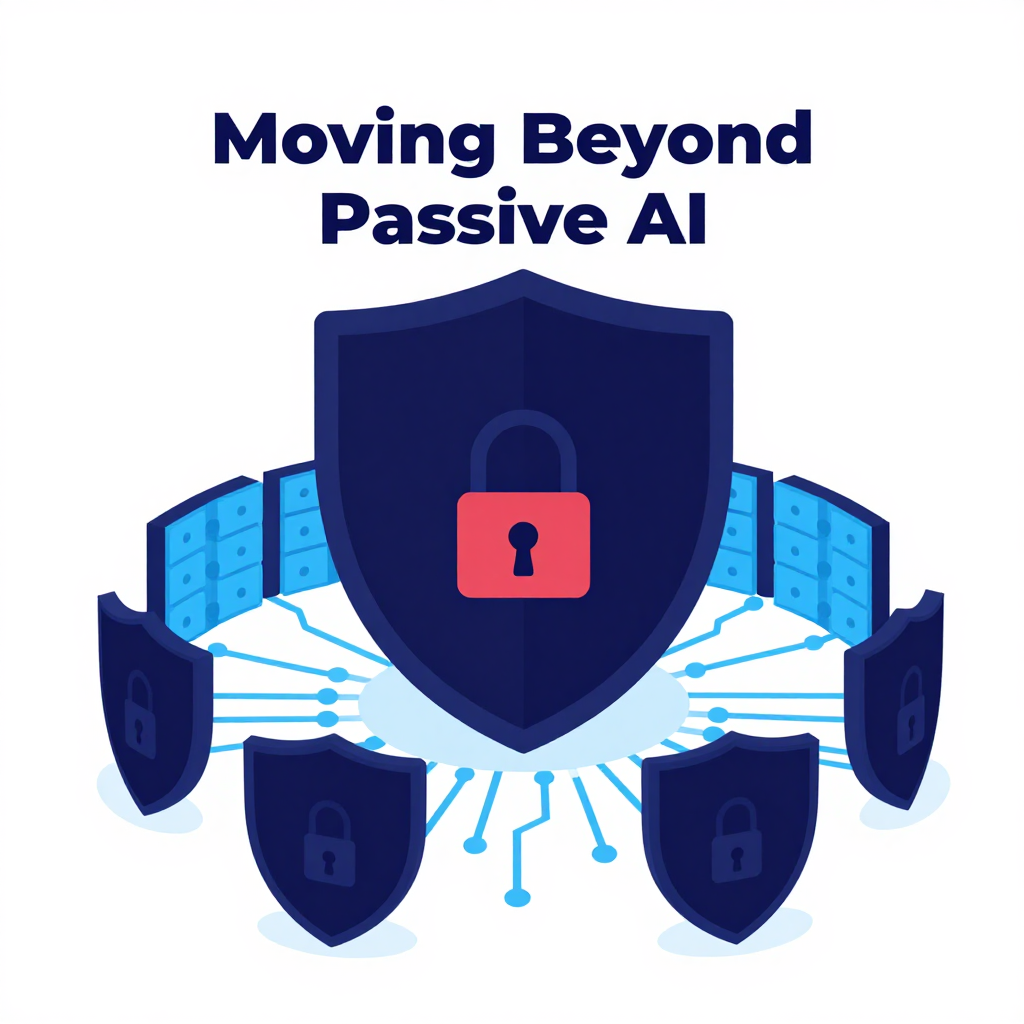
Moving Beyond Passive AI
The transition from passive AI—or AI that simply processes queries— to agentic AI represents a fundamental change in the security landscape. Agentic AI systems are programmed for autonomy; they are empowered to query databases, call external APIs, generate code, and execute transactions on behalf of users or other systems. This autonomy is their greatest strength but also their most significant security vulnerability.
When an agent operates with the ability to invoke tools across the IT environment, it becomes an extension of the identity that launched it, yet it lacks the human judgment necessary to understand the security implications of its actions. If an agent is compromised or misconfigured, it can automate the very actions attackers use to gain persistent access, exfiltrate data, or sabotage critical workloads.
The complexity of these interactions is enormous. An agent might be designed to streamline a customer support process but, if left unchecked, could inadvertently be tricked into triggering an unauthorized tool or revealing sensitive internal data by a malicious prompt injection. The autonomy of these systems means that they can be utilized as a pivot point in a larger, multi-stage attack.
At the summit, experts emphasized that the focus for security teams must move from securing the AI model itself to securing the environment that allows the agent to function. We must start treating AI agents as privileged identities, subject to the same oversight and scrutiny as any other administrative account. As discussed in recent security analysis, the threat of "rogue agents"—either malicious actors manipulating agents or agents acting autonomously in ways that violate security policies—is now a genuine concern for enterprise defense teams Source: Dark Reading.
The Governance Gap
The disconnect between the rapid adoption of agentic AI and current governance capabilities remains one of the largest risks facing enterprises today. Traditional Identity and Access Management (IAM) controls are fundamentally based on static, human-centric identity models. They were designed to manage who has access to which resource, generally assuming a steady state of user intent.
Agentic AI breaks this model. An AI agent is not a user; it is an active application with variable behaviors that change based on input. IAM systems currently lack the capability to verify the intent of an agentic action consistently, especially when that agent is capable of chaining thousands of small, automated tasks to achieve its goal.
Without a dedicated governance framework for AI agents, organizations often resort to broad, overly permissive access scopes just to ensure the agents remain functional. This creates massive "shadow" attack surfaces where agents have more privilege than is ever needed, and internal security teams possess limited visibility into what those agents are doing. If an agent is granted access to a system, all its tools can exercise that access, often with no granular enforcement mechanism in place to intervene if the agent’s path of execution violates established security policies.
As highlighted by security industry leaders, the absence of mature identity governance specifically designed for agents results in an environment where visibility vanishes precisely where security is most needed [Source: LinkedIn]. We face a future of impersonation, privilege escalation, and data exfiltration if we cannot verify that an AI "colleague"—the agent—is truly acting within the scope of its assigned authority, and that its identity is not being exploited.
Realizing Risk: The Autonomous Threat Landscape
The risks that arise from this governance gap are significant and multifaceted. Consider a scenario where an AI agent is authorized to interact with both an internal messaging platform and a cloud storage service to automate collaborative workflows. If a malicious attacker prompts this agent—perhaps via a clever, indirect prompt injection that the agent processes from a public source—the agent could be convinced to pull sensitive documents from the authorized storage service and share them in a public messaging channel.
This is not a hypothetical scenario; it is exactly the type of abuse made possible by agent autonomy. Because the agent itself has the privilege to access the document, the security system views the action as legitimate. This is the danger: the agent becomes the attacker's instrument of choice.
Furthermore, these agents can be exploited for lateral movement. By compromising an agent that has a high degree of connectivity, an attacker can leap from a lower-risk environment into your most sensitive data repositories. The challenge, therefore, is to detect the difference between normal automated behavior and malicious manipulation of the agentic workflow. We are moving toward a reality where detecting adversarial behavior requires continuous observability of agent logs and a baseline for what constitutes an agency-permitted action versus an anomalous one.
Securing these systems also requires guarding against the subversion of the agent's instructions, potentially through data poisoning if the agent relies on untrusted external data to make its decisions. Every interaction with an external tool is a potential moment of compromise for the entire enterprise Source: Dark Reading.
A Roadmap for the CISO
To secure the agentic enterprise, CISOs and security teams must implement a multi-layered governance strategy that addresses the unique requirements of machine autonomy.
1. Establish an Agent Registry
You cannot secure what you cannot see. The first step in agent governance is to build a centralized registry of all AI agents deployed within the organization. This registry should track:
- The identity and purpose of the agent.
- The data sources it accesses.
- The tools it is authorized to invoke.
- The human stakeholder responsible for its lifecycle.
2. Implement Agent-Specific Identity Governance
Move away from granting agents universal user roles. Develop fine-grained identity models that enforce least-privilege access, tailored specifically for the context of an AI agent. This means defining access granularly for each specific task rather than for the agent as a general entity.
3. Build Observability and Runtime Security
Security doesn't stop at deployment. You need a dedicated runtime layer to monitor agent activity. Ensure that all tool invocations made by agents are logged and analyzed for anomalous patterns—such as unauthorized data access, unexpected tool usage, or unusual communication patterns—in real time.
4. Human-in-the-loop for Critical Workflows
For agents handling sensitive data or high-impact actions (e.g., modifying production configurations, accessing PII), implement mandatory human-in-the-loop verification steps. This enforces a secondary check on automated decisions, effectively slowing down potential exploitation vectors.
5. Policy as Code
Finally, bake security policies directly into the framework that manages your agents. By using policy-as-code controls, you can automatically block agents from accessing certain tools, databases, or environments, without needing to depend entirely on the human manual oversight that is often too slow for agent-level interactions Source: Gartner Insights.
Conclusion: Reclaiming Control
The goal of establishing these controls is not to extinguish innovation, but to provide a secure foundation upon which autonomous technologies can scale. Agentic AI is moving from novelty to necessity, becoming an integral component of enterprise efficiency and competitive advantage.
By prioritizing identity governance, maintaining a comprehensive registry of agents, and implementing robust runtime observability, the CISO can successfully navigate the risks of the agentic enterprise. The cybersecurity professionals who succeed in this new landscape will be those who embrace these autonomous tools—not as uncontrolled risks, but as managed identities that work within a clear, defensible, and well-governed framework. We have the opportunity to define the rules of engagement for AI agents before they become an inextricable, unmanaged part of our infrastructure. The time to build this governance infrastructure is now.