
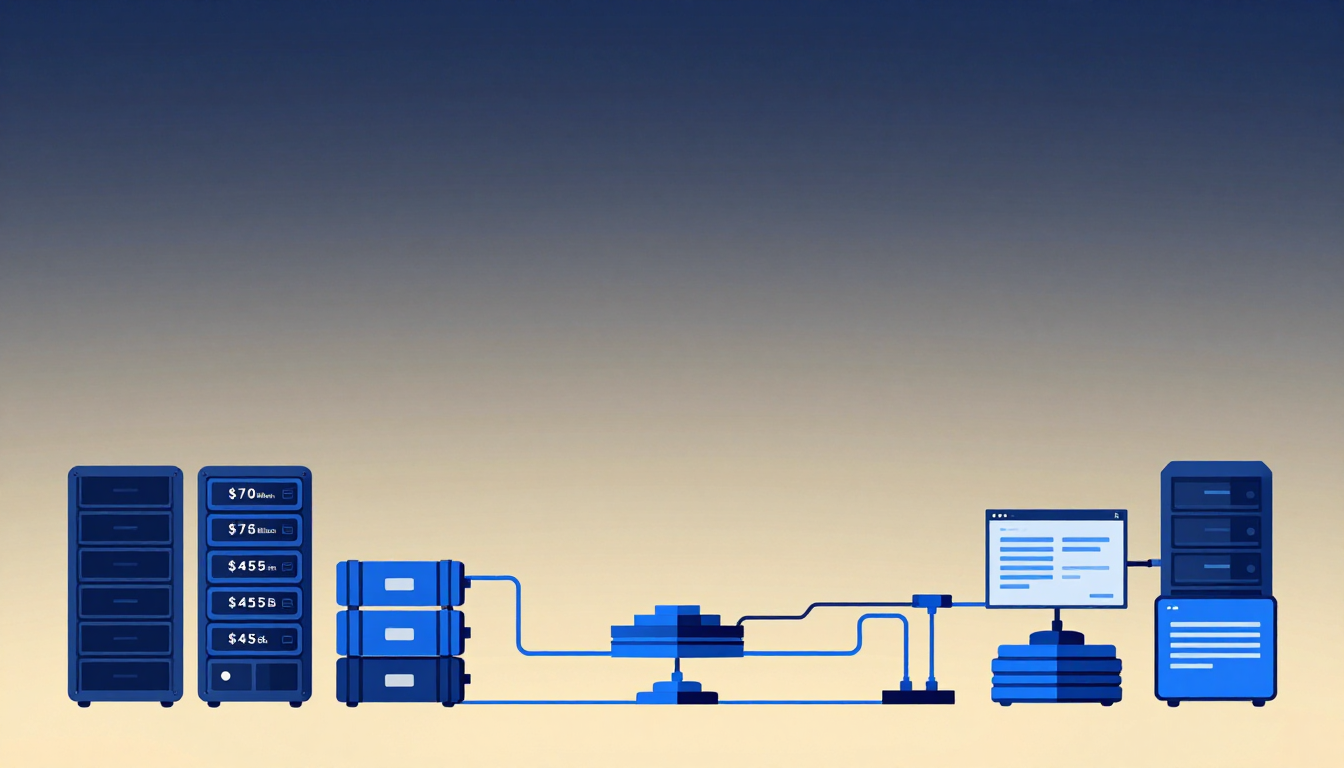
The $70 Billion Question: Why Oracle Is Betting Everything on Speed
Oracle didn’t need an exit interview to know Wall Street is watching its capex habits. But when the company quietly raised last year’s capital spend to $55.7 billion—nearly triple what it spent just twelve months earlier—it handed investors a very real unease: the feeling that this wasn’t just growth, but a leap into an expensive unknown.
The numbers tell the story. In Q4 FY2026, revenue climbed a healthy 21 percent year-over-year to $19.2 billion. Yet the stock fell. Why? Because investors didn’t just see strong sales—they saw what it cost to get them: $55.7 billion in capex, a 163 percent increase over FY2025’s $21.2 billion.
To be fair, Oracle isn’t just sitting pretty waiting for AI to trickle down. CFO Hilary Maxson confirmed the company plans to support its datacenter buildout with around $40 billion in combined debt and equity in FY2027, including a $20 billion equity issuance already announced. That’s serious capital mobilization, and it comes with real financial risk: negative free cash flow, mounting obligations, and investors who increasingly want to know how this will end.
$455 Billion in Backlog? The RPO Bombshell
The real jaw-dropper arrived not on the income statement, but in Oracle’s footnotes: $455 billion in remaining performance obligations (RPOs). That’s contracted revenue Oracle hasn’t even recognized yet because the work hasn’t been performed.
It’s more than 300 percent higher than a year earlier. More importantly, roughly $300 billion of that is tied to one customer—OpenAI—despite the LLM giant having no hardware division of its own. This tells a clear story: OpenAI is essentially outsourcing infrastructure at an unprecedented scale, and Oracle is the chosen builder.
CEO Clay Magouyrk made it clear that this isn’t theoretical. In Oracle’s view, those $455 billion in obligations are the floor, not the ceiling. But here’s where it gets tricky: RPOs don’t equal cash on hand. They’re promises. And until Oracle delivers the actual datacenter capacity—wiring, cooling, GPUs, racks—the revenue won’t materialize, and the cash flows will lag.
How Oracle Plans to Spend $70 Billion (and Call It “Reported Capex”)
Here’s the clever bit Oracle used to explain its guidance: $70 billion in reported capex for FY2027, but only about $45–$50 billion in net cash outlay. The rest? Customer prepayments.
That’s key. Oracle doesn’t want to fund the entire $70 billion itself. Instead, it plans to front-build capacity, then get paid by customers like OpenAI in advance—effectively using their capital to fund Oracle’s infrastructure race. Maxson said the prepayment cushion is expected to be $20–$25 billion, meaning Oracle’s actual out-of-pocket cost will land closer to $45–$50 billion.
Still, $50 billion is a lot of money to lose if demand slows—or if buyers like OpenAI hit their own funding ceilings. The company’s ability to maintain prepayment discipline will make or break this whole equation.
Building the Machine: 1 GW in Q1 Alone
Oracle’s infrastructure buildout isn’t just about money—it’s about execution speed. In Q4 FY2026, the company added around 400 MW of new datacenter capacity. That sounds massive—until you realize Q1 FY2027 is expected to add nearly 1 GW.
To put that in perspective, a single 250 MW hyperscale facility is considered a major achievement. Oracle is deploying roughly four of those per quarter, with an eye toward hitting at least 1 GW in Q1 alone. That pace is aggressive, to say the least.
Magouyrk said Oracle has locked down prices across space, power, energy, and components to manage this ramp. But even with contracts in place, coordinating supply chains for thousands of racks, hundreds of megawatts of electrical infrastructure, and custom cooling systems is a logistics nightmare. One delay—and the entire timeline slips.
Pricing Pressure? Analysts Say the Clock Is Ticking
One Reuters analyst put it bluntly: there’s real demand for AI infrastructure, but the question over how Oracle funds its expansion is getting harder, not easier. Capex came in well above estimates, and free cash flow remains negative.
That’s a dangerous combo. Most companies can absorb one; when you combine both, it signals a company burning cash to grow—exactly the scenario investors punish hardest. Oracle’s stock reaction in late Q4 confirmed this: despite a solid top line, the market gave it a cold shoulder.
The company’s defense? A high-ROI customer base. If Oracle can demonstrate that each dollar of capex unlocks $2 or $3 in recurring cloud revenue, the risk starts looking more like conviction. But that’s a story for next quarter—right now, investors just see heavy spending with no clear payoff timeline.
Final Take: Speed Over Margin, or a Trap for the Next Cycle?
Oracle’s playbook is clear: build fast, lock in customers early, and use prepayments to fund the next wave. It’s a strategy built on timing, confidence, and nerves of steel.
But there’s an undeniable fragility here. If AI spending slows, if OpenAI’s fundraising falters, or if Oracle can’t convert RPOs into actual cash—the balance sheet teeters. And unlike the old days, when Oracle could rely on steady license renewals, this bet is all-or-nothing.
The most honest question isn’t whether Oracle can build the capacity. Plenty of players could, given enough time and capital. The real question is whether Oracle’s timing holds—and whether its customers stay committed long enough for that capital to turn into profit.
One thing’s certain: Oracle isn’t just playing the AI infrastructure game. It’s trying to own it from the ground up. Whether that ambition pays off will depend less on Oracle’s balance sheet and more on whether its biggest customers still want to write blank checks in 2028.
For more insights on AI infrastructure and investment risks, check out Rent-a-GPU Outfits Secure Billions in Venture Capital to Meet AI Demand and Etched’s $1 Billion Inference Bet: How a Stealth Silicon Startup Forced NVIDIA to Rearrange Its Math.