
AI & AI Memory Systems
Articles on AI memory systems, knowledge organization, and long-term recall mechanisms in AI agents.
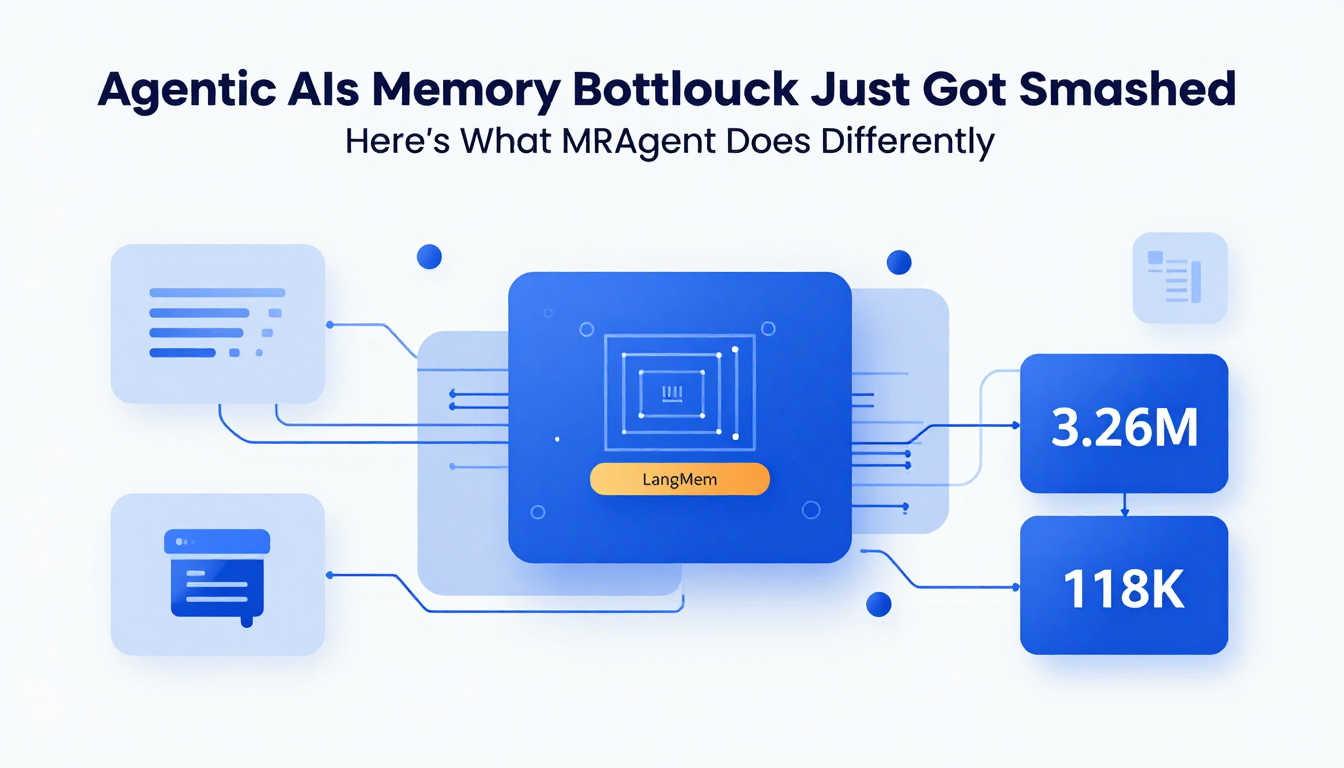
Agentic AI's Memory Bottleneck Just Got Smashed — Here's What MRAgent Does Differently
Researchers at the National University of Singapore built MRAgent, a memory framework that treats agent recall as an active reconstruction process rather than static retrieval — slashing token consumption from 3.26M (LangMem) to 118K per query on long-horizon benchmarks.
Google Cloud Summit London 2026: AI-Driven Databases and the Future of Data Interaction
At the Google Cloud Summit in London, executives discussed the shift towards AI-driven databases, inexact queries, and the role of agents in data platforms. Key announcements included advancements in Spanner, AlloyDB, and BigQuery, as well as the integration of AI functions and the evolution of the Knowledge Catalog.
MRAgent Cuts Agent Memory Costs by 27x — Here's Why That Matters for Production AI
National University of Singapore researchers introduce MRAgent, a memory retrieval framework that slashes per-query token consumption for LLM agent recall from 3.26M (LangMem) to just 118K tokens, enabling more efficient and scalable agentic memory systems.

What Constrains Distributed Systems Isn't Access, It's Execution
This article explores why execution — not access — is the real constraint in distributed systems. With agentic AI moving autonomously at machine speed, traditional API-based boundaries are obsolete. Kernel-level enforcement through eBPF, Cilium, and Tetragon provides the runtime guardrails that autonomous systems need.

Rethinking How AI Stores What It Knows
Exploring how Symbolic Embedding Multi-Quantization (SEMQ) separates meaning from representation to shrink AI memory footprints without the accuracy losses of traditional quantization.

The Shift to AI Production: Guillermo Rauch on Price, Performance, and Decoupling Models from Agents
Vercel CEO Guillermo Rauch discusses the transition from AI prototyping to production optimization, emphasizing price/performance trade-offs and the need to decouple models from agents.