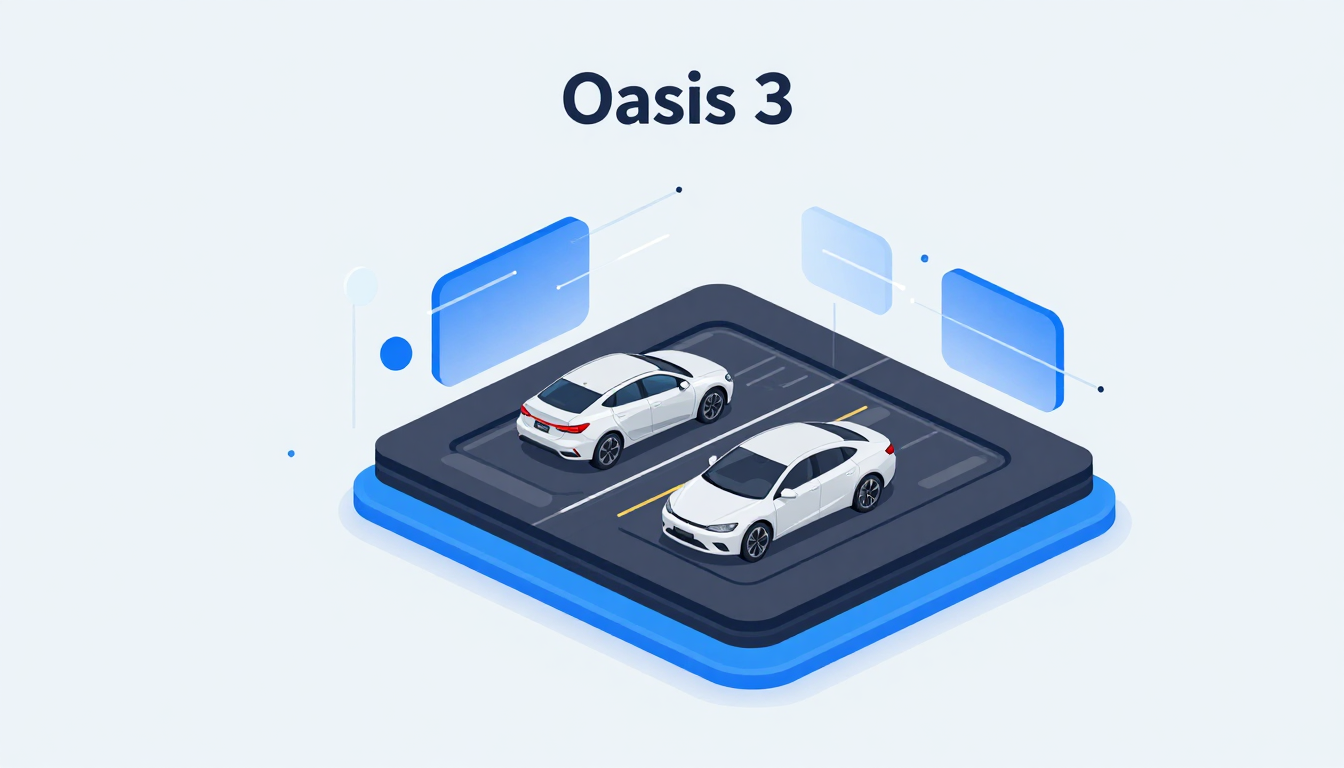
AI startup Decart has unveiled Oasis 3, its latest interactive world model capable of generating photorealistic driving environments in real time. The model is now available via API for developers.
A New Benchmark in World Modeling
Oasis 3 represents Decart's strategic expansion into physical AI applications, building on the foundation of its Lucy real-time video model. While the company previously served e-commerce and livestreaming markets with over 100,000 developers in its community, Oasis 3 marks a significant pivot toward autonomous vehicle testing and robotics applications.
Targeting the Autonomous Vehicle Industry
The startup is initially targeting autonomous vehicle companies that require scalable simulation of rare and complex driving scenarios. Traditional simulation approaches have struggled with photorealism and computational efficiency, but Oasis 3 addresses these challenges through its world model architecture.
According to Dean Leitersdorf, Decart's co-founder and CEO: "It's going to be the first usable world model that people can actually program on top of. I think there's going to be an entire developer community that emerges on top of this."
Pricing and Accessibility
Decart has priced Oasis 3 at $0.02 per second of simulation time, with enterprise pricing customized based on specific use cases. The API-first approach mirrors OpenAI's strategy with language models, aiming to build a developer ecosystem around world models.
See Decart's pricing model for more details on how it compares to other AI startups.
Competitive Landscape
Decart enters an increasingly crowded field of world model development:
- Google's Genie 3, released in research preview earlier this year
- Fei-Fei Li's World Labs, which launched Marble for commercial use cases in November 2025
- Video generation startups like Luma and Runway that are also competing in the world model space
For more on AI competition, see our coverage of Anthropic's SEC filing and Niteshift's AI coding startup.
Applications Beyond Driving
While autonomous vehicle testing is the initial focus, Decart plans to expand Oasis 3 into broader robotics and physical AI applications. The world model's ability to generate realistic environments opens possibilities for:
- Robot training and simulation
- Smart city planning and traffic analysis
- Automated warehouse robotics
- Delivery drone navigation training
Limitations and Caveats
Despite its capabilities, Oasis 3 has some limitations that users should consider:
- The model requires significant computational resources for high-fidelity rendering
- Real-time performance depends on the specific hardware configuration
- Edge cases in driving scenarios may require additional fine-tuning
The article from TechCrunch highlights these caveats while noting that Decart is working to address them through ongoing development and community feedback.
The Road Ahead for Physical AI
Oasis 3 represents a significant step forward in making world models accessible and practical for real-world applications. By focusing on API-driven access from day one, Decart is positioning itself to capture early adoption in the rapidly growing physical AI market.
The model's success will depend on developer adoption and the ecosystem that forms around it. If Decart can replicate its success with Lucy in the video space, Oasis 3 could become a foundational tool for autonomous systems development.
As the competition intensifies in the world model space, Oasis 3 brings a unique combination of real-time performance, photorealism, and developer-friendly APIs that may give it an edge in the race to enable practical physical AI applications.
Deep Dive: How Oasis 3 Works
At the core of Oasis 3 is a novel architecture that combines generative AI with physics-based simulation. Unlike previous world models that relied primarily on video generation techniques, Oasis 3 uses a hybrid approach that synthesizes photorealistic visuals while maintaining physical consistency across frames.
The model leverages transformer-based architectures with specialized attention mechanisms designed for spatial reasoning. This allows Oasis 3 to understand the relationships between objects in a scene and maintain coherence over extended periods. The result is the ability to simulate hours of driving time rather than just minutes.
Technical Architecture Overview
The technical architecture of Oasis 3 is built around several key components that work in concert to deliver its remarkable capabilities. At the foundation is a generative pre-training process that teaches the model fundamental principles of physics, geometry, and visual perception. This foundational knowledge enables the model to reason about scenes rather than simply regenerate training data.
The architecture consists of three main components:
- Vision encoder: Processes input images or scenes and converts them into a latent representation that captures both visual details and semantic meaning
- World model decoder: Takes the encoder's output and generates future frames or modified scenes that are physically plausible and visually coherent
- Reward predictor: Evaluates the quality of generated scenes based on criteria like realism, consistency, and task-relevant metrics
This modular design allows for independent optimization of each component and enables the model to be fine-tuned for specific applications without retraining from scratch.
Training Methodology
Training Oasis 3 presented significant computational challenges. The team at Decart had to develop novel techniques for efficient training on large-scale datasets:
- Distributed training across thousands of GPUs to handle the massive parameter count
- Curriculum learning that starts with simple scenes and progressively introduces complexity
- Knowledge distillation to transfer insights from larger teacher models to more efficient student models
- Synthetic data generation to supplement real-world driving data, which is limited and expensive to collect
The training data encompasses millions of hours of real driving footage combined with procedurally generated scenarios. This hybrid approach ensures the model is exposed to both common occurrences and rare edge cases that are essential for robust autonomous driving systems.
Key technical innovations include:
- Temporal consistency engine: Ensures smooth transitions between frames even when simulating unusual scenarios or rare events. This component uses recurrent neural networks with specialized memory management to maintain state across extended sequences
- Multi-modal sensor fusion: Supports virtual versions of cameras, lidar, and radar for comprehensive autonomous vehicle testing. The model understands the strengths and limitations of each sensor type and can generate realistic outputs that match what physical sensors would detect
- Scene graph generation: Creates structured representations of environments that can be modified and queried programmatically. This allows developers to manipulate specific aspects of a scene while preserving overall coherence
- Procedural content generation: Infinitely varies driving scenarios by modifying environmental parameters in real time. This capability enables the simulation of an effectively infinite number of unique driving experiences
Real-Time Performance Characteristics
Oasis 3's real-time performance characteristics vary depending on hardware configuration and desired quality settings. On high-end GPU systems, the model can generate frames at 60 frames per second for standard definition output, while maintaining photorealistic quality.
For autonomous vehicle development, the focus is not on high frame rates but rather on the ability to run many parallel simulations efficiently. The API supports batch processing of scenarios, enabling automotive companies to test thousands of driving scenarios in parallel and aggregate results for statistical analysis.
The system architecture has been optimized for inference efficiency through techniques like:
- Model quantization to reduce memory requirements
- Speculative decoding to accelerate text and image generation
- Caching of repeated computations across similar scenarios
- Adaptive quality settings that adjust detail levels based on scene complexity
The Simulation Revolution in Autonomous Driving
The autonomous vehicle industry has long grappled with the challenge of safe and comprehensive testing. Real-world road testing is limited by the rarity of certain scenarios, such as edge cases involving pedestrians suddenly entering the roadway or extreme weather conditions. Simulated testing offers a solution, but existing tools have struggled to balance realism with computational efficiency.
Oasis 3 addresses these challenges by providing photorealistic simulations that run at scale. Autonomous vehicle companies can now simulate thousands of scenarios simultaneously, dramatically accelerating their development cycles.
Beyond the Test Track: Comprehensive Validation
Traditional autonomous vehicle validation approaches face several fundamental challenges:
- Safety concerns: Real-world testing of Level 4 and Level 5 systems raises safety questions that regulators are still developing frameworks to address
- Cost: Physical testing fleets require significant capital investment and ongoing operational expenses
- Scalability: Scaling real-world testing to cover all possible scenarios is physically impossible given the infinite combinatorial space of driving situations
- Reproducibility: Real-world testing lacks the reproducibility needed for rigorous scientific validation and debugging
Oasis 3 directly addresses these challenges by enabling comprehensive virtual testing. Developers can now specify scenarios at a high level and have the system automatically generate variations, test them, and report results. This capability transforms autonomous vehicle development from a predominantly physical process to a data-driven engineering discipline.
Case Study: Edge Case Testing
Consider the challenge of testing rare edge cases like animals suddenly crossing highways or construction zone navigation. In real-world testing, these events might occur once in thousands of miles driven. With Oasis 3, developers can specify parameters like "urban area at night with poor lighting" and generate thousands of variations in minutes.
The ability to systematically test edge cases has profound implications for safety validation and regulatory approval. Regulators are increasingly demanding comprehensive testing of edge cases before approving autonomous vehicles for public roads. Oasis 3 provides the scalable solution needed to meet these requirements.
Developer Ecosystem and API Access
Decart's decision to offer API access from day one signals its ambition to build a robust developer community. The API allows developers to:
- Generate custom driving scenarios on-demand
- Query and modify scene parameters programmatically
- Export simulation results in various formats for downstream processing
- Integrate with existing autonomous vehicle testing pipelines
This approach follows the successful model of other developer-centric AI platforms, where access to a powerful API catalyzes third-party innovation and ecosystem growth.
See Niteshift for another example of an API-first AI startup challenging incumbent vendors.
API Capabilities and Features
The Oasis 3 API offers a comprehensive set of capabilities:
Scenario Generation Endpoints
- GenerateScene: Create a new driving scene with specified parameters
- ModifyScene: Modify existing scenes while maintaining physical consistency
- QueryScene: Retrieve information about scene elements and relationships
- SimulateScenario: Run a complete simulation with specified parameters
Sensor Simulation
The API supports simulation of multiple sensor modalities:
- Camera: RGB cameras with configurable focal length, resolution, and lens properties
- Lidar: 3D point cloud generation with configurable scan patterns and noise characteristics
- Radar: Doppler radar returns for velocity measurement
- GNSS/IMU: GPS and inertial measurement simulation with realistic noise models
Export Options
Results can be exported in various formats:
- ROS bags: For integration with Robot Operating System workflows
- CARLA Town scenes: For compatibility with popular autonomous vehicle simulators
- Waymo Open Dataset format: For direct comparison with real-world benchmarks
- Custom JSON schemas: For downstream processing in custom pipelines
Developer Tools and Documentation
To support developer adoption, Decart provides:
- Comprehensive API documentation with examples in Python, JavaScript, and other popular languages
- SDKs for major programming languages to simplify integration
- Sample projects demonstrating common use cases and best practices
- Community forums for peer-to-peer support and knowledge sharing
- Regular developer webinars featuring technical deep dives and Q&A sessions
The World Model Arms Race
Decart is not alone in the race to build practical world models. Google's Genie 3, Fei-Fei Li's World Labs with Marble, and video generation specialists like Luma and Runway are all developing competitive offerings. Each player brings different strengths to the table:
- Google's Genie 3 benefits from massive computational resources and deep learning expertise
- World Labs' Marble leverages Fei-Fei Li's pioneering work in computer vision and scene understanding
- Luma and Runway bring expertise in video generation and real-time rendering
What sets Oasis 3 apart is its focus on physical AI applications from the outset. While others may prioritize entertainment or creative use cases, Decart has engineered Oasis 3 specifically for the demands of autonomous systems development.
Comparative Analysis: Oasis 3 vs Competitors
| Feature | Oasis 3 | Genie 3 | Marble | Luma/Runway |
|---|---|---|---|---|
| Target Application | Physical AI, AV testing | General purpose | Commercial applications | Creative/entertainment |
| Real-time Generation | Yes, up to 60 FPS | Limited | Yes | Yes |
| Physics Consistency | High | Medium | High | Low |
| API Access | Yes, from day one | Limited research access | Yes | No |
| Autonomous Vehicle Focus | Primary | Secondary | Secondary | None |
| Multi-sensor Support | Cameras, Lidar, Radar | Limited | Limited | None |
| Scenario Generation | Full support | Basic | Limited | None |
Market Differentiation Strategy
Decart's differentiation strategy centers on:
- Domain specialization: Deep focus on physical AI and autonomous vehicles
- Developer experience: API-first approach with comprehensive documentation
- Pricing model: Accessible pricing that scales with usage
- Community building: Active developer support and engagement
By focusing on a specific use case and executing exceptionally well, Decart aims to capture significant market share in the autonomous vehicle simulation space before expanding into adjacent markets.
Practical Applications Across Industries
Beyond autonomous vehicles, Oasis 3's capabilities have implications across multiple industries:
Robotics
Robotics companies can use Oasis 3 to train their agents in simulated environments that closely mirror reality. This is particularly valuable for humanoid robots and mobile manipulators that require nuanced interaction with complex environments.
Robot Learning Applications
- Manipulation tasks: Train robots to handle various objects in different environments
- Navigation: Develop robust navigation algorithms for complex, dynamic spaces
- Human-robot interaction: Simulate various human behaviors to improve safety and usability
- Multi-robot coordination: Test fleet coordination strategies in realistic scenarios
The ability to train robots in virtual environments before deployment significantly reduces the risk and cost associated with physical prototyping.
See our article on FablePool's decentralized AI agent funding for another perspective on AI agent development.
Urban Planning
City planners can simulate traffic patterns and evaluate the impact of infrastructure changes before implementation. This enables data-driven decision making with minimal risk.
Planning Scenarios
- Traffic flow analysis: Evaluate the impact of new roads or traffic management systems
- Pedestrian safety: Test intersections and crosswalk designs with simulated pedestrian flow
- Public transit optimization: Simulate different transit routes and schedules
- Emergency response planning: Test evacuation procedures and emergency vehicle routing
The virtual testing capability allows cities to make informed decisions before committing to expensive infrastructure projects.
Insurance and Safety Analysis
Insurance companies can simulate accident scenarios to better understand risk factors and develop more accurate pricing models.
Risk Assessment Applications
- Accident reconstruction: Simulate real-world accidents to understand contributing factors
- Risk factor analysis: Identify high-risk scenarios and develop mitigation strategies
- Telematics analysis: Simulate sensor data for developing new insurance products
- Fraud detection: Train models to recognize patterns of suspicious claims
The simulated environment allows for comprehensive analysis without exposing real assets or personnel to risk.
Education and Training
Driving schools and professional training programs can provide students with exposure to challenging scenarios in a safe, controlled environment.
Training Applications
- New driver education: Provide diverse driving experiences before real-world deployment
- Defensive driving: Simulate emergency scenarios for practice
- Commercial driver training: Train for specialized vehicles and conditions
- Autonomous vehicle literacy: Help human drivers understand AV behavior
The ability to safely experience rare but critical scenarios significantly improves training outcomes.
Manufacturing and Logistics
Industrial applications for Oasis 3 include:
- Factory floor simulation: Test automation layouts and workflow optimization
- Warehouse robotics: Simulate material handling and inventory management systems
- Supply chain visualization: Model complex logistics networks
- Safety training: Simulate hazardous scenarios for worker safety training
Entertainment and Gaming
While not the primary focus, the entertainment industry can leverage Oasis 3 for:
- Movie scene generation: Create complex background environments
- Video game asset creation: Generate realistic environments for gameplay
- Virtual production: Test camera angles and lighting in virtual sets
- Training simulations: Prepare actors and crew for complex shooting scenarios
Challenges Ahead
Despite its promising capabilities, Oasis 3 faces several challenges:
Computational Requirements
Running high-fidelity simulations requires substantial computational resources. While Decart's API abstracts this complexity, users should be prepared for the infrastructure costs involved.
Cost Considerations
- Basic usage: $0.02 per second of simulation time
- High-fidelity rendering: Additional charges for premium quality settings
- Batch processing: Discounted rates for large-scale scenario testing
- Enterprise plans: Custom pricing for high-volume users
Users should budget for API costs based on their testing frequency and complexity requirements.
Edge Case Handling
While Oasis 3 excels at common scenarios, truly rare or unusual events may still require specialized fine-tuning or additional data.
Common vs. Rare Scenarios
- Common scenarios: High accuracy with standard model settings
- Rare but plausible scenarios: May require scenario-specific optimization
- Truly edge case events: May need custom model fine-tuning or additional data
The system provides uncertainty estimates to help developers understand when results may be less reliable.
Integration Complexity
Integrating the API into existing workflows may require significant engineering effort, particularly for organizations with established testing pipelines.
Integration Challenges
- API familiarity: Teams new to API-based workflows may need training
- Data format conversion: Mapping existing test data to Oasis 3's schema
- Pipeline modification: Adapting continuous integration workflows for API-based testing
- Quality assurance: Validating that simulated results match real-world expectations
Decart provides integration support and migration services to help teams overcome these challenges.
Regulatory and Ethical Considerations
As with any AI system, Oasis 3 raises important regulatory and ethical questions:
- Data privacy: Ensuring simulated data does not inadvertently include real-world PII
- Bias detection: Identifying and addressing potential biases in generated scenarios
- Regulatory compliance: Adapting to evolving AI regulations across jurisdictions
- Transparency requirements: Providing explainability for simulation results
Decart addresses these concerns through robust data governance practices and compliance frameworks.
Market Opportunity and Commercial Prospects
The global autonomous vehicle simulation market is projected to grow significantly over the next decade. Estimates suggest a compound annual growth rate of over 20%, driven by increased investment in autonomous technologies and regulatory pressure for comprehensive safety validation.
Decart's positioning with Oasis 3 places it at the intersection of several high-growth trends:
- The rise of Level 4 and Level 5 autonomous vehicles
- Increased focus on safety validation and regulatory compliance
- Growing demand for simulation-as-a-service offerings
The company's pricing model of $0.02 per second creates a scalable revenue stream while remaining accessible to startups and smaller companies.
Target Market Segmentation
Decart is initially targeting:
- Autonomous vehicle startups: Need cost-effective simulation solutions
- Tier 1 suppliers: Require comprehensive testing capabilities for multiple OEMs
- OEM research divisions: Developing in-house AV technology
- Robotics companies: Need simulation for physical AI development
- Research institutions: Academic and government research programs
Revenue Model
The revenue model includes:
- Usage-based pricing: $0.02 per second of simulation time
- Enterprise subscriptions: Flat-rate pricing for high-volume users
- Custom development services: Consulting and integration services
- Training and support: Professional services for advanced use cases
Partnerships and Ecosystem
Decart is building partnerships with:
- Autonomous vehicle platforms: Integrating Oasis 3 into existing development workflows
- Hardware providers: Optimizing for various sensor and compute configurations
- Research institutions: Collaborating on academic and applied research projects
- Industry standards bodies: Contributing to AV testing and validation standards
Long-term Vision
Decart's long-term vision extends beyond autonomous vehicles to become a comprehensive physical AI platform:
- Expand to additional modalities: Walking robots, drones, and other physical agents
- Develop sim-to-real transfer techniques: Improve translation of simulation results to real-world performance
- Create developer marketplace: Enable third-party scenario and tool development
- Build physical AI standards: Contribute to industry-wide testing frameworks
The company's ambition is to establish Oasis 3 as the standard platform for physical AI development, much like large language models have become foundational for natural language applications.
Looking Forward: The Future of World Models
Oasis 3 represents a significant milestone in the evolution of world models. As the technology matures, we can expect to see:
- More sophisticated physics simulation
- Real-time interaction with simulated environments
- Enhanced multi-agent capabilities for complex scenario generation
- Better support for emerging sensor technologies like solid-state lidar and terahertz imaging
The vision is clear: world models that are not just simulations but truly interactive digital twins of the physical world, capable of serving as testbeds for any physical AI system.
Decart's Oasis 3 brings us closer to that future, offering a glimpse of what may become the standard platform for physical AI development in the years to come.
The Digital Twin Revolution
The ultimate evolution of world models may be the digital twin—a persistent, up-to-date virtual representation of a physical system or environment. Digital twins could enable:
- Real-time monitoring: Virtual replicas that mirror real-world conditions
- Predictive maintenance: Forecasting failures before they occur
- Scenario projection: Testing the impact of potential changes virtually
- Training and testing: Continuous improvement through simulation
Oasis 3 lays the groundwork for this future by demonstrating that high-fidelity, interactive simulations are not only possible but practical for real-world applications.
Standardization Efforts
As the world model market matures, we can expect standardization efforts to emerge:
- API standards: Consistent interfaces across different world model platforms
- Data format conventions: Standardized schemas for simulation data and results
- Benchmarking protocols: Common metrics for comparing model capabilities
- Security frameworks: Best practices for safe and ethical simulation
Decart's early move to establish Oasis 3 as an API-driven platform positions it well to influence these standards.
Broader Implications for AI Development
The rise of world models has profound implications for the entire AI field:
- Reduced reliance on real-world data: Simulations can substitute for expensive or dangerous data collection
- Faster iteration cycles: Virtual testing enables rapid prototyping and refinement
- Democratization of AI development: More accessible infrastructure for smaller organizations
- New research avenues: Exploring scenarios impossible in the physical world
Oasis 3 represents a pivotal moment where these possibilities transition from theory to practical reality.
Conclusion: A New Era for Physical AI
Decart's Oasis 3 signals the beginning of a new era in physical AI development. By providing realistic, interactive simulations at scale, it addresses one of the field's most persistent challenges: the gap between simulation and reality.
The road ahead promises even more sophisticated capabilities, but Oasis 3 has already demonstrated that world models are ready for prime time. For autonomous vehicle developers, robotics teams, and anyone building physical AI systems, Oasis 3 offers a powerful new tool to accelerate development and improve safety.
As the technology continues to evolve, Oasis 3 may well become as fundamental to physical AI development as large language models are to natural language processing—a foundational technology that enables the entire ecosystem.
The future of autonomous driving and physical AI is being simulated today, and Oasis 3 is at the forefront of this revolution.