Introduction
The same memory can feel vivid and accessible one moment, yet stubbornly out of reach the next—even when the memory itself remains intact. This everyday experience of memory variability has long puzzled cognitive scientists and neurologists alike. Is the forgetting due to degradation of the memory trace itself, or could there be a more dynamic mechanism at play?
A groundbreaking study led by Professor Hiroshi Nomura at the Institute of Brain Science, Nagoya City University Graduate School of Medical Sciences, has identified a neural mechanism that may finally explain this variability. The research shows that slow spontaneous fluctuations in brain histamine neurons help control moment-to-moment memory accessibility.
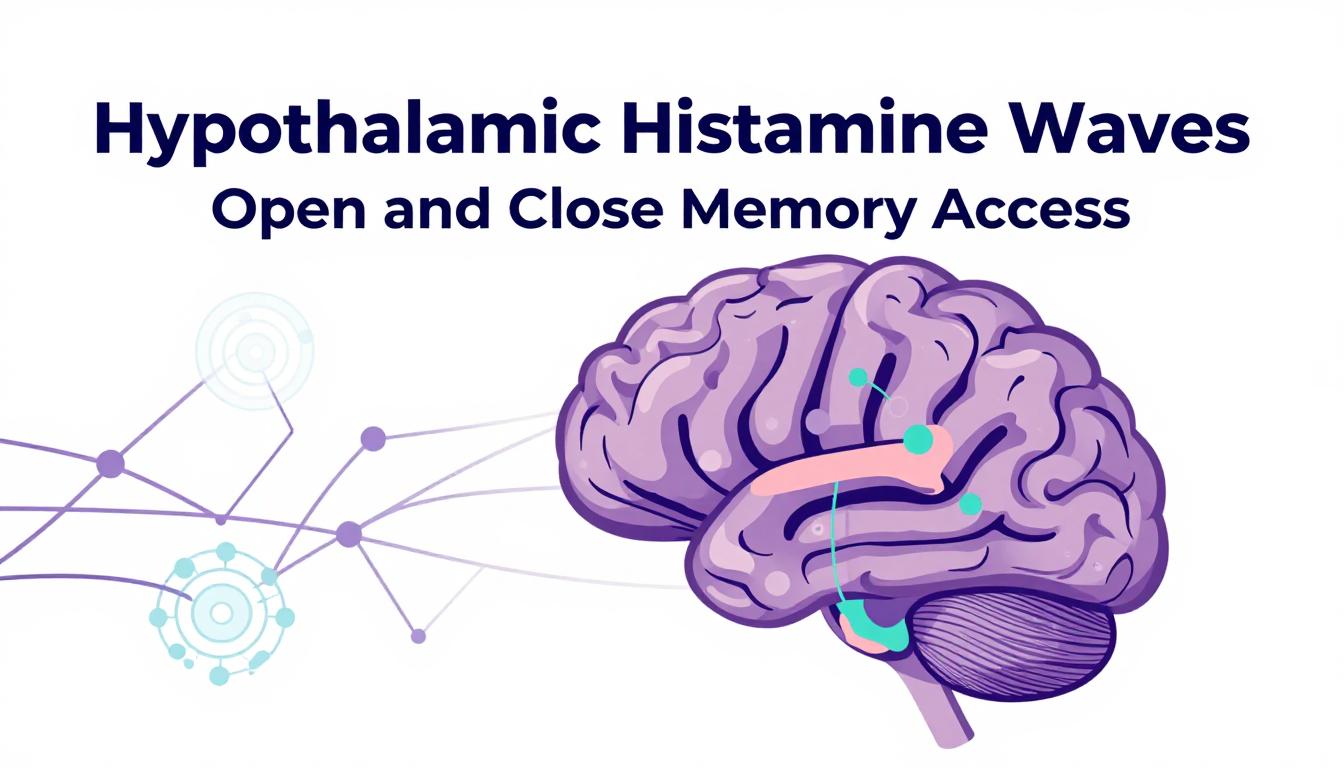
Using real-time neural monitoring, optogenetics, and deep-brain calcium imaging in mouse models, the research team discovered that slow, spontaneous fluctuations within hypothalamic histamine neurons act as an internal "gatekeeper" for memory retrieval. When these neurons fire at a high baseline immediately before a retrieval cue appears, they prime downstream memory circuits, specifically within the basolateral amygdala, allowing stored memories to be successfully accessed. Conversely, when baseline histaminergic activity dips, identical cues fail to trigger the memory pattern, leaving the intact memory temporarily out of reach.
This paradigm-shifting discovery moves beyond traditional cognitive models that attribute retrieval failure to the permanent degradation or erosion of an engram (a physical memory trace). Instead, the brain undergoes continuous internal state fluctuations that dictate whether a perfectly intact memory trace can be accessed at any given second.
The Hypothalamic Histamine Clock
Histamine-producing neurons reside within the tuberomammillary nucleus of the hypothalamus and project extensively to core memory hubs, including the cortex, hippocampus, and amygdala. While best known for maintaining wakefulness and driving peripheral allergic reactions, this new research reveals a previously underappreciated role for histamine in fine-tuning memory access.
The Nagoya team discovered that these neurons exhibit slow, spontaneous activity waves that rise and fall over windows of tens of seconds. These fluctuations act as a biological clock, determining when the brain is in an optimal state for memory retrieval and when it is temporarily closed off to accessing stored information.
The significance of this finding cannot be overstated. Historically, histamine has been viewed primarily as a neuromodulator for arousal and alertness. The discovery that these same neurons provide precision gating for memory traces—completely independent of general arousal levels—represents a fundamental shift in our understanding of how the brain manages its vast store of memories.
The 40% Gating Effect
To demonstrate causality rather than mere correlation, researchers deployed a sophisticated closed-loop experimental system. Using real-time monitoring of histamine neuron activity, they delivered learned auditory memory cues precisely at the peak or trough of histaminergic activity.
The results were striking: mice tested during a high-histamine state exhibited a 40% increase in memory-guided behavioral responses compared to identical trials initiated during low-histamine states. This precise timing effect, achievable through automated detection and delivery of cues at optimal moments, demonstrates the profound impact that internal brain state can have on cognitive performance.
This 40% gating effect provides a quantifiable measure of how dramatically brain state can influence memory access. For individuals experiencing memory lapses, this finding suggests that the problem may not be forgetfulness or cognitive decline, but rather a temporary state in which the brain is unable to access otherwise intact memories. Related insights into brain state dynamics are explored in our coverage of Alzheimer's disease research and the neurobiological roots of cognitive health.
Optogenetic Proof of Causality
To definitively establish that histamine fluctuations were the direct cause of memory access variability—rather than merely being correlated with it—the researchers employed optogenetics, a technique that allows precise control of specific neuron populations using light.
When histamine neuron firing was suppressed immediately prior to a memory cue, retrieval behavior was completely blocked. Conversely, when histamine neurons were artificially activated at moments of low activity, successful recall was instantly restored. This bidirectional control provides irrefutable evidence that histaminergic activity directly gates memory accessibility.
The optogenetic experiments also revealed something equally important: these manipulations did not alter general movement, sensory hearing thresholds, or native reward consumption behaviors. This critical control experiment isolated the histamine waves as a precise, dedicated memory-priming mechanism rather than a generic, broad-scale change in full-body wakefulness or arousal.
In essence, the brain has evolved a specialized system for moment-to-moment memory regulation that operates independently of overall arousal states. This precision gating mechanism allows the brain to fine-tune memory access without compromising other essential functions.
Stabilizing the Amygdala Engram Blueprint
Through deep-brain calcium imaging, investigators tracked individual cellular networks inside the basolateral amygdala—the region holding reward-cue associations. The imaging revealed exactly what happens at the neural circuit level when histamine levels fluctuate.
When histamine firing was high, incoming cues caused amygdala neurons to flawlessly recreate the exact cellular firing pattern learned during training. The memory trace was activated with high fidelity, producing robust behavioral responses.
When histamine was suppressed, this memory-related neural pattern immediately degraded. The amygdala neurons failed to properly activate, and the intricate firing pattern that represented the memory became weak and unstable. This provides a direct neural correlate for the behavioral observations: low histamine doesn't erase the memory; it simply prevents the circuit from properly accessing and expressing it.
The basolateral amygdala's role in this process is particularly significant because it serves as a hub for emotional memory and reward-cue associations. By demonstrating that histamine stabilizes the "engram blueprint" in this region, the research provides a mechanistic explanation for why emotional memories can sometimes feel inaccessible despite being intact. For more on neural mechanisms of memory, see our deep dive into cognitive tech and research on neural decoding in neurodegenerative conditions.
A New Diagnostic Framework for Dementia
The implications of this research extend far beyond basic science into clinical practice. Because cognitive performance is known to fluctuate dramatically throughout the day in aging populations and patients suffering from Alzheimer's disease or dementia, mapping this subcortical histaminergic priming system provides a vital new therapeutic target to stabilize memory access in neurodegenerative disorders.
Traditional approaches to treating memory impairment have focused on boosting overall brain function or preventing neurodegeneration. While important, these strategies don't address the state-dependent nature of memory access. A patient might have intact memory traces but be unable to access them due to low histaminergic tone at critical moments.
By targeting the histamine system with precision—either through pharmacological interventions or neuromodulation—the brain could be positioned in an optimal state for memory retrieval during moments when access is most needed. This approach would complement existing strategies by addressing the specific timing and state-dependent aspects of memory failure.
Professor Nomura emphasizes the clinical implications: "Our findings suggest that failure to recall is not always due to loss of the memory itself. Instead, the brain may sometimes be in a state in which a stored memory is difficult to access."
This reframe of the problem has profound implications for how clinicians assess and treat memory disorders. Diagnostic tools may need to evolve beyond static measures of memory capacity to include dynamic assessments of brain state and its fluctuations throughout the day.
Conclusion
This research from Nagoya City University fundamentally reshapes our understanding of memory retrieval. The discovery that slow, spontaneous fluctuations in hypothalamic histamine neurons act as a precision gate for memory access provides a compelling explanation for everyday memory variability and offers new hope for individuals struggling with memory impairment.
The findings suggest that what we experience as forgetfulness may often be a temporary state of the brain rather than a loss of information. This distinction is crucial: if memories remain intact but temporarily inaccessible, then the path forward involves modifying brain state rather than attempting to recover lost information.
As research continues in this area, the histaminergic system emerges as a critical regulator not just of wakefulness and alertness, but of the very accessibility of our past experiences. The brain's ability to precisely gate memory access moment by moment represents a sophisticated evolutionary adaptation that allows for dynamic interaction with our environment—accessing relevant memories when needed while filtering out irrelevant information during low-activity states.
This discovery opens new avenues for both basic research and clinical applications, potentially leading to novel therapeutic approaches for memory-related disorders and a deeper understanding of how brain state shapes our cognitive experiences. For more on the intersection of neuroscience and AI, see our coverage of AI Psychology.