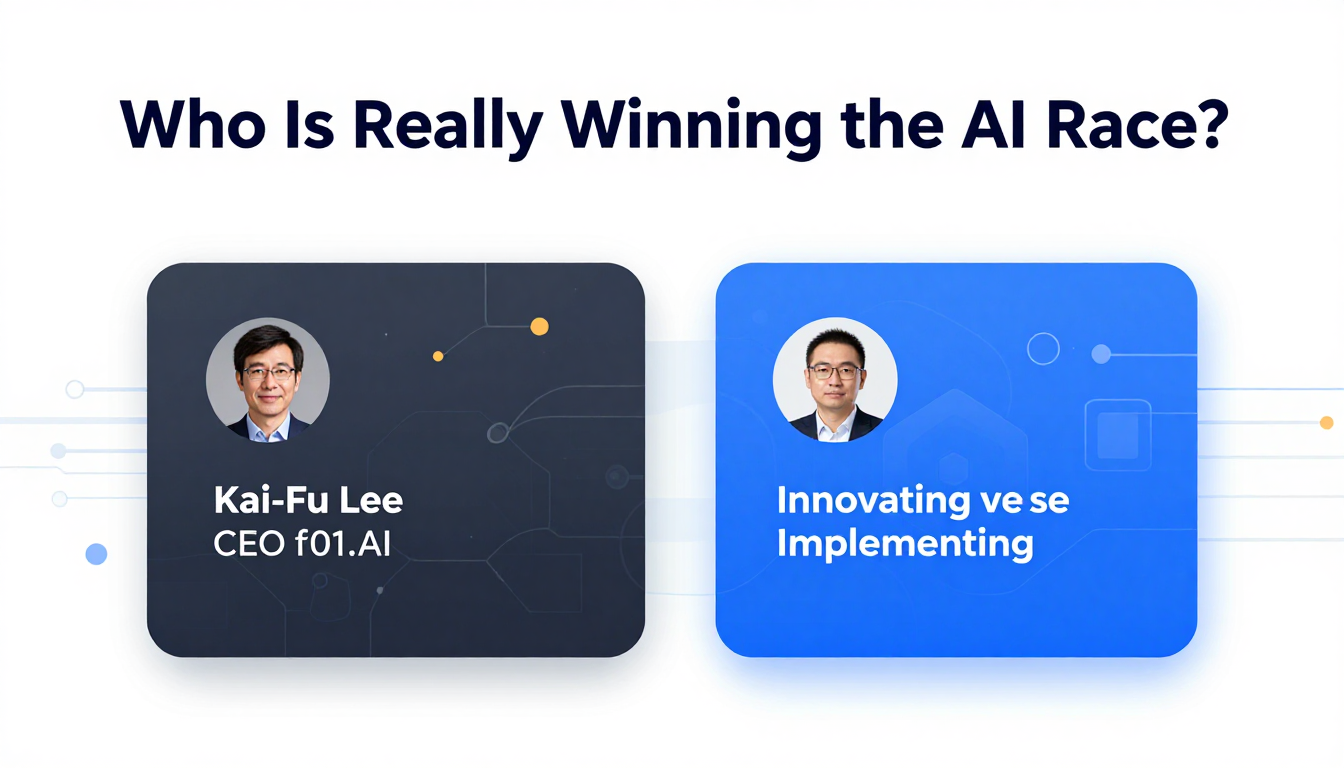
At the WSJ Leadership Institute CEO Summit in London, Kai-Fu Lee—technologist, entrepreneur, and author of the bestseller AI 2041—delivered a counterintuitive analysis of the global AI race that has reverberated through boardrooms and government chambers alike. The longtime venture capitalist and former head of Google China argued that the United States and China are not locked in a zero-sum contest but instead are each winning different kinds of AI races, driven by their distinct institutional strengths and cultural orientations.
This framing fundamentally shifts how leaders should think about national AI strategy. Instead of asking which country is ahead in raw model performance or hardware capability, Lee's thesis invites us to consider who is better positioned to deploy AI at scale, adapt it to real-world problems, and create sustainable value. The answers, according to Lee, lie in a nuanced interplay of innovation versus implementation, foundational research versus applied engineering, and top-down coordination versus entrepreneurial ecosystems.
The Two Races: Innovation vs. Implementation
According to Lee, the US is winning the race for foundational innovation. American institutions—particularly leading research labs at institutions like OpenAI, Anthropic, and various university AI centers—continue to push the boundaries of what large language models can achieve. Breakthroughs in reasoning, multimodal understanding, and agents are emerging predominantly from Silicon Valley and elite academic labs. The US ecosystem excels at creating the next generation of model architectures, training methodologies, and core algorithmic advances.
Meanwhile, China is winning the race for implementation and deployment. Chinese companies and government agencies have demonstrated unparalleled ability to scale AI systems across vast populations, integrate them into everyday economic activity, and iterate rapidly based on real-world feedback. From facial recognition at scale to AI-driven healthcare diagnostics in rural clinics, from smart city traffic management to hyper-personalized e-commerce experiences, China is deploying AI with speed and scope that often leaves Western competitors catching up.
Lee's key insight is that these are not mutually exclusive achievements but complementary phases of a single, broader AI transformation. As he stated at the WSJ summit: "The US is building the most powerful engines, but China is building the highways and filling them with traffic."
The Structural Advantages: Why Each Nation Leads Its Domain
Several structural factors explain why each nation leads in its respective domain. In the United States, a combination of world-class universities, venture capital funding that tolerates high risk and long time horizons, and a culture of scientific inquiry has created fertile ground for foundational breakthroughs. The proximity of research labs to engineering talent, combined with relatively open academic publishing traditions, accelerates the dissemination of ideas.
China's implementation prowess stems from different advantages. The country's large, unified market provides economies of scale that are impossible to replicate in fragmented regulatory jurisdictions. Data availability—subject to different regulatory constraints than the West—enables more robust training and validation of models for specific applications. Government coordination, particularly through national AI initiatives and regional innovation hubs, has streamlined the path from prototype to deployment at scale. In sectors like autonomous driving and smart manufacturing, Chinese firms can test multiple approaches simultaneously across thousands of nodes, rapidly converging on the most effective solutions.
Critically, Lee noted that neither advantage is permanent or guaranteed to persist indefinitely. The US faces challenges in translating breakthrough research into products that achieve widespread adoption, while China confronts increasing headwinds from global technology restrictions and a need to develop more generalizable AI capabilities rather than highly optimized applications.
Implications for Global Technology Strategy
For technology leaders and policymakers, Lee's two-race framework offers several important implications. First, it suggests that collaboration—not just competition—will be essential to advancing the field as a whole. Many of the world's most pressing challenges, from climate change to pandemic response, will require AI capabilities that draw on both nations' strengths.
Second, the framework suggests where strategic investment makes sense. Nations outside the US and China may find opportunities by focusing on specific vertical applications where local expertise combined with AI implementation can create unique value. Europe, for example, might leverage its regulatory framework and industrial base to develop AI systems that prioritize privacy and safety without sacrificing capability.
Finally, Lee warned against over-indexing on either innovation or implementation at the expense of the other. An ecosystem that produces brilliant research but fails to deploy it will ultimately cede influence to one that implements existing capabilities effectively. Conversely, an ecosystem skilled at implementation without pursuing novel research will eventually find itself constrained by the capabilities available to it.
The Role of Ethical Considerations and Governance
The WSJ Leadership Institute discussion also touched on the ethical and governance dimensions of AI development. Lee argued that different regulatory environments—whether the EU's precautionary principle, China's emphasis on social stability, or the US's relatively lighter-touch approach—will shape not just how AI is deployed but what kinds of AI are developed in the first place.
For instance, privacy-preserving AI techniques may advance more rapidly in jurisdictions with stringent data protection laws. Similarly, safety-critical applications like autonomous vehicles may face longer timelines in regulatory environments that prioritize caution over speed. Lee suggested that rather than viewing these differences as barriers, leaders should see them as variables in a broader optimization problem: the goal should be to develop AI systems that perform well across multiple regulatory and cultural contexts.
The Road Ahead: 2041 and Beyond
Lee's book AI 2041 offers a fictional but research-grounded vision of how AI might reshape the world over the next two decades. The WSJ summit discussion echoed many of the same themes: AI will not be a monolithic technology but rather a set of capabilities that permeate different sectors at different paces. Healthcare, education, and government services are likely to see profound transformations, while the nature of work itself will be reshaped in ways that demand new skills and new approaches to lifelong learning.
What's clear from Lee's analysis is that the AI race is not a sprint but a marathon—and different countries and organizations are running different segments of that marathon. Understanding which segment you're in, and whether your strength lies in invention or implementation, may be the most important strategic question for leaders navigating the coming decades.
As the summit concluded, Lee's message was both hopeful and urgent: rather than asking who is winning, leaders should ask how they can contribute to a future where AI enhances human capability across all nations and cultures. The true measure of success, he suggested, will be not which country leads in AI, but whether AI helps humanity rise to meet its greatest challenges.
This article is based on Kai-Fu Lee's presentation at the WSJ Leadership Institute CEO Summit in London. The video of his remarks is available via The Wall Street Journal.