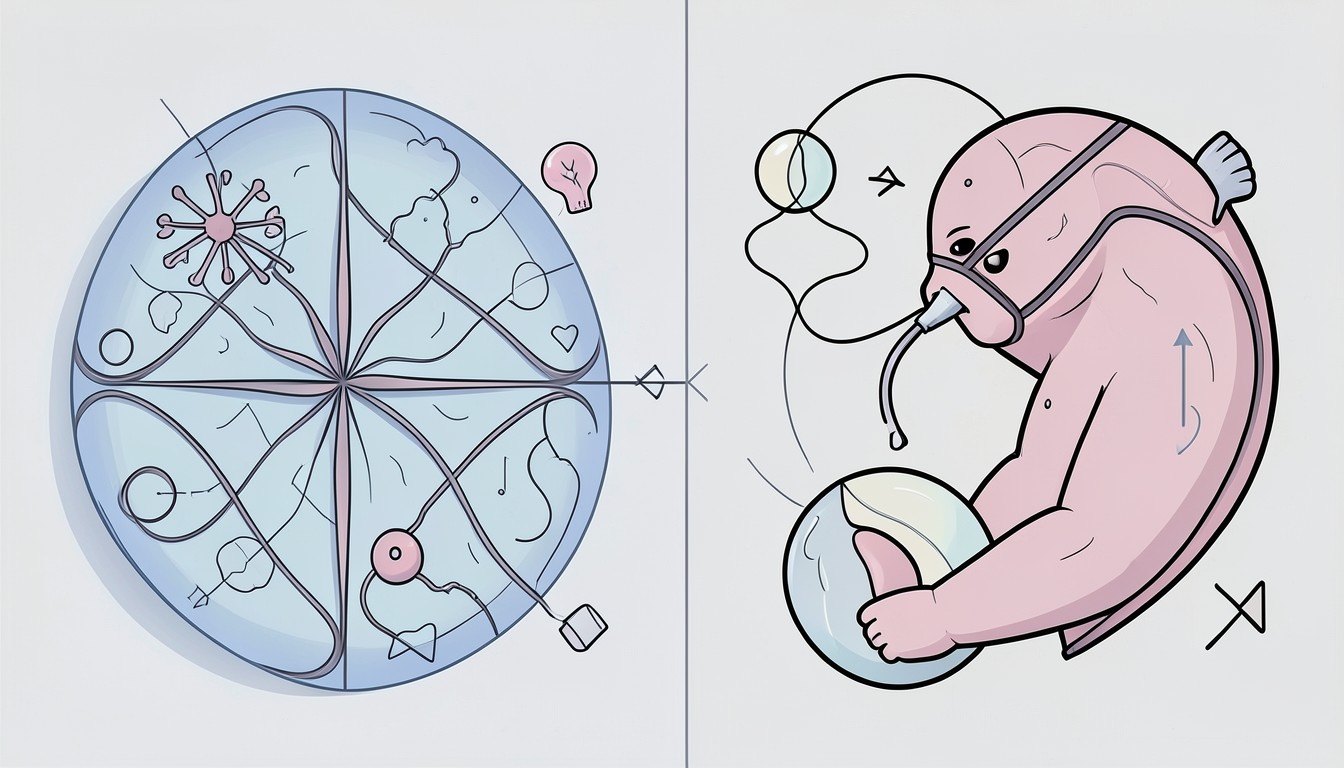
Mapping Infant Agency Through Neuroscience Mental Health Research
Every living thing acts with purpose. It is a fundamental truth so woven into daily life that we rarely pause to wonder how a squirming newborn—a creature seemingly defined by random, flailing reflexes—ever crosses the line into intentional action. For centuries, philosophers and scientists have grappled with the origins of agency. How do humans first realize they can affect the world around them?
Recent breakthroughs in neuroscience mental health research offer a startlingly clear window into this transition. By pairing classic infant behavioral tasks with cutting-edge 3D motion capture, researchers at Florida Atlantic University have quantified the exact moment a baby shifts from a passive observer into an active agent. This work bridges decades of developmental psychology with modern dynamical systems theory, offering profound implications for how we understand early human cognition.
Shifting Developmental Trajectories During Critical Periods of Brain Formation
To understand how volition takes root, we have to look closely at what happens when an infant interacts with its immediate environment. For over fifty years, developmental psychologists have used a deceptively simple experimental setup: tethering a baby's foot to a crib-mounted mobile with a soft ribbon. Every kick makes the mobile spin and jingle.
Traditionally, scientists treated the baby and the mobile as separate entities, assuming that seeing the mobile move simply stimulated more kicking in a straightforward, linear loop. But groundbreaking work published in the Proceedings of the National Academy of Sciences flips that script entirely. Utilizing coordination dynamics—a theoretical framework championed by J.A. Scott Kelso and colleagues at FAU's Center for Complex Systems and Brain Sciences—researchers tracked both infant limb movement and mobile movement simultaneously in 3D space.
What they found reveals profound shifts in developmental trajectories during critical periods of brain formation. Agency isn't pre-programmed as a static switch; rather, it emerges organically from the functional coupling between the organism and its surroundings. Supporting broader research streams—such as those tracked by Frontiers and discussed widely across neuroscience and psychology today—demonstrate that when positive feedback amplifies the cause-and-effect relationship between foot movement and visual feedback, a critical threshold is crossed. At this precise level of coordination, the infant recognizes its own causal power, moving from spontaneous activity to deliberate exploration.
The Eureka Moment: Detecting the Aha! Shift
Lead author Aliza Sloan and her team didn't just watch babies kick; they developed a sophisticated quantitative "aha!" detector. By analyzing continuous high-resolution movement data, they captured an abrupt surge in infant movement rates that marks the birth of conscious awareness and intentionality.
This isn't a gradual, linear slope. Instead, it operates as a sharp, pattern-changing phase transition within a complex dynamical system that spans the baby, the developing brain, and the external environment. Before this transition, the system operates in a loosely correlated state where limb motion and mobile motion are largely decoupled. After the discovery, infant limb motion and mobile motion lock into a tight, highly coordinated dance.
Understanding these early behavioral patterns offers far more than academic satisfaction. It gives clinicians a quantitative tool to map individual developmental fingerprints, shedding light on how human agency organizes itself from the bottom up.
Stillness Speaks: The Rhythm of Discovery
One of the most striking takeaways from the FAU study is that agency isn't forged solely through constant, frantic motion. Co-author Nancy Jones, a professor in FAU's Department of Psychology and director of the WAVES Lab, points out that patterns of infant pausing proved just as informative as active kicking.
The emergence of agency is a punctuated, self-organizing process. There is action in the midst of inaction, and inaction in the midst of action. Babies use both movement and stillness to sample their environment, test hypotheses, and consolidate their understanding of cause and effect. It turns out that stillness isn't merely the absence of movement—it is an active ingredient in conscious exploration, providing the nervous system with necessary moments to integrate sensory feedback.
Behavioral Phenotypes and Future Clinical Frontiers
By mapping these dynamic signatures, the research team discovered distinct clusters in the timing and intensity of infant movement bursts. These variations point to observable behavioral phenotypes of agentive discovery.
In plain terms, not all babies discover agency in the exact same temporal rhythm or through identical movement profiles. Recognizing these distinct behavioral phenotypes opens up entirely new horizons for early clinical screening. By identifying atypical developmental trajectories early in life, pediatric researchers and mental health specialists may soon spot neurodevelopmental risks long before traditional behavioral milestones are missed.
We are only beginning to decode how conscious awareness flickers to life in the human infant. But by marrying complex systems theory with high-precision 3D motion capture, modern science is finally catching the spark of volition right as it ignites.