
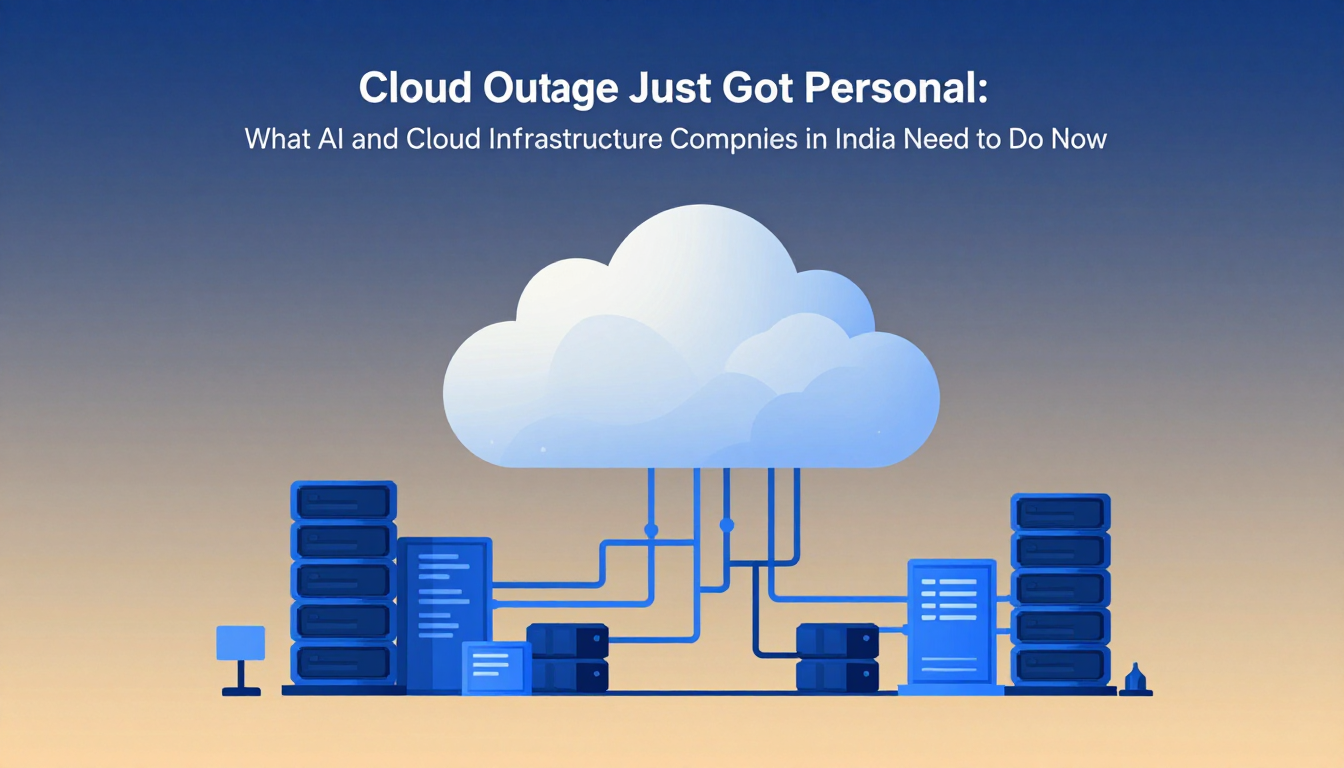
Cloud Outages Are Normalizing — And AI Companies in India Are Sitting Ducks
Let’s cut the cord.
If you’re still treating cloud outages as rare, unpredictable events, you’re not just behind — you’re dangerously naive.
Here’s what actually happened in the last 12 months: Google Cloud went dark on June 12, 2025. Spotify crashed. A dozen downstream apps vanished. No one had mapped the dependencies. Then, AWS took a hit in October from a misfired network health monitor — again, US-East-1, the same damn region. Azure followed on October 29 with a global meltdown triggered by a misconfiguration in its Front Door control plane. February 2026? Another Azure outage, ten hours long, because of a storage account hiccup. And last month? AWS lost power in a Virginia data center. EC2 and EBS? Down.
What was once a headline is now a Tuesday.
And here’s the kicker: AI and cloud infrastructure companies in India are uniquely exposed. Why? Because your entire stack — your agentic AI platforms, your managed cloud services, your customer-facing tools — runs on top of these hyperscalers. When Google stumbles, it’s not just your internal dashboard that goes dark. It’s your customers’ AI agents mid-task. Their workflows die. Their users get angry. And you? You’re the one who looks broken.
This isn’t a technical problem anymore. It’s a strategic one. And if you’re not treating it that way, you’re already losing.
The Cost Isn’t Just in Downtime — It’s in Trust
Sure, a two-hour outage can cost millions in lost revenue. That’s the headline. But the real damage? It’s the erosion of trust.
When your e-commerce platform vanishes during Black Friday, you don’t just lose sales — you lose customers who’ll never come back. When your collaboration tools go offline, productivity doesn’t pause — it shatters. When your data pipelines stall, decisions get delayed, or worse — made on stale data.
But for AI infrastructure teams in India, there’s a deeper wound.
What’s an embodied agent? It’s an AI system that doesn’t just think — it acts. Think warehouse robots, autonomous vehicles, industrial sensors that adjust in real time. They need the cloud for model updates, coordination, and shared context. When the cloud goes dark, they don’t just freeze — they become dangerous. They lose their sense of the world.
And what is agentic AI? Google Cloud defines it as AI that doesn’t just respond — it plans, adapts, and executes multi-step workflows autonomously. IBM calls it AI that acts with intent, not just inference. The difference? Traditional AI answers questions. Agentic AI does things — and it depends on the cloud to do them.
Now imagine that agentic AI agent is managing your customer’s supply chain. It’s negotiating with suppliers. It’s adjusting inventory. It’s communicating with other agents. Then — poof — the cloud goes down. The agent can’t complete its task. It doesn’t know whether to wait, retry, or fail safely. Your customer doesn’t care about SLAs. They care that their order didn’t ship.
And don’t get me started on SLAs. Cloud providers offer credits that barely cover a fraction of your losses. They absolve themselves of indirect damages. They cap liability at a percentage of your monthly bill — a joke when your business runs on uptime. You’re trusting your survival to platforms you can’t control, with contracts that protect them, not you.
This isn’t a vendor problem. It’s a power imbalance. And you’re on the wrong side of it.
Three Things You Must Do — Not Just Think About
The truth? You can’t wait for Google, AWS, or Azure to fix this. Their business model depends on you believing the cloud is bulletproof. So you fix it.
Here’s what you do.
1. Audit Your Dependencies Like Your Business Depends On It — Because It Does
Start with a brutal audit. Map every single system. Every API. Every microservice. Every AI agent’s dependency chain.
Most teams think they know their architecture. They don’t. They’ve got a dozen services calling Google’s Vertex AI, three workflows relying on AWS Lambda, and an agent that pulls data from Azure Blob Storage — all undocumented. You can’t protect what you haven’t mapped.
For AI infrastructure companies, this means tracing every agentic workflow. Which models are hosted where? Which API calls are synchronous? Which agents can’t function without cloud connectivity? Find the single points of failure. The ones you didn’t even know existed.
This isn’t a one-time exercise. It’s a living map. Update it every sprint.
2. Build Hybrid — Not Just for Compliance, But for Survival
Stop pretending everything belongs in the cloud.
For your most critical workloads — the ones that run your core agent orchestration, your customer-facing decision engines, your real-time monitoring systems — build a hybrid path. Run them on-premises. Or in a secondary region you control.
You don’t need to repatriate everything. Just the things that can’t afford to blink.
For AI companies in India, this isn’t even a stretch. Data sovereignty, latency, and regulatory pressure already make hybrid a natural fit. Use that to your advantage. Start with one critical agent system. Run it locally. Test it. Learn. Then expand.
This isn’t about being old-school. It’s about being resilient.
3. Test for Cloud Failure — Not Just Data Center Failure
Most disaster recovery drills? They assume a power outage. A flood. A server crash.
They don’t assume the cloud goes dark.
That’s the flaw.
You need to simulate exactly what happens when your primary cloud provider’s API stops responding. When Google’s authentication service vanishes. When AWS’s control plane goes silent. When Azure’s managed identities stop working.
For an AI infrastructure company, that means: What happens to your agents when they lose their cloud backbone? Do they fail gracefully? Do they queue tasks? Do they fall back to local models? Do they alert before they crash?
If you don’t know the answer — you’re not ready.
Schedule these tests. Quarterly. With real traffic. No dry runs.
The goal isn’t perfection. It’s knowing what breaks — and fixing it before your customers do.
The Tradeoff? It’s Not a Tradeoff — It’s Survival
I won’t sugarcoat it. Hybrid architecture is messy. Managing multiple clouds, on-prem gear, and different toolchains adds complexity. Licensing costs rise. Skills gaps widen. Onboarding engineers becomes a nightmare.
But here’s the thing: the alternative is worse.
Waiting for the next outage to expose your fragility? That’s not a risk. That’s a guarantee.
The organizations that survive the next wave of cloud failures aren’t the ones with the fanciest SLAs. They’re the ones who built redundancy into their bones.
For AI and cloud infrastructure companies in India, this isn’t optional. Your competitors are still treating cloud outages as edge cases. You? You’re building systems that keep running — even when the cloud doesn’t.
The question isn’t whether you can afford the investment.
It’s whether you can afford to lose your customers the next time Google or AWS stumbles.
Don’t put all your eggs in one basket. Accept that the cloud will fail. Again.
And build your architecture like you mean it.