Introduction to the Uncanny Valley
In the mid-2010s, videos of eerily human-like robots began to flood social media feeds across the globe. Meant to showcase technological progress, they instead drew widespread discomfort. The faces moved, blinked, and even attempted subtle smiles, yet viewers experienced an immediate visceral reaction of revulsion. This phenomenon, long studied in robotics and psychology, is known as the uncanny valley.
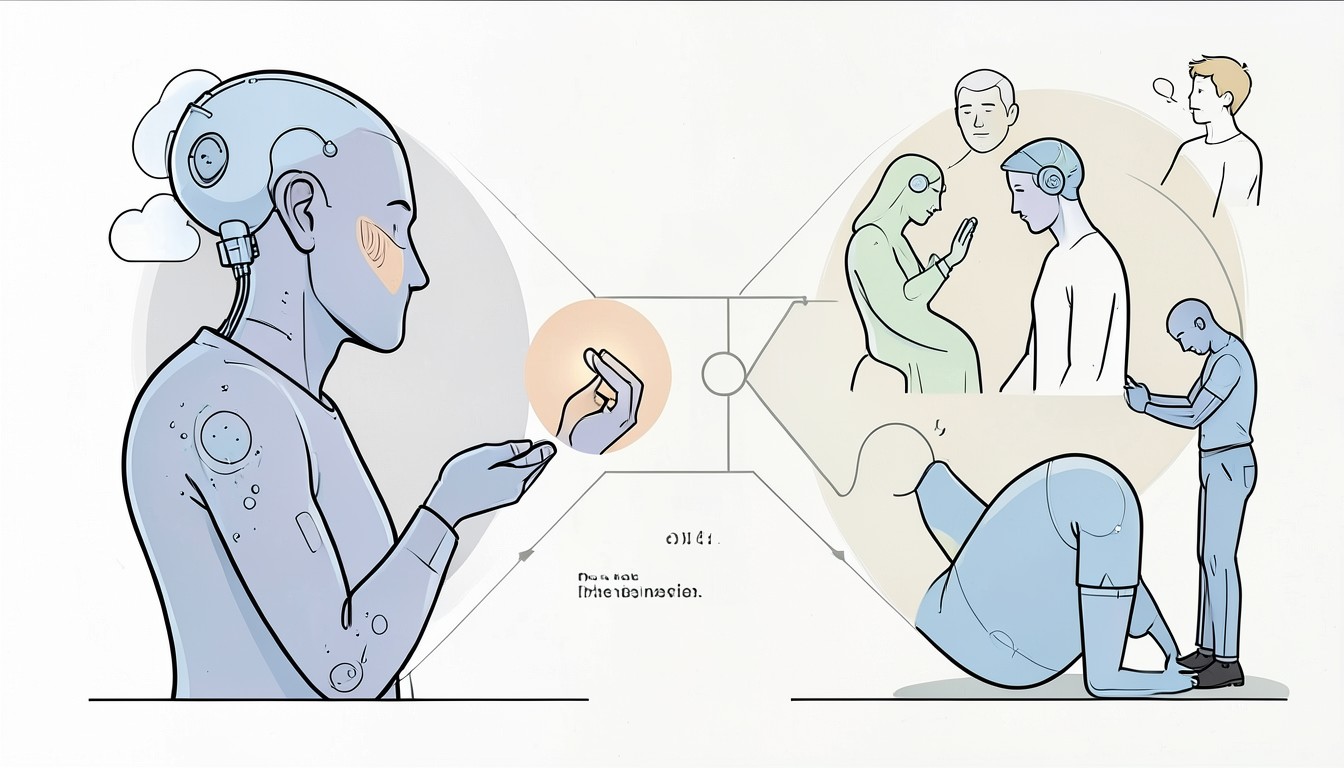
As artificial intelligence and humanoid robotics continue to advance, understanding why near-identical approximations of humanity trigger discomfort matters more than ever. The challenge is not merely technical; it touches fundamental aspects of human cognition, perception, emotional trust, and our evolutionary heritage. Increasingly, the conversation is also about what happens on the other side of the valley: the quality of our relationships with these systems, and whether human-AI relationships and their therapeutic implications can be designed with the same care we bring to the machines themselves.
The Mid-2010s Robot Surge and Public Discomfort
When Hanson Robotics' humanoid robots went viral around 2015-2016, millions watched videos showing remarkably lifelike faces capable of nuanced expressions. The initial reaction was fascination, but that quickly gave way to discomfort. Comment sections filled with words like "creepy," "terrifying," and "unsettling." Despite remarkable technical achievements, these robots consistently failed to generate genuine emotional connection.
Sophia the robot, developed by Hanson Robotics, became perhaps the most famous example. By 2016, she could maintain conversation, make facial expressions, and respond to questions. But public reaction revealed something revealing about human perception: viewers described feeling uneasy precisely when robots seemed almost, but not quite, human. The more sophisticated the technology, the stronger the discomfort—suggesting the effect intensifies at higher levels of human-likeness.
Social media accelerated and amplified this response. Short video clips spread rapidly, creating a collective cultural moment around unease toward humanoid robots. The phenomenon became a shared reference point for public discomfort with technology advancing faster than our emotional adaptation.
Understanding the Uncanny Valley: Origins and Definition
The concept traces back to 1970, when Masahiro Mori published his essay "Bukimi no Tani Genshō," usually translated as "The Uncanny Valley Phenomenon." Mori observed that as artificial things become more human-like, our emotional response improves—until a point near perfect resemblance, where empathy abruptly inverts into revulsion. Only by crossing the valley and achieving true indistinguishability does comfort recover.
This graph defies the intuitive assumption that realism always breeds affinity. Near-perfect human likeness produces not admiration but unease, a sharp dip between the warmth we feel for a clearly artificial machine and the comfort we feel for a real person. The uncanny valley is the no-man's-land in between: too human to dismiss as a tool, too artificial to accept as a being.
Psychological Explanations
Several competing theories attempt to explain why we react with revulsion rather than affection.
Predictive Processing and Expectation Violations
Modern neuroscience suggests the brain works as a prediction engine. When we encounter something new, we match incoming signals against stored templates. With humanoid robots, we expect human responses but receive mechanical or inconsistent behavior, producing prediction errors. The discomfort is our system flagging a mismatch: these robots break the patterns our brains use to understand the world.
Mortality Salience and Death Awareness
Another framework proposes that near-human robots trigger subconscious awareness of mortality. They function as living reminders of the boundary between life and death—human forms without human consciousness. This can activate existential anxiety.
Pathogen Avoidance and Disease Detection
Evolutionary perspectives suggest the response may be an adaptation for avoiding disease. Slightly off facial features, unnatural movement, and subtle markers of "wrongness" might trigger our behavioral immune system. What we experience as creepiness could be an ancient avoidance response.
Categorization Ambiguity
A more cognitive account holds that the discomfort comes from categorization difficulty. Our brains categorize things rapidly as human or non-human. Uncanny robots straddle the category boundary, creating cognitive dissonance that feels subjectively like revulsion. The psychological literature has never converged on a single explanation, and the truth likely involves several of these mechanisms at once.
Design Implications: Crossing the Valley
Roboticists have developed practical strategies. One is stylization—deliberately avoiding full human realism, as in toy-like designs that sidestep the uncanny zone entirely. A second is motion synchronization, since mismatched facial expression and body movement reliably trigger unease. A third is transparency: research suggests that when people understand an artificial agent's limitations and purpose, they categorize it more easily and the valley effect weakens.
These principles matter because the uncanny valley is not a single fixed point. It shifts with experience, culture, context, and exposure, and people's tolerance for near-human machines appears to move over time.
The Expanding Frontier: LLMs and the Uncanny Valley
As large language models entered daily use, people began reporting the valley's signature discomfort in a new form. Text that reads perfectly human but is unmistakably artificial—confident yet hollow—triggers the same violation of expectation that a plastic face once did. The discomfort now shows up in emails that sound sterile, messages that hit all the right notes but none of the right feeling, and leadership communication that is technically correct yet emotionally vacant.
The valley is no longer confined to faces in motion. We feel it whenever a system comes too close to sounding human without truly being alive to the exchange. As these models proliferate, users increasingly report the same sense of betrayal: the system performs humanity convincingly enough that its absence of genuine understanding becomes the most conspicuous thing about it.
Human-AI Relationships and Their Therapeutic Implications: From Faces to Feelings
This shift reframes the question. If the valley now lives in our everyday exchanges with AI, then the design problem is not only how to make machines less creepy but how to make our human-AI relationships and their therapeutic implications healthier. Recent thinking in psychology argues that the way "out" of the uncanny valley is not more polish but more of what machines cannot replicate. In a coaching and organizational context, the most transformative breakthroughs tend to come not from the cleverest insight but from someone who already knows how you think, what matters to you, and what patterns you have repeated over time. That is a capability no algorithm trained on aggregate data can genuinely hold.
The Human Time Advantage
One of the most under-appreciated assets in any relationship—professional or personal—is accumulated relational knowledge. Longtime mentors, trusted colleagues, and close friends carry historical insight that years of context make possible, emotionally attuned support born of familiarity, and a rich synthesis that sees connections transcending any model's training data. Especially in moments of upheaval, this relational depth helps us orient, reframe, and act with clarity. It is the counterweight to the sterile correctness that makes AI communication feel uncanny: presence built over time, not generated in a single pass.
Metacognition: Thinking About Thinking in an AI World
Metacognition—the ability to reflect on our own thought processes—is among the most sophisticated human skills, and one of the first to erode under stress. AI does not have it. A model does not know when its predictions are wrong or whether its patterns carry unintended consequences; that judgment remains ours. As AI becomes embedded in decision-making, staying conscious of how we are thinking, not just what we are doing, becomes a leadership and therapeutic imperative. Good metacognition usually arrives through dialogue—a friend reflecting your words back, a colleague asking a surprising question, a coach noticing what you skipped. Relationships mirror not only our ideas but our mental habits in a way an autonomous system cannot.
Emotion as the Invisible Engine
We tend to separate emotion from logic, yet cognitive neuroscience treats that as a false divide: emotion drives cognition, fueling attention, motivation, memory, and behavior. AI tools, however fluently they mimic empathy in tone, lack true emotional processing. Relying too heavily on machine-generated responses risks dulling the nuance that makes feedback land, that helps people feel seen, that signals when to change course. Emotional data often lives beneath the surface—a pause before a sentence, a shift in tone, a glance that says more than words. Machines can measure sentiment, but they do not feel it.
Momentum and Trust Through Movement
Trust does not emerge from perfection; it emerges from movement. The neuroscience of trust suggests we build faith in one another through consistent, emotionally engaged interactions that allow course correction, not through flawless performance. AI can draft a plan, but only people can carry it forward in ways that resonate. Collaborative iteration—the human capacity to reflect, revise, respond, and openly change our minds—reinforces trust far more than the illusion of certainty. Momentum is also emotional: it is about feeling that things are moving, even imperfectly.
Integrating the Human Edge
When leaders and practitioners ask how to prepare for disruption, the most durable answer is relational rather than technical. The uncanny valley, in both its original robotic form and its new conversational form, is ultimately a signal about emotional resonance, not realism. It marks the gap between something that resembles understanding and something that actually understands. Closing that gap is not a task for better rendering or more fluent text; it is a task for us. Humanizing AI, in other words, starts with the human relationships, metacognition, emotion, and trust we bring to the encounter. The systems that prove genuinely valuable will be the ones that make room for those capacities.
For related perspectives, see why human presence matters in therapy and the limits of AI in therapeutic healing.