AI workforce restructuring at Tesla: Optimus training, fixes, and human work
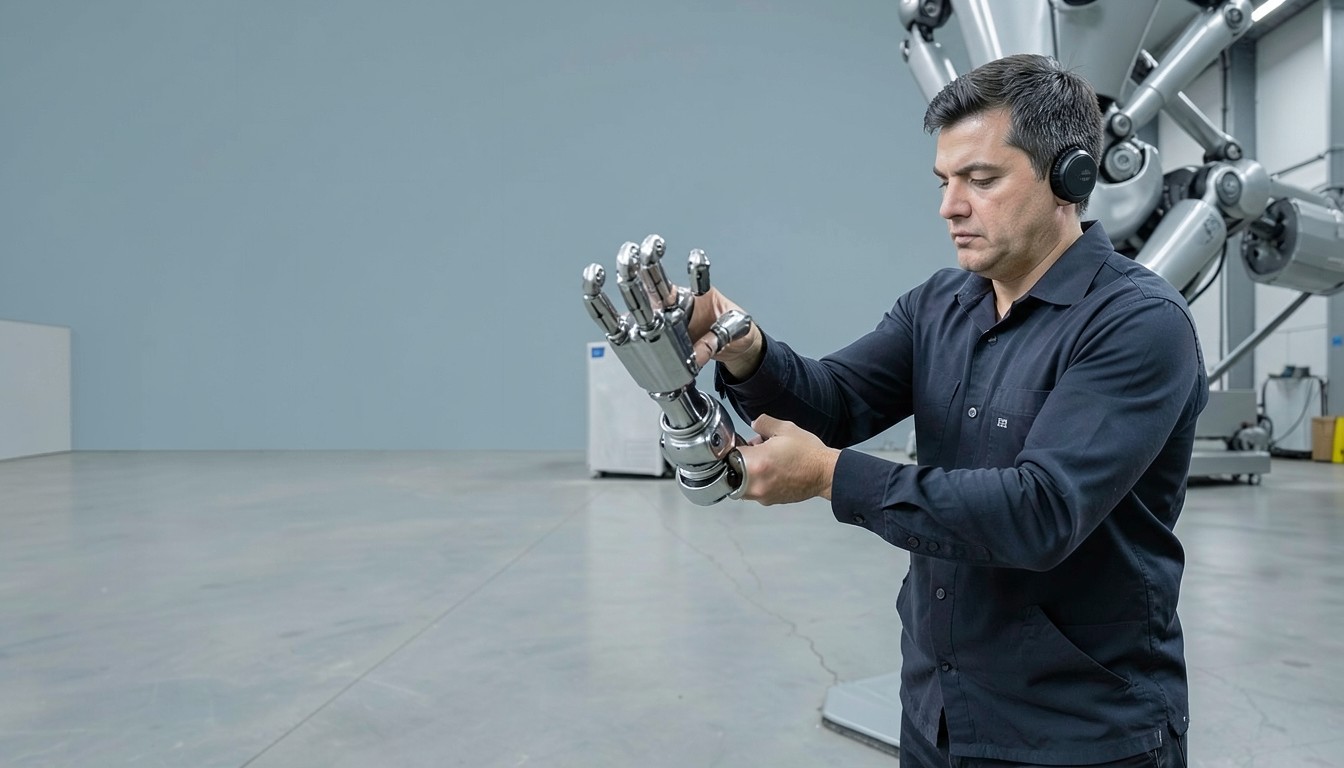
Ars Technica reports that Tesla workers train its Optimus humanoid robots and that the robots need fixes. These are the central reported facts: human labor is involved in preparing the robots, and correction is needed. The available source does not quantify the training or repair methods, how often fixes occur, their duration or cost, or their effects on jobs. This boundary matters: the report identifies real work around the system, but does not establish the eventual operating model or workforce outcome. (Ars Technica)
The report is useful precisely because it complicates a simple picture of automation. A robot is not equivalent to an independent worker merely because it can perform a task. Deployment also involves preparation, supervision, and correction. Whether those requirements diminish as a system matures, or persist as routine operating work, is a practical question for any company deciding where automation fits into production.
Training and correction are part of the production system
Training and fixing are not external footnotes to automation; they are activities that can shape how a system functions. Training concerns the relation between a robot and the task it is expected to perform. Correction concerns what happens when the system’s behavior or condition does not meet the required standard. In a factory, the relevant unit of analysis is therefore not the robot alone but the larger arrangement of equipment, workers, procedures, and outputs.
This distinction helps avoid treating human involvement as evidence either of failure or of success. A period of intensive preparation could be an ordinary part of introducing a new tool. Alternatively, recurring human intervention could become a lasting requirement. The distinction can only be evaluated by observing performance over time: whether the robot can complete specified tasks reliably, and whether the human effort required for training and correction changes as experience accumulates.
For managers, that means asking how work is organized around a robot, not only what the robot is designed to do. Who prepares it? Who notices a problem? Who determines whether a correction worked? How are these duties coordinated with existing production responsibilities? These are operational design questions. Their answers influence whether automation functions as a supplementary tool, a source of new specialist work, or a system that depends on frequent attention from workers already responsible for other tasks.
Rework, reliability, and the economics of AI
The need for fixes makes reliability a production issue. A meaningful assessment would distinguish a correction that is quick and exceptional from one that consumes recurring labor or interrupts a process. It would also distinguish a robot that performs a task once under favorable conditions from one that can repeat it to a consistent standard. These are different dimensions of performance: capability, repeatability, availability, and the human effort needed to sustain operation.
That is why output counts alone can mislead. If a company evaluates only the units or tasks completed by a machine, it may leave out the people-hours spent preparing, adjusting, and restoring the system. A fuller accounting would compare the robot’s usable output with its downtime and the human work associated with it. It would also define the task being compared: a robot’s successful completion of one bounded activity is not automatically equivalent to replacing an entire job, which may include multiple tasks, judgments, and responsibilities.
This is a version of the Simple Macroeconomics of AI: adoption matters economically when it changes the amount or kind of labor and capital needed to produce goods and services. A technical demonstration does not by itself show a productivity gain at the level of a factory, much less across an industry. A productivity claim requires a denominator as well as an output measure: resources used, including labor time, equipment, support, and interruptions. The relevant comparison is not human versus robot in the abstract, but alternative ways of delivering a defined production result.
If training and correction are concentrated during early deployment and then decline, the economics may differ from a process where support remains substantial. Conversely, even a system requiring meaningful human oversight could still contribute value if it performs useful work safely and reliably alongside people. The point is not to assume either trajectory but to measure the actual production arrangement rather than infer it from the presence of a humanoid machine.
AI workforce restructuring: task change is not job displacement
Workers’ involvement in training and correction makes clear that automation can alter the composition of work even before any claim about headcount is justified. Tasks may shift toward preparing systems, monitoring their operation, diagnosing problems, or coordinating machine and human activity. Such changes can matter to workers’ responsibilities, training needs, and the organization of shifts, even if the number of jobs remains unchanged.
Job displacement is a separate claim. To establish it, evidence would need to show what roles existed before deployment, what tasks the robots took over, and what happened to staffing and job duties afterward. A company might use automation to expand output, reduce particular tasks, reassign employees, or redesign jobs. These are distinct outcomes and should not be collapsed into a single story about replacement. The reported training and fixes do not determine which path Tesla will take.
For workers, the question of who benefits from a task transition is also important. If new responsibilities require specialized knowledge, access to training and pathways into those roles affect whether employees can participate in the change. If duties are added without corresponding time or support, the impact may instead be an increase in workload. Those are labor-process questions that require evidence about how work is assigned and experienced, not assumptions based on the robot’s form or intended purpose.
A grounded assessment would therefore track job categories and duties alongside staffing. It would ask whether workers remain in the same roles with different tools, move into technical support, or leave work that has been automated. It would also consider whether increased production changes demand for labor elsewhere in the operation. In the absence of those observations, the sound conclusion is that task change is plausible and worth examining, while a net employment effect remains unestablished.
What evidence would clarify the production and labor effects
A useful operational study would define tasks and record how consistently the robots complete them, how much human setup and correction each task requires, how often equipment is unavailable, and how performance changes over repeated runs. Results should be reported over a meaningful period rather than as a single demonstration. Comparing early and later operation could show whether learning and repair demands taper, stabilize, or remain a significant part of the process.
A complementary labor study would document staffing, assignments, hours devoted to training and maintenance, changes in job duties, and any redeployment or reduction in roles. The baseline matters: without a clear description of production and staffing before the robots are introduced, a later snapshot cannot establish what changed. It would also be useful to separate robot-related work from other changes in production so that employment shifts are not automatically attributed to automation.
Together, these measures would allow a more concrete comparison between human effort and machine output. They could show whether the system increases throughput, changes the mix of tasks, reduces some labor requirements, or creates ongoing support work. They could also reveal that effects differ by task or over time rather than resolving into a single verdict about humanoid robots.
The current evidence supports a narrower but still consequential point: workers train Optimus, and the robots need fixes. That is enough to reject the idea that introducing a robot makes the surrounding human work disappear by definition. It is not enough to declare the system productive or unproductive, to calculate its costs, or to say that jobs have been displaced. Those conclusions depend on operational and employment evidence that the report does not provide. The next question is not whether humans or robots win in theory, but how the work is actually divided, what results follow, and who bears the labor of making the system function.