Why a DNA Storage Startup Just Raised the Stakes for AI Cloud Infrastructure Companies
Here's something the hyperscalers didn't put on their roadmaps. A French biotech company with a Boston lab just launched the first commercial product for protecting your most critical data using synthetic DNA — and it directly threatens the assumptions underpinning how AI cloud infrastructure companies in India store their training checkpoints, model weights, and cryptographic keys.
Biomemory, founded in 2021 out of research labs at Sorbonne University and CNRS, opened Early Access to DNA Shield on October 15, 2026. It's a managed service for sovereign data protection: an offline, independent layer for the handful of digital assets an organization genuinely cannot afford to lose. The product runs on what Biomemory calls its Molecular IT platform — a stack where information is encoded into synthetic DNA fragments rather than magnetic or silicon media.
That sounds exotic. It is. But the logic behind it is straightforward enough that it should make infrastructure architects sit up and pay attention.
The Year That Turned Research into a Commercial Product Line
Biomemory didn't stumble into this launch. Two specific moves over the past year set the stage.
In March 2026, Biomemory acquired the assets of Catalog Technologies, the Boston-based pioneer in DNA data storage and computing. That wasn't a rescue deal. Catalog had been working on scalable, high-throughput DNA printing and reading since the early 2010s. Biomemory brought a patented enzymatic process for volume production of biosafe DNA and a modular architecture designed for data centers. Together, the combined IP portfolio covers everything from data encoding to long-term physical retention.
Olivier Lauvray, Biomemory's VP of Industrialization, put it plainly in the acquisition announcement: "Biomemory is the first company in the DNA Data Storage industry to have implemented a complete end-to-end industrialized process. It spans the digital file or object ingestion to DNA writing and storage with a data retention of 50 to 150 years, and has the capability to access and read stored digital content all along the retention lifetime."
The second move: in early 2026, Laurent Guengant was appointed CEO of Group Catalog, the legal entity hosting Biomemory's commercial operations. Guengant is a veteran of the IT industry — he built his career at IBM across Europe and Asia-Pacific, then spent five years as President of Business France for Asia-Pacific (the national export promotion agency). He also served as General Manager of Dassault Systèmes for Southeast Asia and Korea. In 2015, he received the Knight of the National Order of Merit from the French government.
In his first public statement on the launch, Guengant framed DNA Shield with characteristic directness: "Today we are not announcing a research prototype. We are putting into production a sovereign data-protection service built on the Biomemory Molecular IT platform, for the most critical information a company or a nation cannot afford to lose."
That's a CEO speaking to enterprise buyers, not to a grant committee. The distinction matters because it signals Biomemory's shift from lab validation to revenue-generating operations.
What DNA Shield Actually Does
Strip away the biology metaphors and DNA Shield solves a specific, unglamorous problem: keeping a small set of high-value data safe from risks that don't exist yet.
The product targets information that must remain trustworthy over years or decades — root cryptographic keys, model weights for frontier AI systems, intellectual property that takes years to reproduce, sovereign digital identities. Traditional cold storage on tape or encrypted object storage assumes your encryption algorithms and key hierarchies remain secure over that timespan. Quantum computing and advanced AI break that assumption.
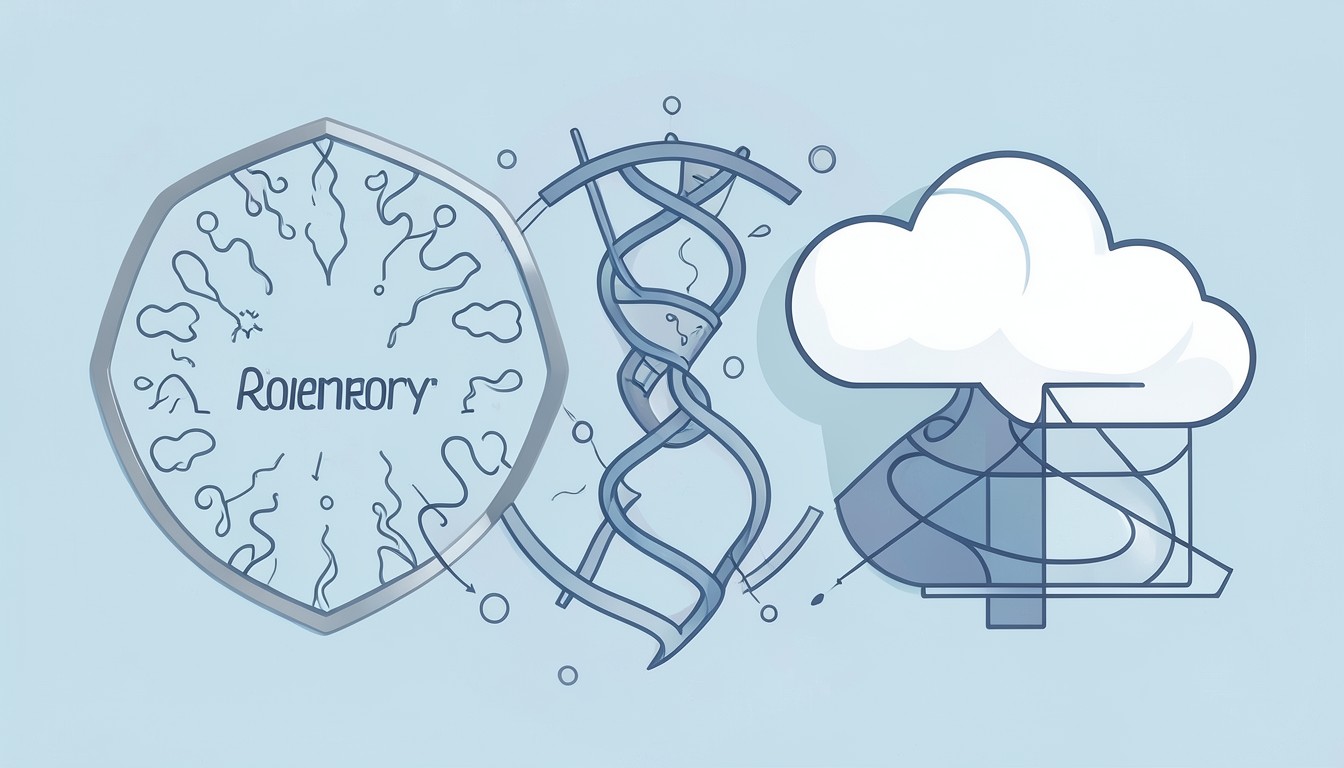
DNA Shield works by taking your data, encoding it into synthetic DNA fragments through Biomemory's enzymatic process, and physically storing it. DNA as a storage medium is stable for decades to centuries under the right conditions. It's immune to electromagnetic pulses. It doesn't degrade from software bugs. It sits in a vial, not on a network. The attack surface is literally the physical security of a room.
Biomemory claims a data retention lifetime of 50 to 150 years with IT-compatible Uncorrectable Error Rate. Both Biomemory and the former Catalog platform use a "biosafe DNA blocks" approach rather than base-by-base synthesis — a mapping strategy that Biomemory says enables massive improvements in reading speed, cost, and data volume while maintaining what the company calls "biosecurity by design."
For the AI infrastructure gap that keeps widening across cloud platforms, this addresses a gap nobody's naming yet: the long-term integrity of model artifacts themselves. If you've invested hundreds of millions in training a frontier model and the encryption protecting your weights becomes breakable in a decade, what's your plan?
Scaling AI Infrastructure Meets Molecular Compute
The broader Molecular IT platform that DNA Shield sits on isn't just storage. Biomemory and co-founder Erfane Arwani have been explicit that the acquired Catalog portfolio — particularly its patent-backed search and computing capabilities — will eventually be integrated into the stack. The company co-chairs the DNA Data Storage Alliance, a sign of how seriously the research community treats this category.
This is where it gets interesting for anyone thinking about scaling AI infrastructure beyond what silicon alone can sustain. Biomemory and Catalog share a common architectural philosophy: mapping data to biosafe DNA blocks. Biomemory says this approach "provides a path toward massive improvement in reading metrics (cost, speed and data volume), and the ability to add a variety of search and computing features inaccessible to bit-to-base encoding schemes."
The company's modular IT-friendly architecture and ISO-like qualification protocol were designed to slot into existing data center environments. Biomemory says it targets the rackable storage server form factor. If that vision matures, DNA-based cold storage could become one layer in heterogeneous AI edge infrastructure — the place you park the data that training pipelines don't touch daily but can't afford to lose.
Biomemory hasn't published the full Molecular IT roadmap. The company says future announcements will detail the compute layer. For now, DNA Shield stands alone as the first commercial expression of this architecture.
A Year of Consolidation, A US Footprint, and What Comes Next
The Boston acquisition gave Biomemory something it previously lacked: a North American operational presence with R&D, production units, and customer support staffed by former Catalog experts. Guengant's appointment reinforced that geographic push — a CEO whose entire career has been about scaling technology businesses into international markets.
In a February 2026 statement tied to the Catalog deal, Guengant described the combination as creating "a unique and unrivaled combination of technology, expertise, hardware and Intellectual Property under a single roof." Biomemory says the consolidated entity holds the highest industrial readiness level in the DNA storage sector, with an advantageous CapEx profile and competitive OpEx enabled by its enzymatic production method.
The company launched its first commercial solutions leveraging the Catalog assets in the second half of 2026. DNA Shield is that first solution. The second and third will presumably add Catalog's search and computing capabilities on top of the storage substrate.
For buyers evaluating this against traditional cold storage — AWS Glacier, Azure Archive, or whatever the AI cloud infrastructure equivalents become — the question is whether DNA Shield's quantum-resistance and century-scale retention justify what will initially be a premium price with limited ecosystem tooling. For sovereign data, cryptographic root keys, and model weights of genuinely irreplaceable systems? That's not a premium. That's insurance against a tail risk most organizations are still pretending doesn't exist.
Biomemory headquartered in Paris, with this Boston hub as its US launch pad. The company doesn't publish customer names or pricing for Early Access. That secrecy is typical of early-stage infra products sold into regulated industries. But the product is real, the CEO has operational IT credibility, and the underlying science has moved from paper to production line. In a market where "AI infrastructure" mostly means more GPUs in more warehouses, Biomemory's bet that molecules will outlast silicon for the data that matters most is at least worth watching.