AI server hardware architecture has a power geography
A faster accelerator doesn’t make a power line appear. That’s the infrastructure fact behind the debate about ever-larger AI clusters. Hardware architecture is usually discussed through accelerators, memory, interconnects and utilization; at very large scale, it also means deciding where reliable electricity can be obtained.
Epoch AI examines whether a training run could be spread among facilities rather than concentrated at one campus. Its illustrative scenario models a 10-gigawatt run across 23 existing gas plants connected by a 4,800-kilometer fiber network. This is a modeled design, not a roster of confirmed data centers or power contracts. Epoch cautions that the identified plants are unlikely to be ready to provide their full estimated capacity to data centers.
That distinction is the whole story. A technical scenario can reveal a possible architecture; it cannot establish that fuel, permits, grid rights, land or generation are secured. Operating facilities, announced projects, proposals and contracted power are different things.
Distributed training changes the architecture
A conventional large cluster colocates much of its compute so machines can communicate with low, predictable delay. Decentralized training relaxes that assumption: facilities at separate locations cooperate as one training system. That could widen the search for power beyond a single campus, but distance doesn’t vanish. The network becomes part of the machine.
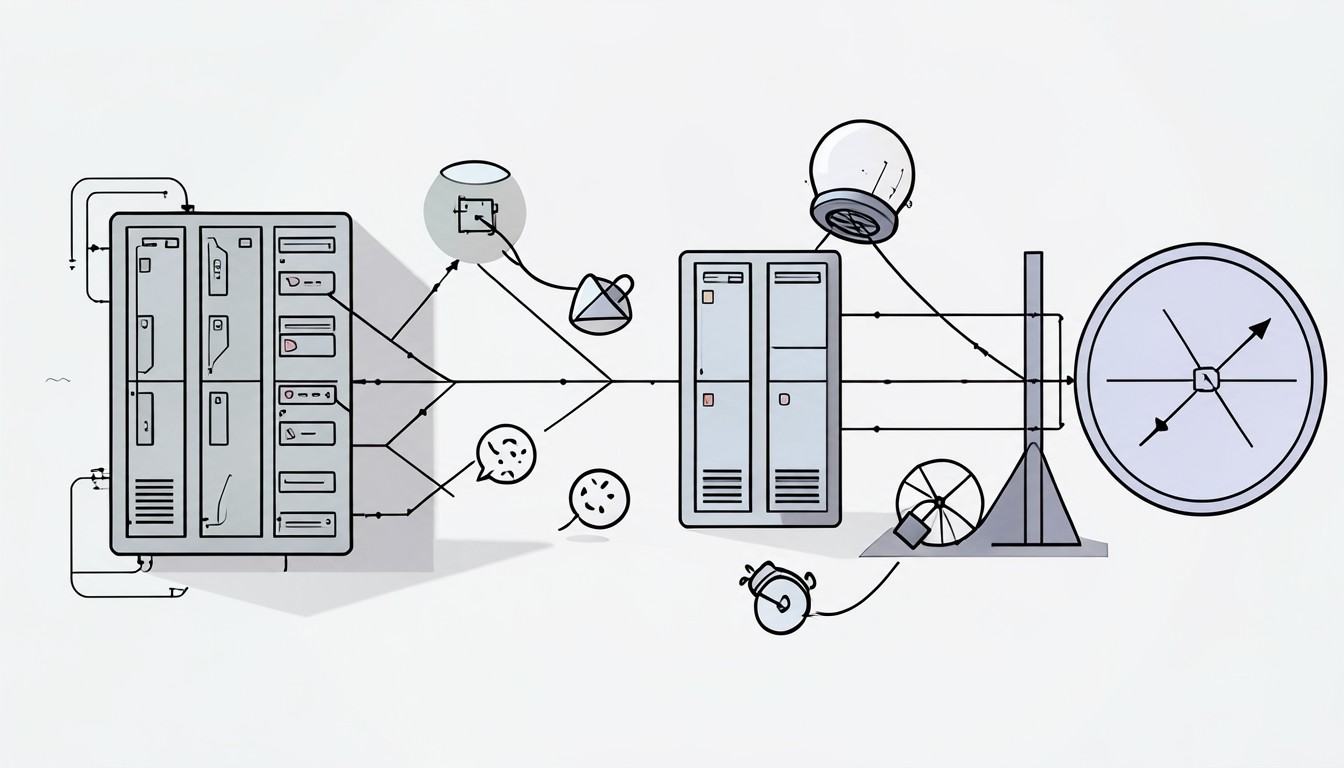
Epoch’s illustrative design uses data parallelism across sites. Computation happens at the participating locations, with training information exchanged among them. The practical result depends on bandwidth, latency, synchronization and workload behavior, not simply on adding up accelerator capacity.
This is a trade, not a free workaround. A single campus is easier to coordinate; a distributed system might reach power that cannot be assembled in one place, while introducing networking and operating complexity. Epoch concludes in its analysis that multi-gigawatt training spread across dozens of locations and thousands of kilometers is technically feasible without a large increase in training time or construction cost. That conclusion belongs to the report’s modeled assumptions, not every model, network or real-world site.
What the 10 GW example does—and doesn’t show
Epoch’s example draws on 23 existing gas plants and estimated spare-capacity values in the approximate 300–800 MW range, then considers hypothetical nearby data centers. The report identifies Rock Springs Generation Facility in Maryland as its largest capacity-adjusted location, at about 800 MW estimated spare capacity; it also reports that the facility operated at roughly 2% of nameplate capacity annually. These are the report’s estimates, not proof of uncommitted output or a contract to supply a data center.
Annual utilization, estimated spare capacity and deliverable power are not interchangeable. Local demand, transmission constraints, operational needs and commercial arrangements all affect whether a facility can serve a new load. Epoch’s list is a way to explore candidate locations, not evidence that the listed capacity is approved or contractually available for AI.
Behind-the-meter announcements need status labels
Cleanview says it identified 59 behind-the-meter data-center projects with approximately 90 GW of announced capacity, representing more than a quarter of planned U.S. data-center capacity in its project-tracker comparison. Its report says 92% of the identified projects—about 82 GW—were announced in the preceding year. These are Cleanview’s project counts and announced-capacity estimates, not operating generation totals.
The same report estimates roughly 2 GW operating at the time of its analysis, with other projects at differing stages. An announcement, a project under construction, a permitted project and an operating plant should not be rolled into one figure for power that is ready today. Cleanview’s numbers describe its tracked project set and methodology; they do not imply that every project will be built or serve a particular training cluster.
Cleanview describes developers considering mobile gas generators, aeroderivative turbines, reciprocating engines and refurbished turbines as they seek power. That mix signals development activity and varied equipment choices; it is not evidence that all announced capacity has been installed. The headline total is useful as a measure of interest, but it is not a forecast of delivered electricity.
Off-grid power still depends on infrastructure
“Off-grid” can sound like independence from the energy system. In practice, on-site generation still needs fuel, equipment, permits and delivery infrastructure. Natural Gas Intelligence has reported on data centers pursuing off-grid natural-gas power to find a route to electricity; the discussion is evidence of development interest, not proof that a specific gigawatt-scale project has completed its infrastructure or secured fuel.
A large gas project may require major infrastructure, including pipelines. That is not a minor detail to be waved away by drawing a generator beside a data center. The cited reporting frames off-grid natural gas as one response to power access constraints, while the actual deliverability of any proposal depends on its own fuel and infrastructure arrangements.
Epoch’s report makes a related scale point: it says no AI data center planned today involves off-grid power generation over one gigawatt. That statement concerns planned off-grid generation in the report’s scope; it should not be confused with a modeled 10-GW distributed-training scenario or with aggregated announced project capacity.
The architectural decision remains conditional
For AI server hardware architecture, decentralized training belongs among serious options—not as a magic answer, but as a way to trade a single-site power bottleneck for a more complex system. If no one location can conveniently support an entire load, several smaller facilities might collectively host a run. Whether they can do so efficiently depends on the network and the training method.
The evidence supports a measured conclusion. Distributed training could broaden the geography of large compute, and plant data can help identify locations worth investigating. It does not show that every listed plant has power available, that announced behind-the-meter projects will be completed, or that a particular multi-gigawatt project is secured. Architecture may make compute less geographically concentrated. It cannot make fuel, pipelines, permits, grid access or reliable networking optional.