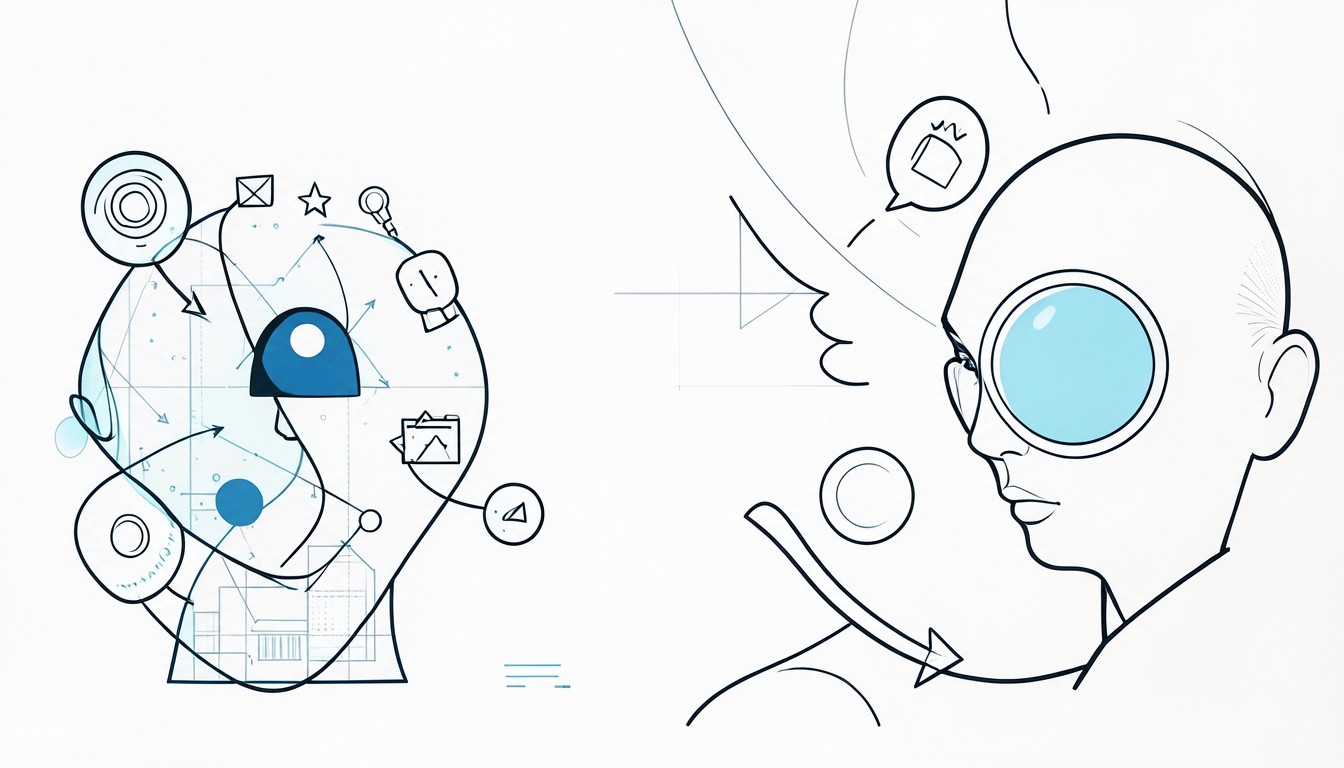
AI impact on human psychology: the question behind face judgments
A face invites a story. We look at someone and, often before we notice we’re doing it, decide whether they seem competent, kind, or trustworthy. That reflex is psychologically interesting. It is also a poor foundation for knowing what a person is actually like.
A Psychology Today article, “A Hidden Bias of AI Revealed,” describes research examining whether language models produce character-related judgments from faces in ways that resemble human assumptions. That framing matters: the object of study is what a model says in a particular task. It is not a demonstration that the model sees a person’s character, nor that its impressions are true. Read the Psychology Today account.
The distinction can get lost in a striking headline. If a system assigns a trait to a face, the output may sound like perception. But fluent language is not evidence of insight. A model can produce a familiar human-sounding judgment without knowing anything about the person behind the image.
What is AI in psychology?
“AI in psychology” can mean several things: using computational systems to support psychological research or practice, studying how people interact with AI, or examining whether AI systems reproduce patterns associated with human thought and judgment. In this story, the relevant question is the last one. Researchers are interested in model outputs as a possible site where human-like social assumptions appear.
That is narrower than asking whether a machine has a mind. The reported task concerns responses to faces and the character impressions those responses express. It does not, by itself, establish that the model has emotions, beliefs, or a psychological life. Nor does it show that a face provides reliable evidence about competence or trustworthiness.
This is a useful place to be precise. A system can imitate a pattern in language, or generate an answer that resembles a human judgment, without experiencing the judgment or understanding the person being judged. Similar wording is not equivalent to a similar inner process.
What the reported findings do—and don’t—show
The Psychology Today report presents the work as evidence of a hidden bias in AI: models can make character assumptions from faces that echo human tendencies. The careful reading is that these are model outputs in the reported task. They may reveal something about the associations available to a system, or about the conventions it has learned to reproduce. They do not validate those assumptions.
That caveat is not a technical footnote. People have long been tempted to infer stable character from appearance. When a machine repeats that move, its answer can acquire an undeserved aura of objectivity. It is still an inference generated under particular conditions, not a measurement of a person’s competence, trustworthiness, or worth.
The source account does not give grounds here to turn the report into sweeping claims about every model, every face, or every setting. So we shouldn’t. Findings from a defined task are not a universal verdict on AI, and a model’s output should not be treated as a diagnosis or a dependable guide to someone’s personality.
Can AI understand human psychology?
Not on the strength of this finding. A model may produce language that resembles a psychological interpretation, and it may reflect patterns in human judgments. That is not the same as understanding a person’s inner life. The reported result concerns what the system outputs when asked to make a face-based judgment; it cannot establish what the model understands, if anything, about the person in the image.
This distinction is easy to blur because language models are good at sounding certain. A sentence such as “this person seems capable” reads like a conclusion. Yet the sentence alone tells us neither that the impression is accurate nor that the system has a human-like grasp of competence. It tells us that the model generated those words in response to a task.
For psychology, that can still be worth studying. If models reproduce familiar assumptions, their use in settings where people are evaluated deserves scrutiny. But the report does not license a claim that AI can read character. The safer conclusion is modest: outputs can echo human social judgments, and those judgments can carry bias.
Why appearance-based impressions deserve caution
We often treat first impressions as useful shortcuts. They can also be misleading. A face is not a transparent window onto ability or moral character, and an automated label does not make an uncertain impression more reliable. If a system is asked to infer personality from appearance, the central question should be why that inference is being requested and what harm could follow if someone mistakes it for fact.
The same caution applies when discussing “AI bias.” It is tempting to jump from a reported pattern to a story about what a model believes. But the evidence described here is about outputs. We should keep the claim at that level unless additional evidence supports a broader one.
What readers and practitioners should take away
Treat face-based character judgments from AI as claims to question, not facts to accept. Don’t use a fluent response as proof that a system has accurately assessed someone. And don’t confuse a resemblance between model output and human stereotyping with evidence that machines understand human psychology.
The interesting point is also the uncomfortable one: AI can repeat the social habit of reading character into faces. That makes the output worth examining, but not worth trusting as a verdict about a real person. The Psychology Today article is the source for this study-related account; its reported finding should be kept within that boundary.
The concise answer
AI can generate psychological-sounding judgments, including assumptions about character from faces, in the task described by the report. That does not show that those judgments are accurate, that all AI systems behave this way, or that a model understands a person’s inner life. The distinction between producing an impression and knowing a person is the point—not a detail to gloss over.