
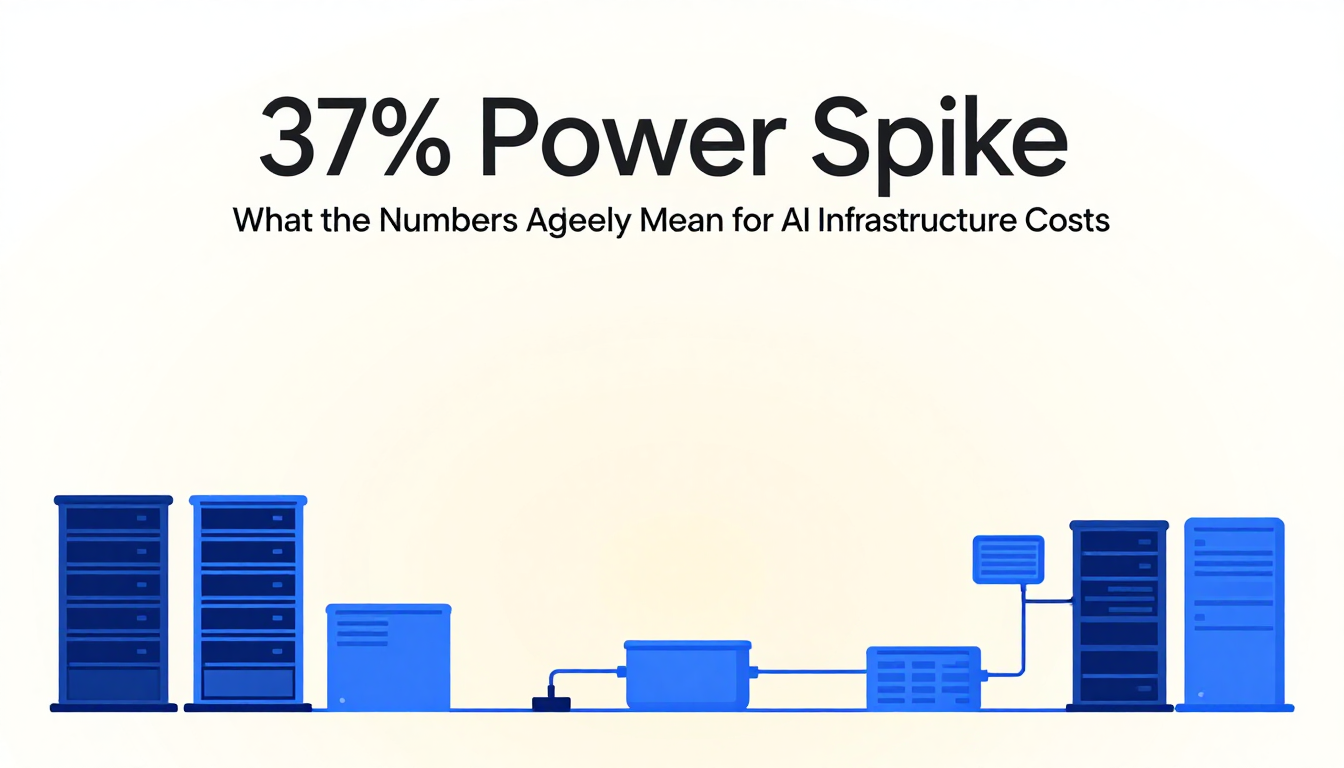
The Number That Should Keep You Up
Thirty-seven percent. That's not a typo, and it's not a projection either. Google reported that its annual electricity consumption rose by 37 percent in 2025 — the largest single-year increase in the company's history, and one that tells you everything you need to know about where AI infrastructure is heading.
I've been tracking GPU cluster economics for years now, and I can tell you this: nobody builds that kind of power demand without a reason. And the reason, as Ars Technica reported in July 2026, is AI infrastructure buildout. New data centers. Massive GPU clusters. The whole shebang.
Here's what most coverage misses: this isn't just a Google problem. It's an infrastructure economics problem, and the cost allocation implications are going to ripple through every multi-tenant cloud provider in the industry.
Why 37% Is Actually Terrifying
Let me put this in perspective. Google's been growing steadily for years — data center expansion, new regions, the usual hyperscaler playbook. But a 37% jump in a single year? That's not organic growth. That's something else entirely.
Think about it from a cost allocation standpoint. When you're running a multi-tenant AI cluster, electricity isn't just an operational expense — it's your primary cost driver. And when that cost driver spikes 37% year-over-year, suddenly your chargeback models look like they were designed for a different century.
The math is brutal. If you're allocating GPU cluster costs across teams based on historical power consumption patterns, and those patterns just got rewritten in a single fiscal year, you've got a problem. A big one.
I've seen teams get hit with 40% cost increases because someone deployed a new inference workload without updating the power model. Now imagine that scenario at Google's scale.
The AI Buildout Behind the Spike
So what's actually driving this? According to the reporting, it's AI infrastructure — specifically new data centers and GPU clusters dedicated to training and running large language models.
Here's the thing about AI workloads that most people don't understand: they're power-hungry in a way that traditional compute isn't. Training a single large model can consume more electricity than a small city uses in a year. And Google isn't just training models — they're running inference at scale, serving billions of queries daily through Gemini and other AI services.
The data center buildout required to support this isn't incremental. It's exponential. New facilities, new cooling systems, new power connections to the grid. And let me be clear: you can't just plug in more servers and call it a day. The electrical infrastructure has to keep up, or you've got thermal throttling, brownouts, or worse.
This is why I always tell clients: when you're planning AI infrastructure, start with the power budget. Not the GPU budget. The power budget.
What This Means for Cost Allocation
Let's get practical. If you're responsible for cost allocation in an organization running AI workloads, this news should change how you think about your models.
First, static power allocation is dead. If you're still using annual averages to allocate data center costs across teams, you're already behind. The volatility in AI workloads — training runs that spike for weeks, inference patterns that shift with product launches — means you need dynamic allocation models that can handle rapid change.
Second, you need to factor in the full power cost of AI, not just the GPU amortization. Too many organizations budget for hardware and forget about electricity until the bill arrives. With Google's 37% spike, that's exactly the kind of surprise that can blow a quarterly budget.
Third, and this is where it gets interesting: the cost allocation problem is going to force better visibility into AI workloads. You can't allocate what you can't measure. Organizations that haven't invested in granular power monitoring for their GPU clusters are going to face the same kind of cost surprises Google is reporting.
The Sustainability Question Nobody's Answering
I'll be honest — I don't have great answers for the sustainability angle here. Google's made commitments to operate on carbon-free energy 24/7 by 2030, and they've been investing heavily in renewable energy purchases. But a 37% increase in consumption is hard to reconcile with any sustainability narrative, no matter how aggressive your renewable procurement gets.
The industry needs to have this conversation. We're building AI systems that consume electricity at rates that strain local grids and challenge environmental commitments. That's not an anti-AI position — it's a reality check.
What I will say is this: the organizations that figure out how to allocate AI infrastructure costs transparently and efficiently are going to be better positioned to make sustainable choices. You can't optimize what you don't track, and you can't track power consumption without good cost allocation models.
It's a feedback loop, and right now we're stuck at the beginning.
The Bottom Line
Google's 37% electricity spike isn't just a headline. It's a signal flare from the future of AI infrastructure economics.
If you're building or running AI workloads, pay attention. Update your power models. Invest in granular monitoring. And for the love of everything, stop treating electricity as a fixed cost that you can allocate on autopilot.
The era of cheap, predictable AI compute power is over. Welcome to the new reality.