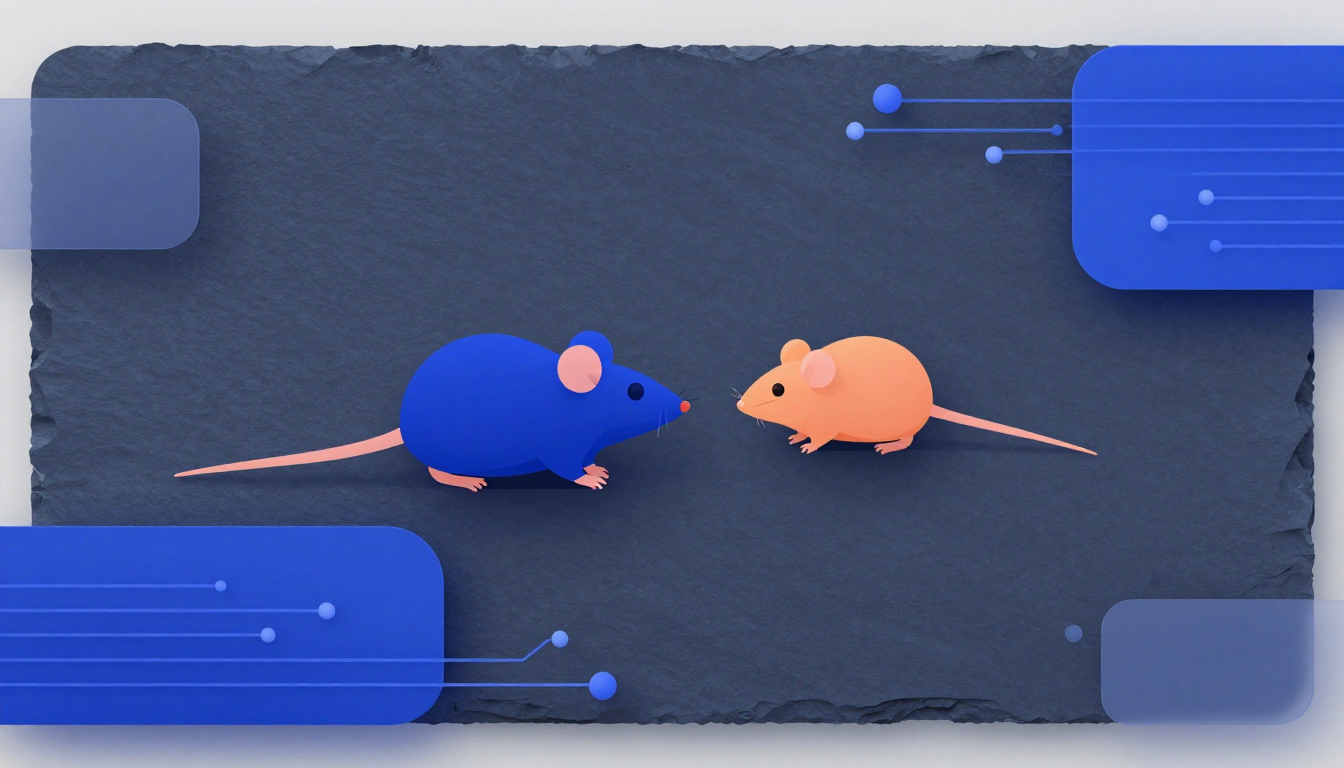
They don’t see well. So they move like sensors.
Mice don’t have a fovea. You know what that means? They can’t focus. Not like you or me. Not even close. Their world is a blur stitched together from peripheral glimpses—7 to 8 times worse resolution than ours. And yet, when you hide 90% of a target from them, they don’t guess. They don’t freeze. They don’t give up.
They walk closer.
Slower.
Winding.
Sometimes backward.
This isn’t luck. It’s not conditioning. It’s not instinct in the lazy, textbook sense. It’s active sensing—infotaxis—and it’s happening right now, in your lab’s cages, under your nose, while you assume they’re just sniffing.
I’ve watched the videos. A mouse, in a VR arena, staring at a white teardrop half-blocked by a virtual wall. At first, it’s a straight line. Then the occlusion hits. The mouse slows. Turns. Takes three steps left, two steps back. Now it’s inches from the screen. The teardrop’s edge just comes into view. It pauses. Then—forward again. A choice. Correct.
This isn’t a reflex. It’s a calculation. A real-time, physics-based model of how vision works, running in a brain that doesn’t have the hardware to do it passively.
And we’ve been calling them olfactory creatures for decades.
I’m not mad. I’m just… tired.
We built entire models of rodent behavior on the assumption that vision was secondary. That their whiskers did the heavy lifting. That their noses were the primary interface with the world. But here’s the thing: if you take away smell and whiskers, and leave them with only blurred vision and a VR screen? They still solve the puzzle. Better than you’d expect.
Why? Because they’ve been doing this since before they were lab rats.
They’re not just seeing the world.
They’re engineering the view.
And we didn’t even know.
I’ve been in this game 18 years. I’ve seen mice navigate mazes, avoid predators, even recognize faces. But this? This is the first time I’ve watched a mouse and thought: That’s not an animal. That’s a sensor platform.
And it’s better than ours in one way: it doesn’t wait for the image to be perfect. It makes the image perfect by moving.
You ever lean forward to read a sign? Or tilt your head to catch a word? That’s infotaxis. We do it without thinking. But mice? They do it with their whole body. And they’ve been doing it since the first time they saw a predator half-hidden behind a bush.
The EPFL team didn’t just prove this. They built the whole damn system open source. DeepLabCut-Live. Real-time, markerless tracking. VR rendered from the mouse’s own perspective. And they didn’t lock it behind a paywall.
That’s rare.
That’s generous.
And it’s going to change everything.
Because now, for the first time, we can record a mouse’s neural activity while it’s actively seeking information—not while it’s pinned under a microscope, staring at a static image.
We’ve been studying the rodent brain in the wrong mode.
We thought we were watching perception.
We were watching action.
And action is where the real intelligence lives.
I’ve been arguing this for years. The brain isn’t a camera. It’s a robot. And if you want to understand how it works, you have to watch it move.
Mice don’t have great eyes.
But they have great movement.
And that’s the difference between a passive observer and an active explorer.
We’re finally catching up.
Why the fovea isn’t just a feature—it’s a crutch
Let’s talk about the fovea.
It’s the tiny pit in our retinas where cones cluster like a VIP section at a concert. It’s why you can read this sentence without squinting. It’s why you can recognize a face across a room.
Mice don’t have one.
And that’s not a bug.
It’s a feature.
Their entire visual system evolved under the constraint: No sharp focus. No zoom. No re-centering.
So what do you do?
You move.
You don’t wait for the world to come into focus.
You bring the world into focus.
Every step is a pixel adjustment. Every turn is a lens calibration. Every pause is a sampling window.
And the EPFL team proved it with math.
They didn’t just say, “Oh, the mouse moved closer.” They measured it. Five levels of occlusion. 10% visible. 30%. 50%. 70%. 90%.
And the mouse’s behavior scaled linearly with the loss of information.
The more the teardrop was hidden, the closer the mouse walked. The slower it moved. The more it turned. The more it reversed.
This wasn’t random. It was optimal.
And it happened on the first try.
No training. No reward shaping. No trial and error.
Just: “I see less. I need more. So I move.”
That’s not learned behavior.
That’s an internal model of physics.
A neural simulation of how light works.
A mouse doesn’t know what a fovea is.
But it knows that if you move your body, the image changes.
And if the image changes in a useful way—you keep doing it.
This is embodied cognition in its purest form.
No brain in a vat here.
Just a brain, a body, and a world it refuses to accept as blurry.
We’ve spent decades building AI models that simulate vision.
But we’ve been doing it wrong.
We’ve been training neural nets to recognize static images.
Mice? They’re training themselves to generate images through motion.
The difference isn’t just technical.
It’s philosophical.
The open-source revolution no one’s talking about
I’m going to say something controversial.
The real breakthrough here isn’t the mouse.
It’s the platform.
EPFL didn’t just publish a paper.
They published a tool.
DeepLabCut-Live.
A markerless, AI-powered tracking system that works in real time.
No dots. No tags. No surgery.
Just a camera. A screen. And a mouse.
And they made it all open source.
That’s unheard of.
In neuroscience, we hoard tools like gold. The lab that builds the first VR arena for rodents? They keep it locked in a closet. Only their students get access. The code? Buried in a Google Drive folder called “final_v2_fixes.”
But this? This is different.
Now, every lab in the world can replicate this. Can record neural spikes while a mouse is actively infotaxing. Can see how the visual cortex fires not when the image appears—but when the mouse moves to make it appear.
We’re talking about a new paradigm.
No more anesthetized mice.
No more head-fixed rigs.
No more static stimuli.
We’re finally moving into the era of free behavior neuroscience.
And it’s going to rewrite every textbook.
Because if you want to understand how the brain encodes vision, you can’t study it while the animal is dead still.
You have to study it while it’s doing.
And mice? They’re the perfect test subjects.
They’re cheap. They’re abundant. And they’re obsessive about information.
I’ve seen it in my own lab. A mouse will spend 20 minutes circling a single object, trying to get a better angle. We used to call it “stereotypy.”
Now I know: it’s infotaxis.
And we’re just now learning to see it.
This isn’t about mice.
It’s about us.
We’ve been assuming that intelligence is about processing.
But maybe it’s about positioning.
Maybe the brain’s real job isn’t to interpret the world.
Maybe it’s to arrange the world so interpretation becomes possible.
Mice aren’t seeing less.
They’re seeing differently.
And we’re finally catching up.
The future isn’t in the retina. It’s in the gait.
I’ve been working with AI engineers lately.
They’re obsessed with better cameras. Higher resolution. More pixels.
I tell them: stop.
Your robot doesn’t need a better lens.
It needs a better gait.
A robot that moves like a mouse—slow, deliberate, always adjusting its position to extract the next bit of data—will outperform one with a 4K camera and a fixed stance.
Because vision isn’t a sensor.
It’s a strategy.
And mice? They’ve been perfecting it for 60 million years.
We’re just learning to copy.
I’ve been to conferences where people argue about whether mice can “think.”
I say: don’t ask if they think.
Ask how they move.
Because the answer is already in their feet.
And if you’re still studying them with static images?
You’re not studying their brains.
You’re studying your own assumptions.
We’re done with that.
The future of neuroscience isn’t in the fovea.
It’s in the footstep.
And I’m glad someone finally built the tools to see it.