The Consumer Pivot at Connect 2026
Meta's annual Connect event arrived with a distinct sense of whiplash this year. While the rest of the tech sector scrambles to build enterprise-grade coding tools and multi-million-dollar business models, CEO Mark Zuckerberg took a very different path. The company's new AI agent, Muse, dominated the spotlight, signaling that Facebook's parent company intends to push AI features into every corner of daily consumer life.
It was a head-spinning moment for industry watchers. As discussed on TechCrunch's Equity podcast, competitors like OpenAI and Anthropic are racing toward IPO horizons with a heavy emphasis on enterprise monetization. Their calculations are straightforward: AI is brutally expensive to run, and businesses are the most reliable source of revenue to fund it. That is the logic behind the trillion-dollar valuations orbiting OpenAI, Anthropic, and Elon Musk's xAI and SpaceX ventures.
So when Meta moved in the opposite direction—toward a consumer-first agent it pitches as "personal superintelligence," the kind of tool that brings AI "everywhere and all the time"—it read either as a canny bet or a dangerous distraction. The answer depends almost entirely on a question Meta has never fully answered: can people trust it that close?
Playing to Meta's Strengths: Glasses, Wearables, and the Tamagotchi Problem
There is a method to Meta's apparent contrarianism. As Equity's Kirsten Korosec noted, the consumer focus plays to the company's actual strengths rather than its ambitions. Meta is not starting from scratch in ambient AI; it has spent years quietly building out AI glasses, most prominently its partnership with EssilorLuxottica. Ray-Ban Meta glasses have sold in meaningful volume, and the company has pushed deeper into the category with products like Oakley Meta glasses. Those devices are already generating significant and fast-growing revenue.
Muse extends that trajectory. The agent can live on the glasses—tracking what you see and hear and acting on it—but it does not have to be tethered to eyewear. Meta also introduced a standalone, Tamagotchi-style companion that, the company insists, is for adults only. That deliberate framing is telling. It positions Muse less like a productivity tool and more like a presence: something you carry, talk to, and increasingly relate to.
That distinction matters, because a "cute companion" is exactly the territory where the most interesting, and the most uncomfortable, conversations about human-AI relationships happen.
Human-AI Relationships and Their Therapeutic Implications
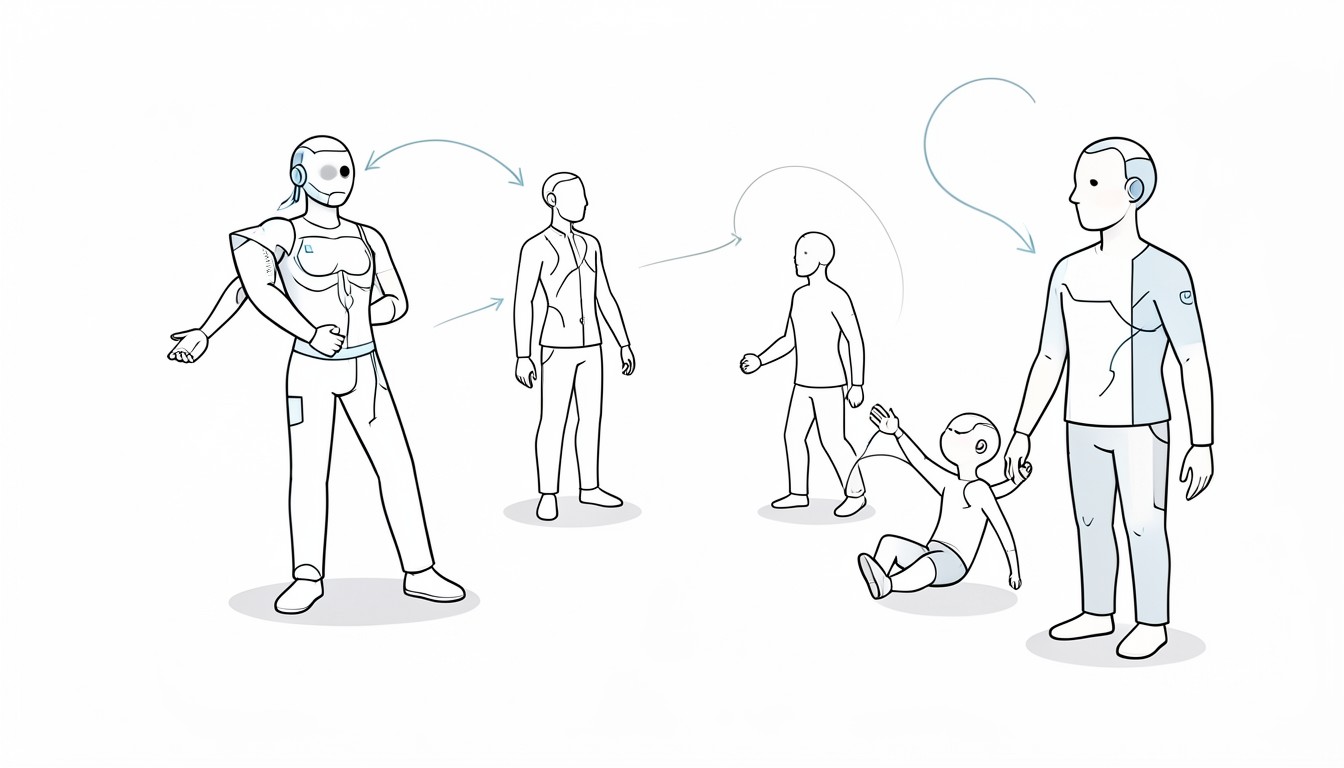
Muse lands in a crowded and contentious space: the rise of AI companions and chatbots that users treat almost as friends or therapists. On the Equity panel, the comparison to platforms like Character.AI came up almost immediately. Those services became commercially successful by offering continuous, intimate-feeling conversation, exactly the emotional texture that makes a companion agent feel indispensable rather than merely convenient.
This is where human-AI relationships and their therapeutic implications move from abstract to urgent. Companion-style agents promise constant availability, judgment-free listening, and a kind of rapport that no traditional app delivers. For some users, that closeness is the entire point. But it is also precisely the line that regulators, parents, and safety advocates have spent the last year arguing some platforms crossed with minors. Meta's insistence that its Tamagotchi-style device is "adults only" reads as an acknowledgment of that risk, a pre-emptive fence built around a product whose whole appeal is feeling personal.
The therapeutic framing cuts both ways. A device that tracks what you see and hear all day, then talks back to you, could in principle support genuine wellbeing: reminders, reframing, a steady hand at a hard hour. The same always-on intimacy, pointed the wrong way, is the "creepy" line the panel returned to again and again. Whether Muse reads as a helpful companion or an intrusion may depend less on the technology than on whether people believe its motives are aligned with theirs.
That belief, more than any feature, is the actual product Meta has to ship.
The Trust Gap: Ads, Data, and the Apple Comparison
Which brings us to the trust problem Muse cannot code away. The glasses use case, following a user around, recording what they see and hear, then acting on that data, is a privacy minefield on its face. The Equity panel also pointed to Meta's recent history with AI on its own apps, including incidents involving AI misbehaving on Instagram, as evidence that the company has not yet built a track record of calm, competent AI rollout.
The most pointed critique came from a comparison to Apple. The panel argued that Apple's "siri-ification" of AI, pushing ambient intelligence into its existing interfaces rather than inventing a new UI, has been effective precisely because people already trust Apple. Co-host Sean O'Kane put it plainly: with something as sensitive as an AI assistant that knows everything about you, he trusts Apple more, "not only from a cybersecurity perspective, but from the fact that its business is not to sell me a bunch of crappy ads."
The panel's rejoinder was blunt. Meta's business is to sell you ads. Yes, Meta will argue that the more it knows about you, the more accurate and useful its advertising becomes, hardly a reassuring framing for a device designed to feel like a confidant. As one host put it, "wake me up when we get to that fever dream."
What Has to Change
The contrast between the two business models frames the entire Muse bet. Apple's only consumer-AI lever, the panel observed, is money, charging more for premium AI features and subscription services. There are limits to how far that goes, and Apple's own AI rollout has been uneven. Meta, by contrast, already found its lever in glasses that sell and grow fast, plus an ad engine that converts attention directly into revenue. A companion that people let into their daily lives is, from that vantage point, the ultimate data and attention asset.
But a companion that feels therapeutic only works if the relationship feels reciprocal and safe, and a business model that profits from mining that intimacy is in structural tension with the trust those human-AI relationships require. Meta has the hardware distribution, the glasses revenue, and now a consumer agent with obvious charm on its side. What it has never had is the benefit of the doubt.
The strategic logic of Muse is coherent: play to your strengths, go where enterprise-focused rivals aren't, and put AI in as many daily moments as possible. The open question is the one the Equity discussion kept circling. The companies racing to build the most capable models are betting that usefulness will outpace caution. Meta's bet is more personal and more fragile, it needs people not just to find Muse useful, but to let it close. Until that trust gap closes, the company's ad-driven motives will stay the loudest voice in any human-AI relationship it tries to build.