
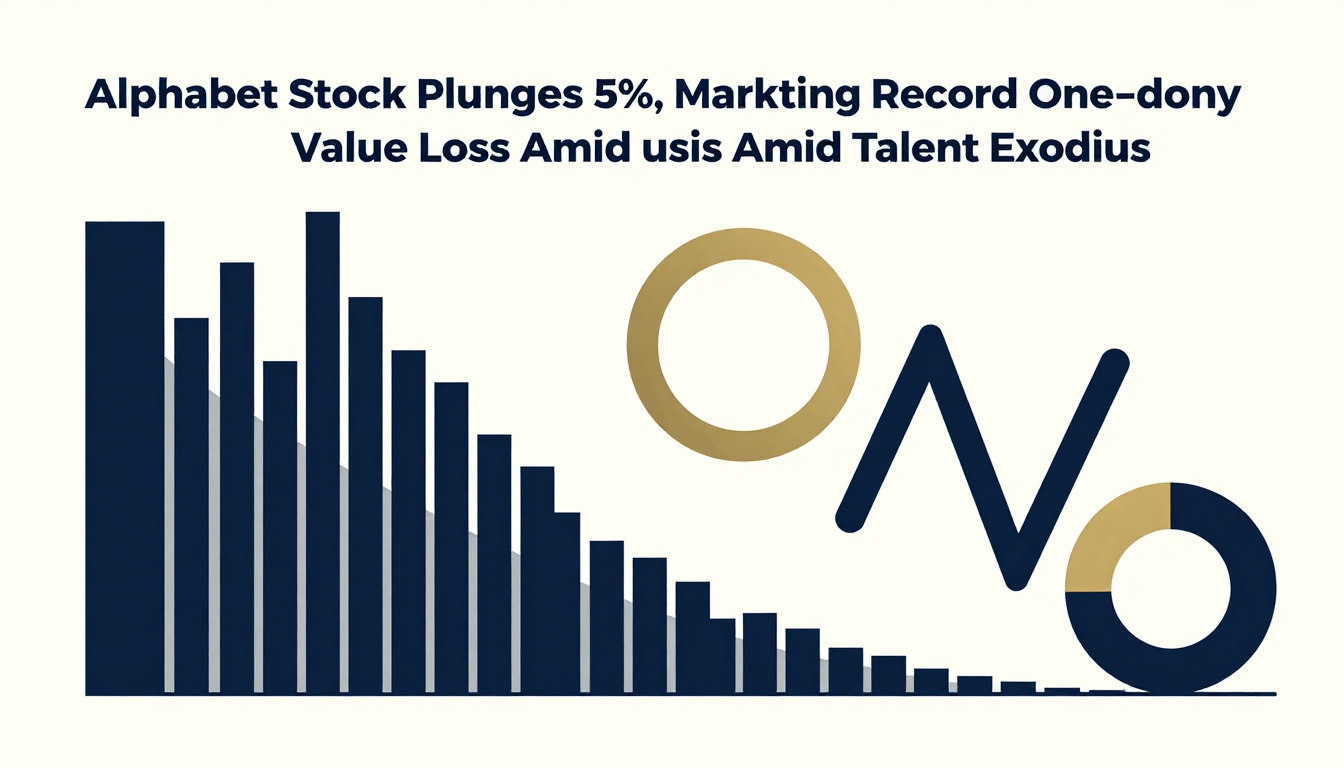
Inside the Bleed: Alphabet’s $115 Billion Wake-Up Call
On June 22, 2026, Alphabet lost over $115 billion in a single trading session. Let that sink in. A 5% drop in shares might look like a bad day on paper, but in reality, it's the largest single-day market value drop in the search giant's history, according to Dow Jones Market Data. The slide didn't happen in isolation, of course. It’s part of a broader revaluation hitting the entire technology sector, but for Google's parent, the pressure points are highly specific, structural, and deeply worrying for anyone looking at their long-term engineering pipeline.
Wall Street isn't just reacting to interest rates or macro noise here. They're looking at the core: the massive gap between what Google spends on premium AI talent and the actual shipping speed of stable, revenue-producing products. For years, Google's strategy has been simple. Hoard the smartest minds in neural networks, build massive data centers, and out-spend everyone else to ensure nobody eats their core search franchise. That strategy is breaking down. When we look at the trading action on Monday, the market wasn't just discounting cash flows; it was pricing in a crisis of faith in Alphabet's leadership.
I've watched this play out from the engineering side for over a decade. In technology research, you can't just buy your way to a moat anymore. The tools are too democratized, the open-source community is too fast, and the elite researchers are tired of fighting internal red tape to launch a feature. The market finally noticed. It’s a painful correction for a company that once felt invincible.
The scale of this loss is staggering. In absolute dollar terms, a $115 billion erase-out is larger than the total market capitalization of most Fortune 500 companies. It highlights a massive realignment in investor sentiment. The era of unconditional trust in corporate AI hype is closing. Shareholders are now demanding concrete results, and Alphabet, with its bloated overhead and stalling innovation pipeline, has become the poster child for this new, harsher phase of market scrutiny.

The Talent Flight: Why the Billion-Dollar Golden Handcuffs Failed
The real narrative of this drop isn't in the financial models. It's in the directory. Alphabet is experiencing an unprecedented exodus of the very researchers who built its modern AI capabilities. The market is reacting to names like John Jumper and Noam Shazeer. When the pioneers of AlphaFold and the Transformer architecture begin to check out or search for the exits, it sends shockwaves through the investment community because Google’s entire valuation relies on them winning the next decade.
It's no secret that Google spent billions clawing back talent. When they paid massive licensing fees to bring Shazeer back from Character.ai, it was a clear signal of desperation. It was a massive payoff for a single mind. But you can't build a sustainable engineering culture on astronomical, ad-hoc talent buybacks. It creates massive internal friction. The rank-and-file engineers who keep the core infrastructure running look at these nine-figure deals and wonder why they're working 70-hour weeks optimizing database queries for normal corporate salaries.
The culture is fraying at the edges. Elite researchers want to ship. They don't want to spend eighteen months in meetings coordinating with policy, safety, and legal departments just to release a minor update to an LLM. Startups like OpenAI and Anthropic have historically offered a direct line from code to production. Even with Google's massive infrastructure advantage, the friction of shipping has become too high. When John Jumper’s team or other key deep learning architects start looking at options outside Mountain View, investors realize that Google's talent moat is actually a sieve. It’s a classic case of diseconomies of scale. Google has the servers, but they're losing the programmers who know how to make them think.
And this talent hemorrhage isn't just about the heavy hitters who make the headlines. It’s a bottom-up crisis. Senior software engineers, staff systems architects, and critical database administrators are also quietly moving to nimbler competitors. They see the writing on the wall. When a company's primary focus shifts from engineering excellence to political firefighting and protective posture, the best builders leave first. This hollows out the technical engine that made Google what it is today, leaving a shell of administrative overhead that struggles to ship even basic updates without major delays.
The CapEx Reckoning and Market Correction
Let's put this sell-off in context. This isn't just about Google's internal HR problems. The entire tech space is hitting a wall. If you track the broader tech sector, you'll see a massive reassessment of AI valuations happening right now. We saw it play out last week with Tech Stocks Reassessing AI Valuation as Market Recoil Intensifies. The capital expenditure numbers are staggering. We are talking about tens of billions of dollars per quarter flowing directly into Nvidia GPUs and custom TPU clusters. And for what? Incremental improvements in search queries and corporate chatbots that don't move the needle on the bottom line.
Traders are running out of patience. They look at the pre-market action and see a sector that has overpromised and under-delivered on monetization. When the Nasdaq slides, it slides fast, as we saw in Tech Sell-Off Extends Into Tuesday as Inflation Focus Intensifies: Dow Gains, Nasdaq Slides 2.3% in Pre-Market. Alphabet is particularly vulnerable because its core business is search. If search becomes commoditized by conversational AI agents run by startups, Google’s massive ads margin goes down the drain.
The margin compression is real. Every conversational query costs ten times more to compute than a standard keyword search. So, Alphabet is in a double bind. They have to spend billions on infrastructure to keep up with the competition, but doing so actively damages their operating margins. That is a terrible business model, and the market is finally adjusting the premium it gives to Alphabet's stock. The 5% drop is a structural correction. The premium valuation it enjoyed for its monopoly cash flow is eroding because that monopoly is being attacked from multiple angles by agile competitors who don't have to protect a legacy print-money machine.
Add to this the macroeconomic backdrop of persistent inflation and hawkish Fed signals, and you have a perfect storm. Investors are no longer willing to underwrite indefinite speculative research. They want to see free cash flow yield now, not in some distant, hypothetical general intelligence future. When macro liquidity tightens, the first assets to get dumped are those priced on distant promises. That is exactly what we saw hit Google on Monday.
The Engineering Reality: Real-World Latency vs. Hype
Why is shipping so hard at a company with Google’s resources? As an engineering leader, I see the same pattern repeat itself across massive organizations. The system becomes too complex. There are too many legacy dependencies, too many layers of management, and too much focus on playing defense. When you have a cash cow like Google Search generating billions in high-margin revenue every single quarter, your primary incentive is not to break it. You become risk-averse.
This risk aversion is the death of AI innovation. Because AI systems are inherently probabilistic and unpredictable, they don't fit well into a corporate structure designed for deterministic, 99.999% uptime services. If a chatbot hallucinates a bad financial tip, the legal liability is massive. So the corporate immune system kicks in. It slows down deployment, demands endless reviews, and suffocates the project. Meanwhile, a startup with fifty engineers and nothing to lose ships three features a week.
This mismatch is driving the talent exodus. The best engineers don’t just want high salaries; they want to see their work in the wild. When they are blocked by internal bureaucracy, they check out. What we are seeing in Alphabet's record-breaking drop is the financial realization of this cultural rot. You can have the largest research lab in the world, but if your organizational structure prevents you from putting that research into production at scale, you might as well not have it at all. The market is starting to price Google not as an agile AI leader, but as a slow-moving utility. If they want to turn this around, they have to restructure how they build and ship. And they need to do it before the next talent cohort walks out the door.
At the end of the day, infrastructure is only as good as the software running on it. Alphabet can buy all the custom silicon it wants, but without a cohesive, product-oriented culture that empowers individual contributors, that hardware is just expensive heating for their data centers. To reverse this slide, Google has to stop burning its cash on defensive acquisitions and talent buybacks, and start dismantling the massive layers of middle management that stall every release. Until they do, Monday's record-breaking drop won't be an anomaly—it will be the new baseline.