Introduction: Divergent Paths in Brain Senescence
When we look at an aging brain, we’re often conditioned to view cognitive decline as a sliding scale—a simple matter of turning the volume down on mental sharpness as the years accumulate. But a landmark neuroimaging study published in Nature Neuroscience, led by researchers at Lund University including Jonathan Rittmo, Jacob W. Vogel, and Oskar Hansson, turns that simplistic model on its head. Examining over 1,000 individuals, the research team discovered something profound: functional brain connectivity doesn’t just fade uniformly. Instead, it reorganizes along fundamentally different trajectories in normal aging compared to the early stages of Alzheimer’s disease.
This isn’t just an academic distinction. For decades, clinicians have wrestled with the challenge of separating the everyday memory slips of senescence from the insidious onset of neurodegeneration—the core question behind any aging memory loss vs dementia discussion. This new work provides a rigorous map of how the brain’s large-scale communication networks actually shift under two completely different biological drivers.
Understanding What Is Normal Cognitive Aging
To make sense of pathological decline, we first have to ask: what is normal cognitive aging? At its core, cognitive aging describes the gradual, natural shifts in processing speed, working memory, and executive function that occur over a lifespan in the absence of neurological disease. It’s the familiar feeling of taking slightly longer to recall a name or juggle multiple complex tasks at once.
Biologically, normal senescence involves subtle adaptations across the brain's functional architecture. As our brains mature past middle age, certain executive control networks naturally adjust their coordination—regions that govern complex planning begin to blend their activity profiles, while peripheral sensory and motor networks maintain distinct differentiation. It’s an orderly, compensatory reorganization. The brain isn't failing; it’s adapting its wiring to maximize efficiency with the neural resources it retains.
By contrast, what is cognitive aging when complicated by pathology? As the Lund University study demonstrates, Alzheimer’s disease is not simply accelerated or exaggerated normal aging. It operates on an entirely separate topological axis.
Divergent Wiring Trajectories: Healthy Aging Versus Alzheimer’s
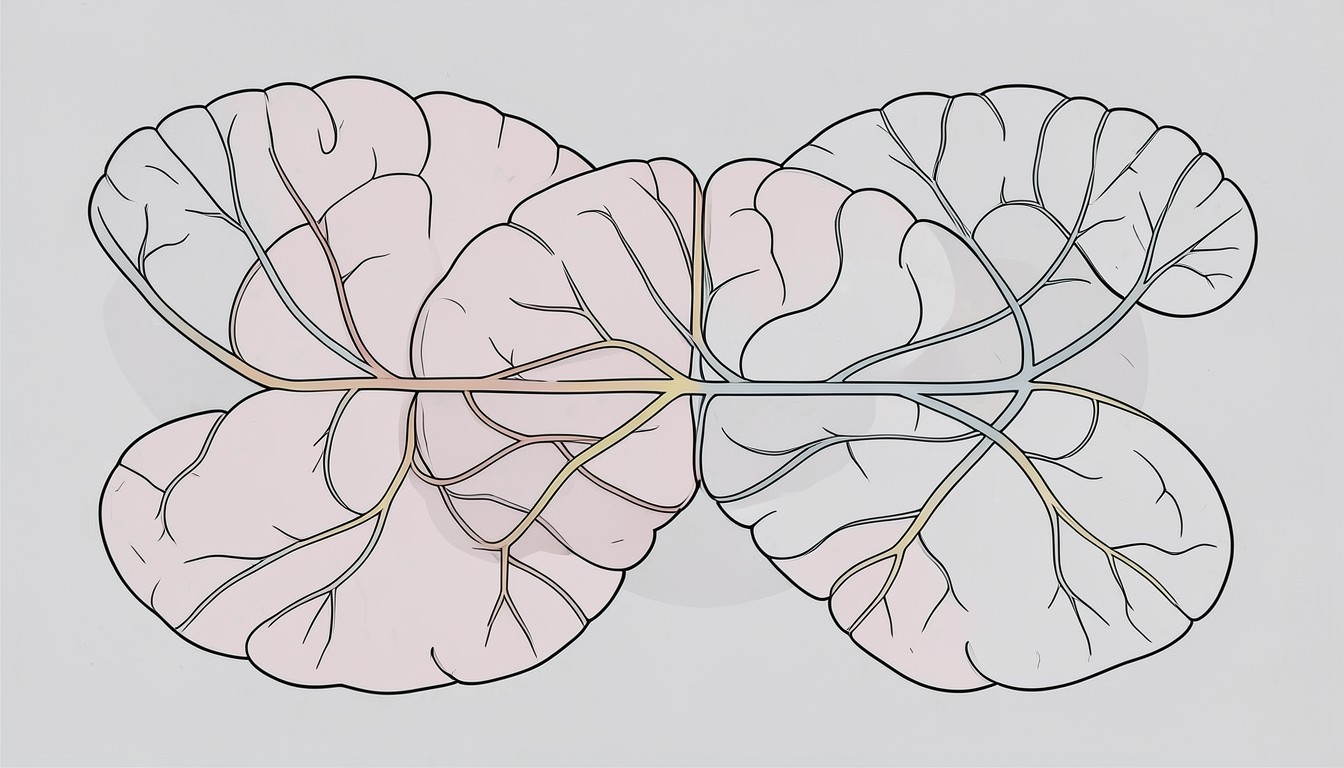
To capture these complex shifts, the Lund team analyzed whole-brain functional connectivity gradients across more than 1,000 participants. Think of the brain's functional architecture like a watercolor painting: certain hues are naturally distinct, while others blend smoothly together. As we age or develop pathology, those boundaries shift.
The study revealed a striking divergence in how those boundaries move:
- In Alzheimer’s Disease: Communication profiles become abnormally blended and homogenized among higher-order cortical regions involved in memory retrieval and introspective cognition. Meanwhile, primary sensory and motor networks pull apart, becoming hyper-segregated and rigidly distinct.
- In Normal Aging: The reorganization takes the opposite route. Executive functioning regions become more closely aligned in their activity profiles, while distinct, specialized patterns emerge across peripheral networks.
Most remarkably, these pathological connectivity shifts were detected in cognitively unimpaired individuals who showed very low levels of classical biomarkers, long before any macroscopic cortical atrophy or brain shrinkage appeared. Long before a patient forgets where they left their keys, their brain's communication highways are already shifting onto a distinct, pathological gradient.
Beyond Plaques and Tangles: Why Network Topology Matters
For generations, Alzheimer’s research has been dominated by the amyloid cascade hypothesis—the idea that the extracellular accumulation of amyloid-beta plaques and intracellular neurofibrillary tau tangles are the primary culprits behind cognitive failure. While these misfolded proteins undoubtedly initiate cellular toxicity, the Lund study uncovered a surprising twist.
When the researchers examined participants experiencing active cognitive decline, they found that whole-brain functional connectivity patterns correlated more strongly with actual cognitive performance than the physical burden of amyloid-beta or tau proteins. In other words, while plaques and tangles provide the toxic spark, the resulting disruption of large-scale communication channels appears to be the proximate driver of clinical memory loss.
When neural networks lose their coordinated timing and integrative capacity, cognition stumbles—regardless of how many plaques are sitting in the parenchyma. This shifts our theoretical framework: neurodegeneration is fundamentally a network disconnection syndrome.
How to Maintain Cognitive Health in Older Age
Understanding that brain wiring follows distinct trajectories raises an urgent, practical question for older adults and clinicians alike: how to maintain cognitive health in older age?
While we cannot yet completely halt biological aging or intercept nascent Alzheimer's pathways at will, we know that brain network topology is surprisingly malleable. Functional signaling can be modulated through targeted interventions. Here is what current clinical evidence supports for preserving cognitive resilience:
- Cardiovascular and Metabolic Management: Vascular health directly supports neural connectivity. Managing blood pressure, metabolic markers, and systemic inflammation protects the white matter tracts that allow distant brain regions to communicate efficiently. (For further reading on metabolic intersections, explore our analysis on metabolic risk and cognitive health.)
- Cognitive and Social Stimulation: Engaging in novel, cognitively demanding tasks encourages compensatory neural recruitment and helps maintain executive network flexibility. Lifelong learning isn't just a cliché; it builds cognitive reserve, one of the protective strategies we examine in our guide to building resilience against Alzheimer's disease.
- Physical Exercise: Aerobic activity stimulates neurogenesis in the hippocampus and improves cerebral blood flow, directly countering the structural decay associated with both aging and early neurodegeneration.
- Emerging Neuromodulation: Because large-scale functional networks are biologically tunable, researchers are actively investigating non-invasive brain stimulation techniques—such as transcranial magnetic or electrical stimulation—as future therapeutic avenues to counteract harmful system-level stress and realign aberrant connectivity gradients.
The transition from normal senescence to neurodegeneration is complex, but mapping these divergent pathways gives us a clearer compass than ever before. By looking beyond simple protein clumps to the grand architecture of brain connectivity, neurology is entering an era where we can finally distinguish normal aging from early pathology—and intervene before memory slips away.