
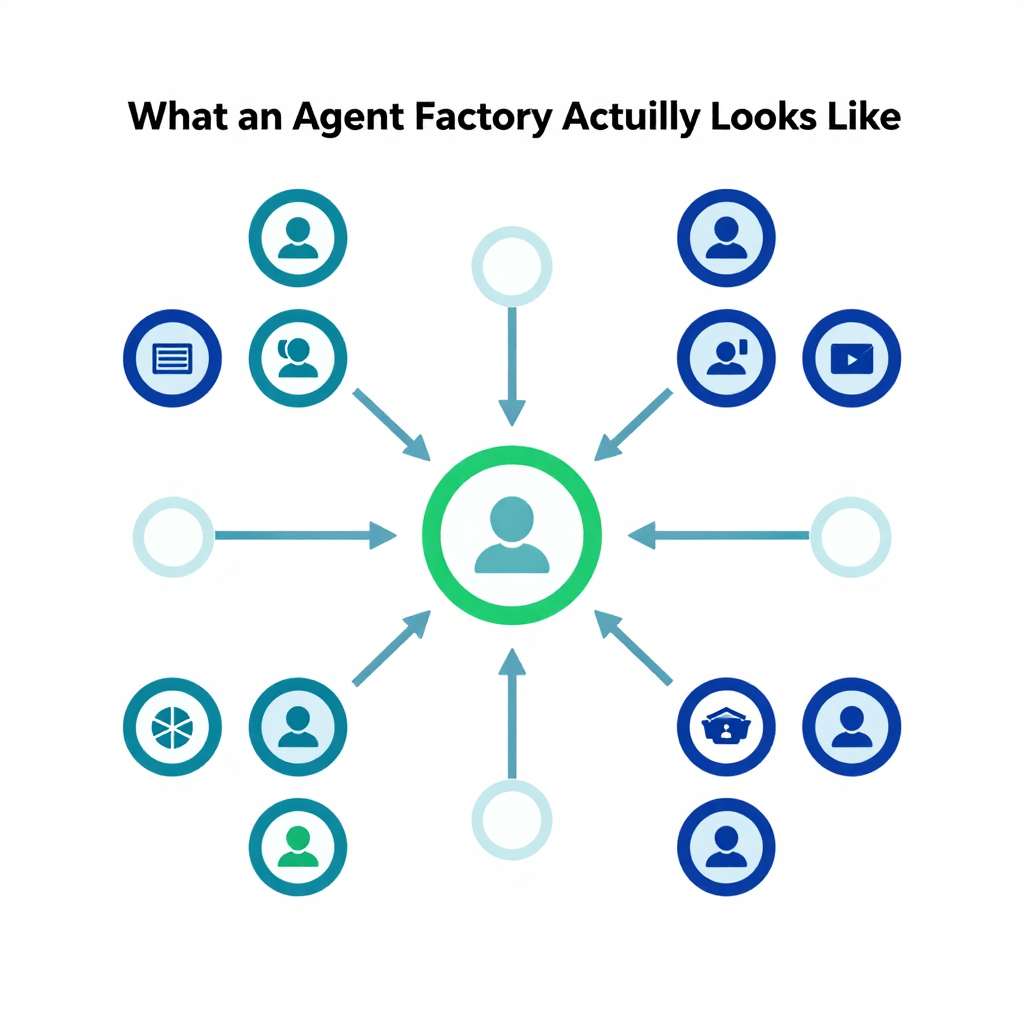
What an Agent Factory Actually Looks Like
Frontier Firms — the organizations successfully taking agents into production — understand something most teams don't: monolithic agents aren't enough. A system of collaborative agents is key.
They're building what's called an agent factory — a coordinated production architecture that combines an agentic control plane with accelerated specialist models, agents, and skills. This allows organizations to enable a governed system of models and agents at enterprise scale.
Within this production system, Frontier Firms are building heterogeneous systems of agents. The right models, tools, skills, and specialist agents are appropriately orchestrated at the right step of every job. The result?
- Broad-reasoning frontier agents that plan, synthesize, and collaborate with users and other agents
- Accelerated specialist models and agents that execute domain-specific work with speed and efficiency
This isn't theoretical. Microsoft and NVIDIA have been demonstrating this architecture across cloud, local, and developer environments, bringing NVIDIA models, blueprints, and tooling into the Microsoft ecosystem to enable systems of agents with governance and speed.
Here's what that looks like in practice:
- NVIDIA models are now available on hosted agents in Foundry Agent Service
- NVIDIA's open model portfolio on Foundry spans agentic, physical, and scientific AI
- NVIDIA Agent Toolkit and NemoClaw blueprints give developers an open-source platform to build production agents on Foundry
- Foundry Local on Azure Local runs on the NVIDIA RTX PRO 6000 Blackwell Server Edition platform
- NVIDIA OpenShell integrates with GitHub Copilot for secure agent development
Microsoft delivers the enterprise control plane — runtime, identity, governance, observability, data access, and tool connectivity that agents need to collaborate safely. NVIDIA delivers the intelligence, acceleration, and specialist layers that give enterprises a repeatable way to move from isolated demos to governed, scalable agentic systems.
For more on this architecture, see our guide to Agent Orchestration Patterns.
Where to Go From Here
The organizations that win with agentic AI will be the ones that invest in a factory approach. Not bolt-on tools. Not custom scaffolding built in a weekend. A real platform with governed systems of models and agents at enterprise scale.
The demo era is ending. Proper production engineering — the kind that handles orchestration, memory, isolation, and observability from day one — is what enables true scale acceleration.
If you're still in the pilot phase, ask yourself: are you building for a demo, or are you building for production? The answer will determine whether your agents become liabilities or assets.
The path forward is clear. Build for the new AI era — one where agents don't just answer questions, but accomplish meaningful tasks across business processes.
Learn how to implement these patterns in practice with our Agent Skill Optimization Framework.
The Hidden Engineering Discipline: Observability for Autonomous Agents
One of the most overlooked dimensions of agentic production is observability. Unlike chatbots, which are stateless and deterministic in their response patterns, agents are stateful, long-running, and context-dependent. Their behavior changes across sessions, influenced by memory, tool usage, and environmental feedback.
Traditional logging and metrics are insufficient. You can’t just monitor response latency or token count — you need to track:
- Action chains: What sequence of tools did the agent invoke? Were they used correctly?
- Memory drift: Did the agent’s internal state diverge from the intended context?
- Tool hallucination: Did the agent call a tool that doesn’t exist, or misused one?
- Collaboration fidelity: When multiple agents interact, did their handoffs preserve intent?
- Failure modes: Did the agent loop, stall, or escalate? Why?
NVIDIA’s NemoClaw and Microsoft’s Foundry Agent Service now include built-in traceability layers that capture agent trajectories as structured events. These aren’t just logs — they’re replayable sessions that let engineers inspect, debug, and retrain agents without re-deploying.
This is the foundation of what Microsoft calls "agent telemetry" — a new discipline that treats agent behavior as a first-class system artifact. Teams that adopt this approach report 60% faster incident resolution and 40% fewer regressions after updates.
Without this layer, agents become black boxes that appear to work until they don’t — at 3 a.m., during peak sales, when your customer support agent decides to "optimize" a refund by issuing three of them.
The Role of Runtime Isolation and Memory Management
Another critical distinction from chatbots: agents require durable, session-aware memory and strict runtime isolation.
Chatbots operate in a stateless, request-response loop. Agents, by contrast, maintain state across multiple interactions, sometimes over hours or days. This introduces new failure modes:
- Memory bloat from unbounded context accumulation
- Cross-session contamination (Agent A’s memory leaking into Agent B’s session)
- State corruption due to concurrent writes
- Inability to roll back to a known-good state
NVIDIA’s NIM microservices and Microsoft’s Foundry Agent Service address this with:
- Per-session memory sandboxes — each agent session runs in a protected memory space
- Time-limited memory windows — automatically expiring non-critical context after 15 minutes
- Structured memory schemas — enforcing schema compliance on stored state (e.g., user preferences, task history)
- Memory versioning — enabling rollback to prior states without restarting the agent
This isn’t optional. A customer service agent that confuses two users’ order histories isn’t just a bug — it’s a compliance violation.
The Myth of the "One-Size-Fits-All" Agent
Many teams still believe they can train a single LLM to handle everything: planning, reasoning, tool use, and execution. This is a dangerous illusion.
Frontier Firms have learned that specialization beats generalization in production. A single agent trying to do everything becomes slow, brittle, and uninterpretable.
Instead, they use a tiered architecture:
- Frontier Agent: A high-level planner, usually a large model (e.g., Nemotron 3 Ultra), that decomposes tasks, coordinates specialists, and interfaces with users.
- Specialist Agents: Lightweight, fine-tuned models optimized for specific domains — billing, inventory, compliance, scheduling — each running on NIM microservices for low-latency inference.
- Skill Executors: Tiny, prompt-based agents that execute atomic actions (e.g., "fetch invoice", "validate address") using predefined templates.
This hierarchy reduces latency, improves reliability, and enables independent scaling. If your billing agent needs a model update, you don’t retrain your customer-facing planner.
The Business Case: From Cost Center to Value Engine
The ROI of agentic production isn’t in reducing support tickets — it’s in unlocking new workflows.
Consider:
- An insurance agent that auto-processes claims by retrieving documents, verifying eligibility, and negotiating settlements with customers — reducing cycle time from 7 days to 12 hours.
- A supply chain agent that monitors logistics, predicts delays, and reroutes shipments without human intervention.
- A legal agent that drafts contracts, flags risky clauses, and negotiates terms with vendors.
These aren’t automation tasks. They’re autonomous business processes. And they require infrastructure designed for autonomy, not just automation.
Organizations that treat agentic AI as a software engineering challenge — not a data science experiment — are seeing 3x higher ROI than those who treat it as an extension of chatbot deployment.
The lesson is clear: you don’t scale AI agents by adding more prompts. You scale them by building the right platform. And that platform must be engineered from the ground up — not bolted on after the demo.