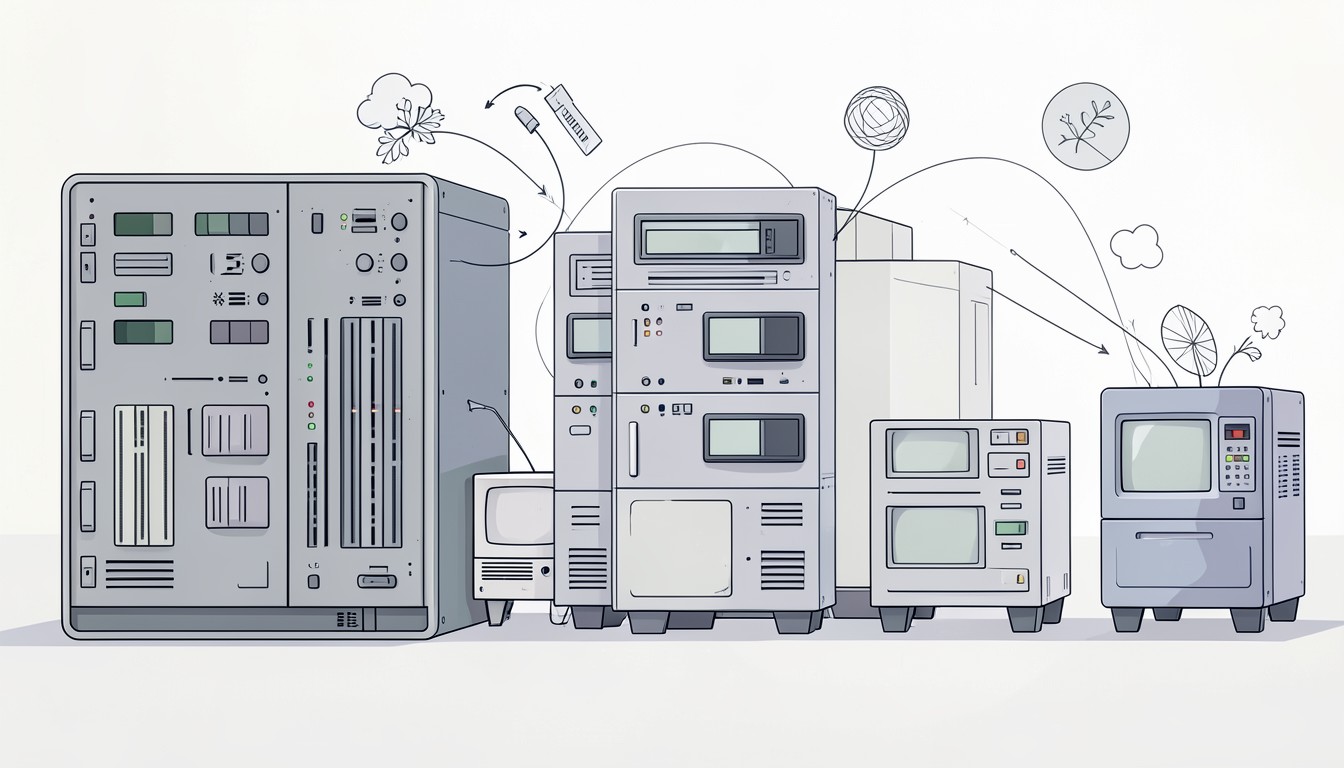
The Three Great Waves of Computing History
History rarely moves in straight lines, but computing neatly splits into three distinct chapters. Mainframes, minicomputers, and microcomputers each solved different economic and technical bottlenecks. If you look closely at how iron gave way to chips, you see a constant tug-of-war between centralization and individual control.
We take instant processing power for granted today. Yet every phone in our pockets rests directly on decades of hardware evolution that started in glass-walled rooms humming with magnetic tape drives. Understanding this progression isn't just about dusty machinery. It explains why software architectures, multi-user permissions, and distributed cloud topologies look the way they do right now.
Mainframes and the Era of Centralized Iron
In the beginning, computing meant mainframes. These massive, air-conditioned behemoths dominated enterprise and scientific data processing through the 1950s and 1960s. Companies didn't buy computers casually. They leased room-sized systems from IBM and a handful of other giants, feeding them stacks of punched cards and waiting hours for batch jobs to finish.
The economics were brutal. Hardware cost millions, requiring a dedicated priesthood of operators, systems programmers, and keypunch staff. Users didn't sit at terminals interacting with code in real time. You dropped off your deck of cards at a counter, prayed there were no syntax errors in column 72, and came back tomorrow for your green-bar printout.
Yet these iron giants built the modern corporate backbone. Banks, insurance firms, and government agencies learned how to process millions of transactions reliably. Mainframes proved that electronic data processing could scale, even if accessibility was restricted to a chosen few with white lab coats and strict access badges. Standard architectures like the IBM System/360 introduced backward compatibility, ensuring that software investments survived hardware upgrades—a vital lesson for enterprise IT that persists to this day.
Minicomputers as the Radical Middle Ground
By the mid-1960s, the cracks in total centralization started showing. Laboratories, university departments, and mid-sized engineering firms needed computing power, but they couldn't justify a multimillion-dollar mainframe or wait weeks for centralized approval. Enter the minicomputer.
Priced in the tens of thousands rather than millions, minicomputers fit into standard office corners or equipment racks without requiring specialized raised flooring or industrial cooling units. Machines like Digital Equipment Corporation's PDP series revolutionized engineering and scientific research. Organizations like the Computer History Museum preserve artifacts from this vibrant era, documenting how robust minicomputers moved beyond academic labs into grueling commercial environments.
Minicomputers acted as the bridge between isolated batch processing and interactive, departmental computing. They introduced timesharing, letting multiple users tap into a single machine simultaneously through teletype terminals. Engineers could write code, test hypotheses, and control laboratory equipment in real time. This decentralization broke open new markets, turning computing into an active, conversational tool rather than a distant overnight batch service.
Industrial Automation and System Integration
The true versatility of the minicomputer era is best seen in specialized industrial applications. Companies that began in entirely unrelated fields recognized that compact, reliable processors could transform physical infrastructure.
For instance, European industrial firms such as Krantz—originally century-old manufacturers of textile equipment—established specialized electronic subsidiaries to build computer systems for automating manufacturing plants and monitoring large buildings. When acquired by U.S. minicomputer maker Varian in the 1976 era, these systems demonstrated how minicomputers functioned as embedded operational brains.
In cooperation with partners like Autophon, minicomputers powered complex information display systems for major transportation hubs and financial exchanges. The Frankfurt Airport, one of the world’s busiest aviation centers, deployed Krantz Mulby modular computer systems in 1979 for real-time flight information display and passenger announcements. Because these machines were designed for system integrators who bundled engineering and consulting services directly with the hardware, they were deployed everywhere from factory floor machine tool control to building automation.
Manufacturing these systems required innovative engineering methodologies. Companies often outsourced heavy fabrication while focusing rigorous in-house efforts on assembly, electrical testing, environmental stress screening, and software verification before shipment. This ensured high reliability in harsh environments where a system failure meant halted assembly lines or stranded travelers.
Microcomputers and the Personal Revolution
Even minicomputers, despite their smaller footprint and departmental accessibility, remained out of reach for everyday consumers, small businesses, and cash-strapped classrooms. The true democratization arrived with the microcomputer. Driven by the invention of the microprocessor—putting an entire central processing unit on a single silicon chip—devices suddenly became small enough, cheap enough, and reliable enough for regular people.
The shift from multi-user iron to personal silicon happened with dizzying speed in the late 1970s and early 1980s. Hobbyist kits turned into polished appliances equipped with integrated keyboards, cathode-ray tube monitors, and floppy disk drives. Suddenly, accounting departments, local print shops, and teenagers in suburban garages had direct access to computational muscle that would have stunned mainframe operators twenty years prior.
This era spawned software ecosystems completely from scratch. Spreadsheets like VisiCalc, word processors, and relational database tools turned the microcomputer from a geeky curiosity into an indispensable business tool. More importantly, it shifted power permanently to the edge. Users didn't ask permission from a corporate IT department to run a script or analyze data. They just turned on the machine and got to work.
What the Evolution Teaches Us Today
Looking back across mainframes, minicomputers, and microcomputers reveals a cyclical rhythm in technology. We centralized into massive mainframes, decentralized into departmental minicomputers, distributed further into personal microcomputers, and then—ironically—centralized much of our workloads back into massive cloud data centers.
Yet the lessons of each era endure. Mainframes taught us ironclad reliability, transactional integrity, and enterprise scale. Minicomputers showed the immense value of interactive, real-time response, system integration, and departmental autonomy. Microcomputers proved that when you put tools directly into the hands of end users, human creativity explodes in ways no central planner could ever predict.
The hardware changes every decade, but the fundamental tension remains. Every new wave asks the same old question: who controls the machine, and what can they build with it?