What Meta Sarpy Actually Is
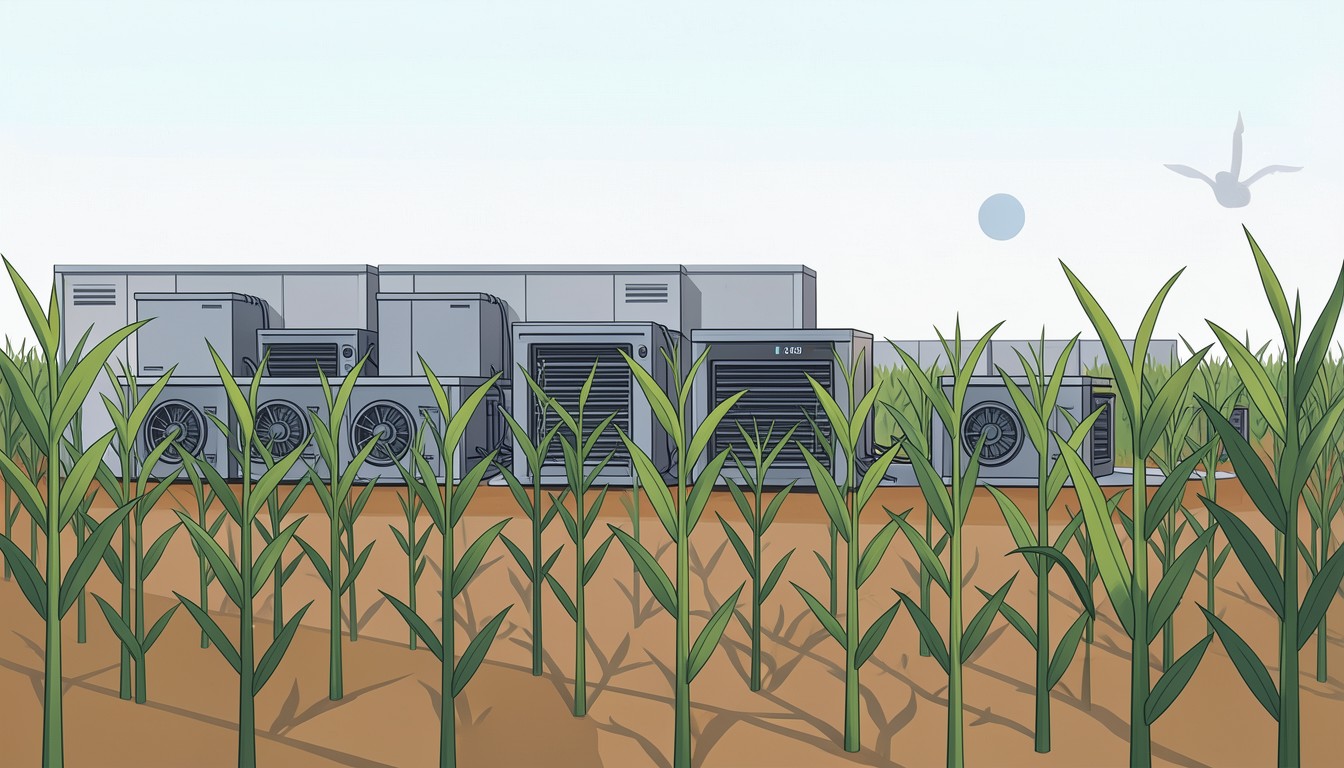
A data center in Springfield, Nebraska doesn't sound like the frontier of artificial intelligence. No glass towers. No Silicon Valley address. Just 146 acres off Nebraska Highway 50 and Capehart Road, surrounded by corn that was there long before the GPU racks arrived.
But Meta Sarpy — the site Meta built for Facebook back when the company still went by that name — has become one of the more interesting data points in the global AI infrastructure race. According to Epoch AI's data center directory, the facility is now operational as an AI data center with chips owned and used by Meta, hosting an estimated 92,000 H100-equivalents of AI compute, supported by 80 MW of IT power, at a capital cost of roughly $3.0 billion.
Those numbers are estimates. I want to be upfront about that before we go further. Epoch AI publishes them clearly labeled as such on their directory page, last updated October 2, 2026. But they're the best public-facing figures we have for a site Meta has never publicly broken out in its earnings calls or infrastructure disclosures.
The Physical Reality Behind the Numbers
Meta owns the building. Construction started in 2018. The first data center came online in 2019. That's not ancient history, but it predates the generative AI explosion that turned every hyperscaler's capacity plan into a frantic scramble.
The original plan was modest by today's standards: two 450,000-square-foot data center buildings plus a 70,000-square-foot administrative building, totaling around 970,000 square feet of enclosed space. Meta has since announced an expansion that will bring the entire complex to 2.6 million square feet. That's nearly a tripling. The utility providers are Omaha Public Power District and Enel Green Power North America — the latter supplying renewable energy under a rate structure OPPD specifically adopted so the data center could run on 100% clean power.
I find the renewable angle genuinely interesting here. Meta's public rationale for choosing the Omaha area cited access to clean power as a key factor. That was a pre-ChatGPT decision, made when the primary workload was still social media serving, not LLM training runs that can burn through megawatts for weeks without blinking.
Reading the 92k Figure Correctly
"92,000 H100-equivalents" is not a GPU count. It's a compute-equivalence estimate — a normalized unit that lets you compare heterogeneous clusters. A site running a mix of H100s, H200s, A100s, and whatever else Meta has deployed gets collapsed into a single number that represents total floating-point throughput relative to a single H100 as the baseline.
This distinction matters because people read "92k H100s" and picture 92,000 physical cards sitting in rows. The reality could be fewer newer cards with higher throughput, or more older cards with lower throughput, landing at the same equivalence. Epoch AI's methodology for these estimates involves analyzing public signals — power allocations, building footprints, chip shipment data, supply chain intelligence — and then modeling the likely hardware mix. It's educated inference, not a facility audit.
The 80 MW of IT power is the more directly measurable figure. IT power refers to the electricity actually consumed by the computing equipment itself (servers, networking, storage), as distinct from the total facility power that includes cooling and overhead. At current typical power usage effectiveness ratios for a well-designed modern facility, total facility draw would be somewhat higher.
The $3 Billion Question
Epoch AI's $3.0 billion capital cost estimate for Meta Sarpy covers the full buildout — land, shell, power infrastructure, cooling, and the chips themselves. That's a number that sounds enormous until you remember what a single large-scale LLM training run costs in compute alone. Meta's Llama 3 405B model reportedly trained on 30,000+ H100s. Sarpy's estimated 92k H100-equivalents means the site could theoretically support multiple frontier-scale training efforts simultaneously, or absorb a single massive one with headroom for inference serving.
The capital cost includes the original Facebook-era buildout plus the AI-specific retrofits and expansions. Meta is famously tight-lipped about per-site breakdowns, so this is Epoch's model-derived figure rather than a disclosed number.
Why This Site Matters Beyond Meta's Balance Sheet
A single data center hosting 92,000 H100-equivalents of compute puts Meta Sarpy in the conversation with the largest known AI training facilities on Earth. When you're comparing sites at this scale, you're looking at xAI's Colossus cluster in Memphis, Microsoft's various Azure AI deployments, and Google's TPU pods. Meta Sarpy sits in that tier.
The Nebraska location is a deliberate strategic choice. Cheap land. Proximity to wind generation capacity in the Midwest. A utility provider willing to build custom rate structures for a single massive customer. Rural communities with available grid interconnect points. And crucially — distance from the coastal power constraints and supply chain bottlenecks that plague Virginia, Oregon, and the other traditional data center hubs.
This is what hyperscaler infrastructure looks like when it's not making headlines. No ribbon-cutting. No keynote announcement. Just a quietly operational site in a town you've never heard of, computing gradients for the next version of a model that will probably ship with a name you'll see everywhere.
The Measurement Gap
Epoch AI's data center explorer is a public good. It fills an information void that companies like Meta have no incentive to address — Meta benefits from opacity around capacity because it makes competitor planning harder and negotiating leverage better. Epoch's team builds estimates from the outside, publishes methodology, updates as new signals emerge, and labels every figure with its uncertainty properties.
The scaling announcement from September 2026 signals they're expanding coverage to more sites and countries with a redesigned interface. That's encouraging for anyone tracking AI infrastructure as a geopolitical or economic phenomenon. The more sites get public estimates attached, the harder it becomes for any single company to claim they're "in the lead" on AI compute without anyone being able to check.
Meta Sarpy doesn't need to be the biggest site to be meaningful. It just needs to be one of the places where the real work happens, quietly, in Springfield, Nebraska.