
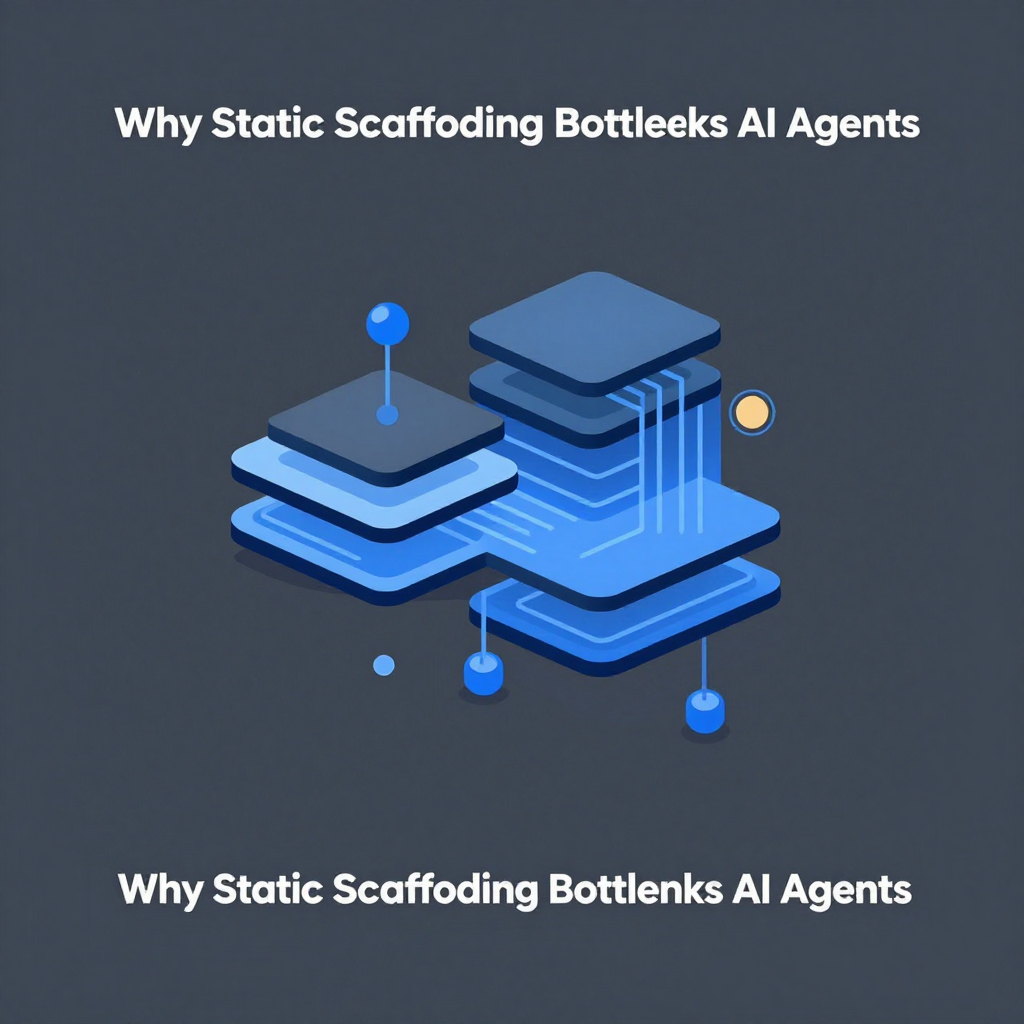
Why Static Scaffolding Bottlenecks AI Agents
When we write compilers, we design systems that translate rigid logic into dynamic, optimized executable paths. Yet when we build AI agents today, we do the exact opposite. We wrap large language models in brittle, static Python frameworks and pray that nothing breaks during runtime. It doesn't work. The second an agent encounters an edge case—an unexpected API payload schema, a flaky tool response, or a minor shift in prompt instructions—the entire execution loop halts.
This static bottleneck isn't just annoying; it is a fundamental flaw in architectural design. Traditional scaffolding operates under the assumption that the environment is deterministic. It assumes the LLM's response patterns will always conform to the structures we hard-code in our system prompts. But they don't. In production, real-world data is messy, and models drift. When the wrapper code cannot adapt to the actual runtime behavior of the executing model, you get parsing failures, failed tool calls, and crashed pipelines.
According to a recent VentureBeat Report, Xiaomi has introduced a novel runtime orchestration framework called HarnessX. Unlike legacy orchestration layers, HarnessX allows AI agents to dynamically rewrite their own scaffolding code mid-task. In preliminary benchmarks, this runtime adaptability delivered a +14.5% average performance increase across general tasks. Even more striking is the effect on compact models under 10B parameters, which experienced a +44% surge in performance.
Anatomy of an Agent Harness: The Legacy Pattern
To understand why mid-execution rewriting works, we have to look at the anatomy of an agent harness. As defined by the LangChain Technical Blog, the harness is the software infrastructure surrounding the base LLM. It is the outer layer that handles:
- Tool connectors (API clients, database drivers, web fetchers).
- Input/output parsers (converting JSON, regex patterns, or XML back and forth).
- System templates and state-tracking mechanisms.
In standard architectures, this wrapper is a compiled or interpreted set of rigid code paths. If a tool returns a slightly different JSON structure than expected, the parser throws a validation error. The database query fails, and the agent gets stuck in a loop trying to retry the exact same failing transaction. The LLM itself might know how to solve the problem, but it is trapped inside a cage of static Python classes.
As software developers, we've seen this before. It is the classic tight coupling problem. When the execution environment or data format changes, the handler must adapt. If the handler is static, the system crashes. In agent orchestration, treating the harness as immutable is like compiling code for a target CPU that can change its register layout mid-cycle. It is an engineering mismatch.

HarnessX: Mid-Execution Code Rewriting in Action
HarnessX addresses this mismatch by treating the agent wrapper as mutable code that can be refactored side-by-side with executing inference steps. Instead of treating parser components and prompt templates as static configurations, it runs an active optimizer loop alongside the agent's main execution thread.
The technical architecture, as detailed in a preprint on the Cornell University arXiv Preprint Hub, relies on tracking model confidence and token probabilities at runtime. When the agent is making API requests or reasoning through a multi-step task, HarnessX monitors details like output distributions and token probability drops. If it detects a spike in parsing exceptions or a sudden drop in LLM confidence, the orchestrator intervenes.
Importantly, it doesn't just prompt the model to "try again." Instead, it dynamically rewrites the harness structure itself. For example, if the model struggling with a tool output begins emitting nested lists instead of flat structures, HarnessX refactors the parser code to map to the new distribution. It rewrites system definitions, updates tool schemas, and adjusts input parameters on the fly, tailoring its environment to the LLM's active state. The runtime acts like an inline compiler, constantly recompiling the middleware to match the model's actual performance patterns.
The +44% Surge: Why Under-10B Models Win Big
The +14.5% overall gain is impressive, but the +44% performance increase for models under 10 billion parameters is where things get interesting. Why do smaller models benefit so disproportionately from HarnessX?
From my perspective as a low-level engineer, the answer is about cognitive margin and representation space. Frontier models like GPT-4 or Claude 3.5 Sonnet have massive parameter counts. They possess the linguistic resilience to work around rigid packaging. If a system prompt demands strict JSON output but the parser fails on a single trailing comma, a large model can often self-correct or reason through the error if the developer gives it a retry loop.
Compact models do not have that safety margin. As noted in the Cornell University arXiv Preprint Hub, models under 10B parameters are notoriously brittle. They tend to fail catastrophically when static prompt schemas or tool configurations deviate even slightly from their training distributions. They cannot shift their output style easily. They cannot write complex workarounds on the fly.
By rewriting the harness to conform to the smaller model's natural output biases, HarnessX removes the friction. It doesn't force a 7B model to act like a 400B model. Instead, it alters the scaffolding to suit the 7B model’s specific quirks. This brings down parser exceptions to near zero, freeing up the model's limited reasoning capacity to focus on the actual task rather than fighting its wrapper's formatting rules.
The Next Frontier: Compilers for Agent Runtimes
This approach signals a larger shift in how we build AI-native systems. For years, we've used heavy, class-based object models to glue agents together. We spent thousands of engineering hours building complex class inheritance systems in Python, only to realize the runtime output from LLMs ignores our software designs anyway. This shift mirrors the transition toward conversational vibe coding, where traditional software constraints yield to flexible, real-time instruction patterns.
We need to start thinking about agent pipelines less like web frameworks and more like compilers. HarnessX treats the wrapper as intermediate representation (IR) code. It optimizes this IR in response to real-time execution telemetry, reducing token overhead and minimizing parsing exceptions. It’s an elegant systems-level solution to a systems-level problem.
As we deploy smaller models locally and on edge devices, the ability to squeeze performance out of tight parameter limits becomes critical. Compacting models is only half the battle. If we continue to wrap them in rigid, bloated, static scaffolding, we will throw away the efficiency gains we fought for. Whether executing locally or managing agent workflows from mobile dev tools, dynamic orchestration runtimes that actively recompose their own adapter code offer a path toward truly autonomous systems.