
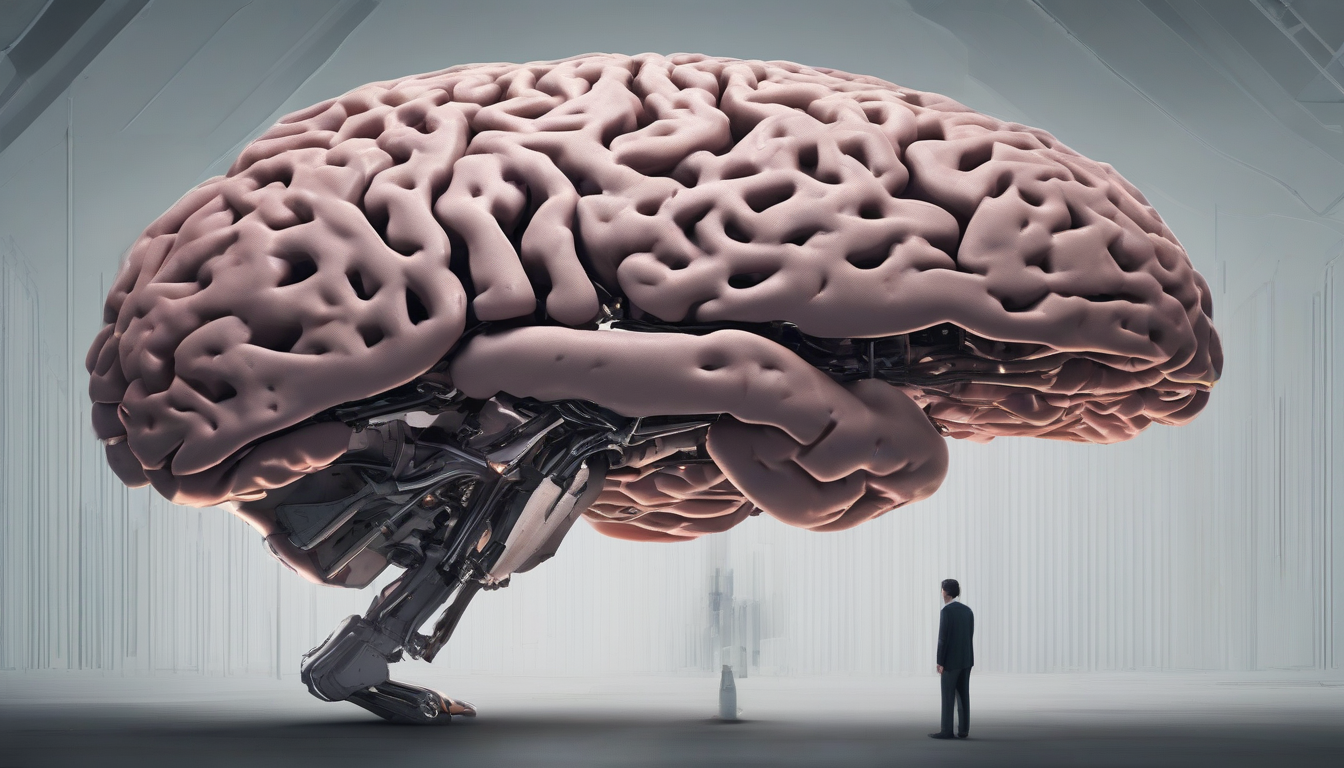
Over a decade ago, I wrote Rewired about our always-on, overwired world. I thought I understood the costs then, but I was wrong. The advent of artificial intelligence didn't just change the game; it fundamentally altered the playing field. For many of my clients, it felt like AI moving closer to their business until it became the business, its tendrils wrapping around every decision, promising efficiency while delivering a pervasive, gnawing exhaustion.
For too long, we've conflated speed with productivity. We believed that by doing more, faster, we were winning. But what happens when the very tools intended to accelerate us start demanding our constant, fractured monitoring? The reality is that AI isn't just changing how we work—it's altering the landscape of our cognitive attention, leading to what many now call "brain fry." For leaders, this isn't just a wellness issue; it's a crisis of leadership capacity.
What is Cognitive Attention?
We talk about focus as if it's a simple commodity, something we can turn on or off at will. It isn't. Cognitive attention is the sophisticated, active capacity to concentrate mental resources on selective stimuli, sustain that focus over time, filter out irrelevance, and manage competing inputs. It's the gatekeeper of your intellectual life.
When your cognitive attention is taxed, you aren't just tired; your ability to filter the noise from the signal is compromised. You stop processing information thoughtfully and start reacting to it reflexively. In an AI-augmented environment, this capacity is not just valuable; it is the fundamental infrastructure for every, single high-level decision you make.
Understanding Attention and Cognitive Control Posner Snyder
To navigate this, we have to look past the AI-driven buzz and return to the foundational science of our own minds. When we discuss focus in this fast-paced environment, we owe a debt to the seminal work of Michael Posner and C.R. Snyder on attention and cognitive control.
Their framework provides the necessary perspective: attention is not a single mechanism but a multi-faceted system that regulates our thoughts and actions. Cognitive control—that vital ability to regulate our impulses while managing multiple, complex, and competing demands—is precisely what a leader needs to remain steady when the digital, AI-driven environment becomes deafening.
When we are constantly distracted, forced into continuous context-switching as we monitor AI, our capacity for top-down cognitive control is degraded. We stop thinking and start reacting. This is the direct antithesis of the deep, deliberative, high-order work required for effective enterprise AI strategy. Their framework reveals that "brain fry" is not merely fatigue—it is a functional, measurable impairment of our most critical leadership tool.
The Brain Fry of Always-On AI Supervision
We've all felt that new exhaustion that a good night's sleep barely touches. It's not just the result of a long workday; it's the result of a persistent, low-grade, and often invisible overload. What we've been calling productivity might actually be brain fry.
Recent findings highlight a stark disconnect in the current AI narrative. It's not the use of AI that's crippling our leaders; it's the oversight of it. Workers tasked with high levels of AI supervision report significantly more mental effort and fatigue compared to those who effectively delegated tasks to AI tools. We've built a trap where we are constantly context-switching between our own work and correcting the output of the tools we're ostensibly using to lighten that load.
It's a cycle that drains the very cognitive resources required for strategic discernment. Every time you shift context, your brain must shut down one framework and rebuild another. This isn't efficiency; it's a cognitive burden. Research shows that as you layer AI tools, productivity generally dips after integrating more than three. We are asking our brains to do something they were never designed to sustain.
Reclaiming Your Leadership
The neurological reality, as neuroscientist Amy Arnsten has shown, is that chronic stress physically weakens the prefrontal cortex—the headquarters of planning, judgment, impulse control, and strategic decision-making. If your organization is doubling down on AI without first addressing this crisis of mental capacity, you are flirting with systemic risk.
If we want to successfully navigate this transition, we need to stop treating recovery as an afterthought and start treating it as essential infrastructure. Individual leaders must protect what AI cannot do: strategic discernment, pattern recognition, and judgment. We must learn to unplug, and to do so not as an act of weakness, but as a disciplined act of restoration.
Your prefrontal cortex needs periods of rest to function at its highest capacity. Organizations that prioritize human capability, according to recent ROI studies, see far higher returns on their AI investments. The machine is not the strategist. You are. The challenge for leaders now is to build systems that recognize that the highest-value output, the most critical pattern recognition, and the most vital strategic discernment occur in a human mind that is capable of true attention and cognitive control. Let us build our future on that foundation.