
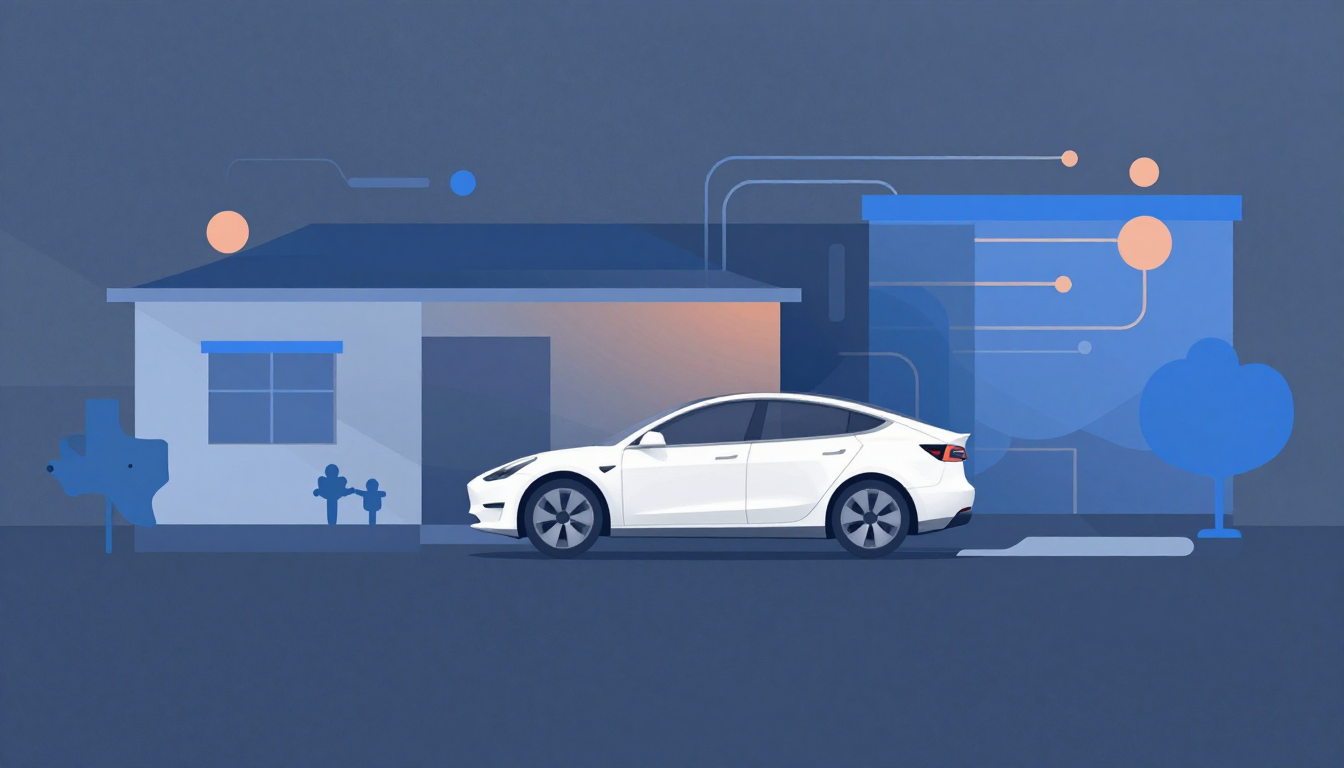
When you build automation systems that move multi-ton kinetic objects through the physical world, your error budget is zero. It has to be. In production, we say that if a system can fail in a catastrophic state, it eventually will unless the safety gates are physically absolute. For Tesla, that theoretical failure mode just became a tragic, real-world courtroom battle in Texas.
Martha Avila, a 76-year-old grandmother, died after a Model 3 crashed directly into her home in Harris County, Texas. She was pinned under the wreckage inside her own house, extracted by emergency crews, and later died at the hospital. Her family has filed a lawsuit in Harris County District Court seeking more than $1 million. The driver, Michael Butler, is also named as a defendant, but he told police a familiar story: the car’s automated driver-assist system was active when he lost control. The details of the crash were first reported in an Ars Technica investigation, highlighting how quickly these automated features can run off the rails when something goes wrong. While Tesla continues its global expansion, recently securing regulatory approval for Full Self-Driving in Belgium, these tragic events raise significant questions about the readiness of the system.
The reaction from corporate headquarters was swift and predictable. Elon Musk immediately jumped on X to declare that "FSD drives slowly through neighborhood streets, and this was a high-speed crash!" It is the perfect hand-waving defense. Basically, Musk is saying that because the car was going fast, the computer couldn't have been in control. It's a deflection. A doorbell camera video shared by The New York Times shows the vehicle slamming into the house at an eye-watering speed.
Then came Ashok Elluswamy, Tesla’s VP of AI software, who went a step further on social media, accusing the driver of overriding the system by pressing the accelerator to 100 percent. According to Elluswamy, the vehicle hit 73 mph and the pedal remained fully depressed even after the collision. But here is the catch: Tesla has not released the actual telemetry data to back this up. We are expected to just take their word for it. In the world of systems engineering, "trust me" is a failing grade. We need logs, not PR statements.
The Voltage Ghost: Sudden Unintended Acceleration
The lawsuit filed by the family’s attorney, Chris Adkins, does not just accept the "driver error" narrative. It points to two distinct engineering flaws that could explain how FSD or Autopilot contributed to the disaster. The first is a bogeyman that has haunted electric vehicles for years: Sudden Unintended Acceleration (SUA).
To understand SUA, you have to look at how EV drive-by-wire systems translate pedal physical movement into electrical signals. When auxiliary systems or main drive motors demand sudden surges of current from the high-voltage battery, it can create significant voltage spikes across the vehicle's electrical network. In theory, if the low-voltage control systems are not properly isolated from these spikes, the motor inverter can misinterpret a voltage surge as a physical press of the accelerator pedal.
Once that signal is misread, the inverter dumps full power into the motors. The vehicle launches.
For a driver, this is a terrifying feedback loop. You do not touch the pedal, yet the car is suddenly wide open. When this happens, human instinct is to panic, and sometimes drivers do press the wrong pedal in the chaos—or the system's telemetry registers the electrical spike itself as a 100 percent manual press. Tesla has historically maintained that every single case of SUA is actually "pedal misapplication" by the driver. But if the control loops themselves are vulnerable to electrical crosstalk during high-load transients, the logs showing "100% accelerator press" might just be recording the error, not the driver's foot. We see similar problems in complex telemetry systems when they are not built with physical isolation in mind. When you lack hardware-level segregation, software bugs and sensor drift can easily morph into hardware commands.
Eliminating the Redundancies: The Chip Shortage Dilemma
The second theory in the lawsuit hits at an even more cynical engineering decision. During the supply chain crunches of the last few years, Tesla famously stripped its vehicles of radar sensors and ultrasonic obstacle-detection hardware. They called it the transition to "Tesla Vision."
In plain terms, they decided that a handful of cheap optical cameras and some machine learning models could replace dedicated physical sensors.
When you do that, you lose redundancy. If you look at how other EV makers approach safety, they pack their cars with active, multi-modal sensor arrays to ensure the system has overlapping field-of-view protection. Even simple, low-cost EV projects focus on hardware clarity. For example, if you look at how the industry has reacted to over-complex sensor suites, some startups have completely reverted to manual systems, like the Slate manual-window electric pickup, aiming to avoid the entire digital mess of active driver-assist software. But if you are going to sell a vehicle as "Full Self-Driving," you cannot just delete the physical radar sensors because the supply chain got tight. You need multiple layers of safety.
Without ultrasonic sensors or radar, Butler's Model 3 was blind to certain cross-sections of the road. At the end of a dead-end street in a residential area, the optical cameras may have struggled to differentiate the flat facade of the house from the road ahead, especially in changing light conditions. In engineering, optical-only systems are notoriously bad at sensing depth for low-contrast, stationary objects. The car simply failed to detect the home directly in its path and did not engage emergency braking. It kept going, assuming the path was clear.
The Black Box Problem and the Struggle for Telemetry
This is not the first time a Tesla has failed to recognize a stationary object. The National Highway Traffic Safety Administration (NHTSA) has investigated dozens of incidents where Teslas on Autopilot crashed into parked emergency vehicles, highway barriers, or stopped trucks. A previous analysis by the Washington Post identified at least 17 fatal crashes linked to Autopilot use. The system has a long, documented inability to properly detect stationary objects.
The problem is that validating what actually happened in these crashes is nearly impossible for anyone outside of Tesla.
Automakers have historically treated crash data as proprietary property. Tesla has a documented history of making it incredibly difficult for independent accident investigators, plaintiffs' attorneys, and even owners to get the raw data logs and telemetry stored in the vehicle. When a crash occurs, the company is quick to pull the data remotely, analyze it internally, and issue press statements blaming the driver's feet while hoarding the raw sensor logs.
Chris Adkins and the Barbour family are preemptively fighting this data containment strategy. The lawsuit includes a strict demand for Tesla to preserve every single piece of evidence: the physical vehicle in its post-collision state, the cabin and exterior camera feeds, the "black box" logs, and the raw system telemetry. They want to see the exact sequence of CAN bus messages in the seconds leading up to the impact. Did the accelerator pedal sensor actually send a physical voltage change, or did the inverter register a phantom SPI communication? If you don't audit the raw signals, you are just guessing.
The Real Toll of Beta Testing in Public
While engineers, executives, and lawyers argue about CAN bus packets and optical depth sensing, the human reality of this crash remains devastating. Justin Barbour was inside the house when the Model 3 tore through the walls, suffering severe injuries to his neck, back, and shoulders. The kids in the home were left traumatized. Martha Avila’s daughter, Jennifer Barbour, expressed the absolute shock of the moment: "I don’t know if it's the driver's fault or the car's fault... I've never seen a car go that fast." Avila was expected to have many more years with her family; she was in good health and on no medications.
We are running a massive, unpaid beta test on public roads, and the people paying the highest price are not even the ones who bought the software.
Martha Avila did not buy a Tesla. She did not sign an FSD beta user agreement. She was simply sitting inside her own living room, expecting the walls of her home to protect her from the outside world. If a software system can misinterpret electrical transients or fail to see a house at the end of a cul-de-sac, it should not be deployed on public streets.
Until we have open, audited telemetry standard protocols for autonomous and semi-autonomous systems, these lawsuits are the only mechanism to force transparency. We need to stop letting companies write the rules of their own telemetry analysis. If a system fails, the code and the data must be laid bare for inspection. Anything less is just corporate gaslighting at high speed. It's time to force the black boxes open.