
Scaling Without the Sprawl: Hardening AI Engineering Against Infrastructure Bloat
Autonomous AI agents are turning into the digital equivalent of suburban sprawl. They're incredibly productive, yes, but they're building massive, inefficient infrastructure in their wake—often without a second thought. They deploy large-scale virtual machine clusters where a single node would suffice, or request container resources that dwarf the actual workload requirements by orders of magnitude. It’s not malicious; it's just the default behavioral pattern they've inherited from their training data.
If you don't constrain these autonomous generators now, your organization is going to be paying for a cloud footprint its actual traffic doesn't justify. You're effectively outsourcing your capacity planning to a model that equates "safe" with "over-provisioned."

The Sustainability Training Deficit
Why do agents create waste? It boils down to a fundamental lack of purpose in their training distributions. When an agent creates Infrastructure-as-Code (IaC) templates in Terraform or YAML, it's statistically predicting the next token based on a vast dataset of public, often legacy, infrastructure configurations.
Most of that historical data—the code they learn from—is fundamentally flawed by today’s sustainability standards. It stems from an era where "bigger is better" was the default safety strategy. According to industry data, a massive majority of enterprise software lacks explicit, green engineering guidelines, and as we push for more AI integration, those old, inefficient habits are being baked directly into our new, AI-automated, service-oriented architectures.
The scale of this issue is compounded by the sheer velocity at which these agents operate. We’re not talking about human developers manually configuring a few clusters; we're talking about agents that can propose and apply infrastructure changes across environments in seconds. When that efficiency is applied to unchecked waste, the environmental—and financial—impact scales exponentially. Data centers are already consuming staggering amounts of energy, and relying on AI agents to scale infrastructure without guardrails is only accelerating that demand.

The Three Pillars of IaC Bloat
To stop this at the source, you have to understand where the agents are going wrong. Based on patterns in modern IaC generation, the waste usually manifests in three high-impact areas:
-
IaC Machine Sizing: The most frequent offender. When prompted to set up a new environment, agents frequently reach for large, general-purpose machine types like
n2-standard-16when ane2-mediumor even a smaller, specialized footprint would handle the task perfectly well. -
Kubernetes Pod Allocation: Many agents don't intuitively grasp the difference between requested resources and actual usage telemetry. If a developer asks for a service to be deployed, the agent often adds generous buffers to the CPU and memory limits. A workload that peaks at 200m CPU might receive a request for 4 full CPUs. That's not a buffer; that's idle compute pay-as-you-go tax.
-
Container Weight: It's common for agents to pull the heaviest available base images. Using full distros like Ubuntu or Debian for small microservices adds unnecessary overhead, increases attack surfaces, and wastes storage and pull time across your entire registry.
Spec-Driven Governance as a Shield
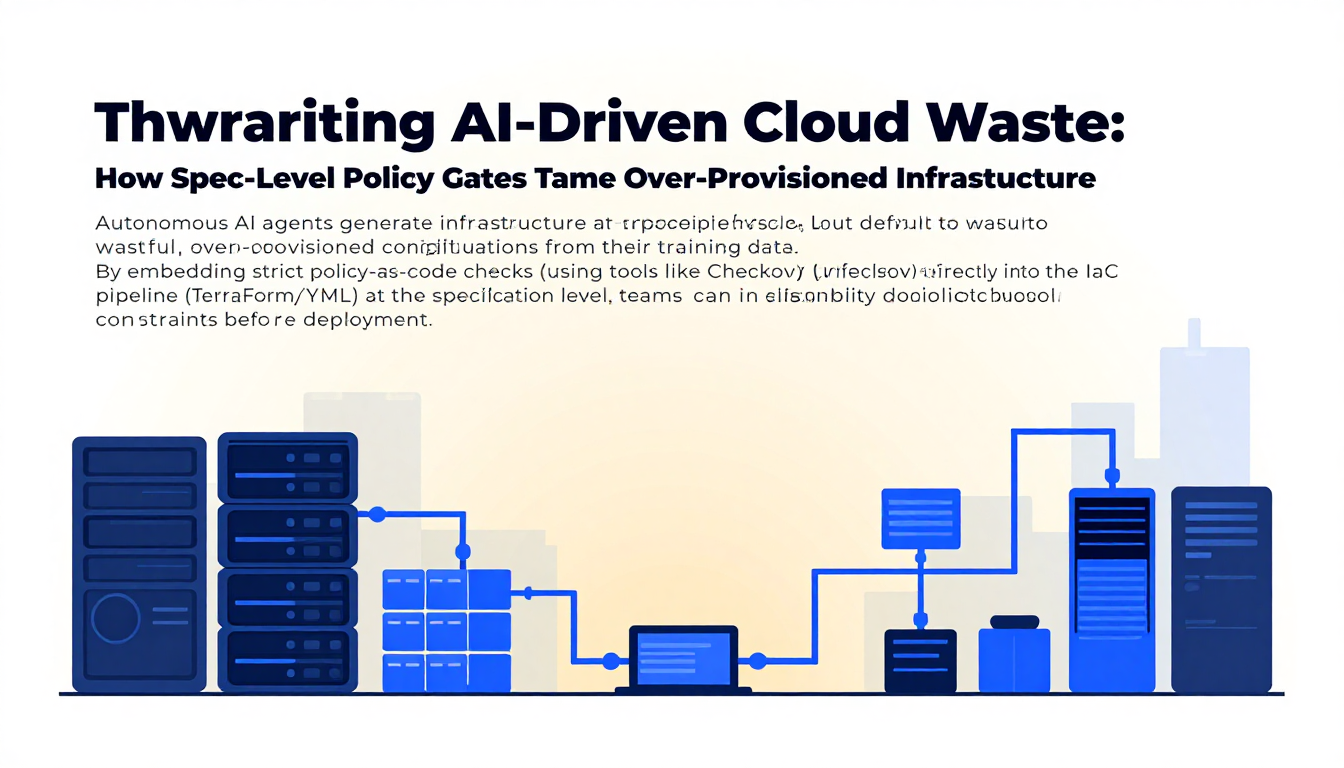
You can't just hope the agents get better. You need to enforce behavioral constraints—policy-as-code—that block these wasteful configurations before they ever reach a production environment.
The answer is shifting from manual reviews to spec-driven governance. You need to treat your infrastructure specifications like application unit tests. Just as you wouldn't deploy code that fails its tests, you shouldn't deploy infrastructure that fails your sustainability compliance checks.
By incorporating static analysis tools into your CI/CD pipelines—I've seen significant success with tools like Checkov for this purpose—you can break the build if the agent-generated code violates sustainability rules.
Building Your Infrastructure Quality Gate
Don't treat this as an advisory warning. Make it a hard failure. Your developers and agents should get that feedback immediately inside their development loop.
First, define your sustainability rules. If you're using Terraform, this means enforcing constraints on the machine_type attribute. It means setting absolute caps on CPU and memory request blocks within your Kubernetes pod manifests.
Second, integrate this into your CI/CD pipeline’s quality gating process. When an agent generates a Terraform plan, a tool like Checkov or tfsec should scan it against these policies. If the plan specifies an instance type that is not on your approved "sustainability-compliant" list, the build must fail.
The goal isn’t to stop the agent from working; it’s to force it to operate within the operational boundaries that your organization actually needs.
The Feedback Loop
This is an ongoing process. Once you have these gates enforced at the spec level, use that data. If your agents are consistently trying to generate specs that fail your sustainability checks, that is your feedback loop. Your policy gate isn't just about preventing waste; it's about continuously learning what the automated agents need versus what they choose, allowing you to refine both your policies and your agent configuration prompts.
Stop letting your agents treat cloud resources like an endless buffet. Implement hard, policy-driven constraints now, and steer your automation toward an efficient, sustainable infrastructure-as-code future.