
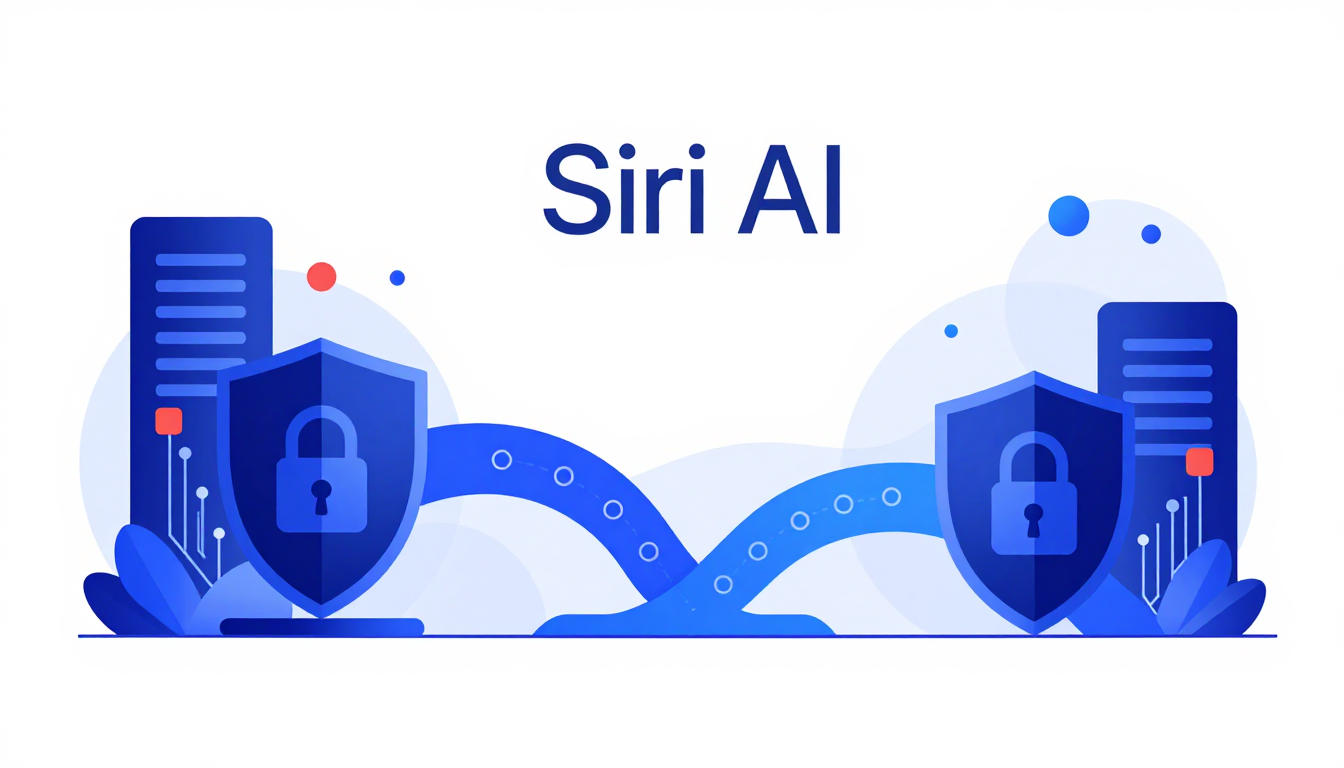
The Transformation: Siri's New Generative Era
Apple's voice assistant has long been a point of pride for the company, a benchmark for usability in its early years. Yet, as the AI landscape underwent a radical acceleration over the past two years, Siri began to show its age, struggling to keep pace with the nuanced, generative capabilities of competitors. The long-anticipated unveiling of "Siri AI" at WWDC26 is more than a superficial update; it is a fundamental architectural reclamation.
Apple has not simply bolted a chatbot onto Siri. Instead, it has reconfigured the assistant's underlying intelligence to utilize a hybrid computation model, offloading complex reasoning to Google’s Gemini language models while strictly maintaining the user-privacy boundaries that have defined Apple’s product philosophy. This strategic partnership acknowledges a difficult reality: building a cutting-edge generative foundation model is resource-intensive, while Apple’s core competitive necessity—maintaining ironclad privacy assurance—is a distinct, difficult technological problem. By partnering with Google for model processing and developing Private Cloud Compute (PCC) for secure query handling, Apple is attempting to solve both simultaneously. This move highlights a pivot toward pragmatic integration, accepting that for advanced AI tasks, the cloud is inevitable, but how that cloud operates is not. The challenge now rests on Apple to prove that its "private-first" AI model isn't just a marketing slogan, but a robust technical reality.

The Engineering of Private Cloud Compute (PCC)
At the cornerstone of Apple's strategy is Private Cloud Compute, an architecture designed specifically to address the tension between generative capability and data privacy. Conventional cloud AI models process queries in data centers where data might be persistent, logged, or scrutinized. PCC, by contrast, acts as a cryptographically isolated environment.
When a query is routed to PCC, it first undergoes a rigorous filtering process on the user's device. Only queries that the on-device AI deems beyond its performance scope are transformed into an encrypted packet and dispatched to PCC. Within the PCC infrastructure, the query is handled inside a secure container that even Apple personnel cannot access. Apple employs the same secure enclave technology used on macOS and iOS, scaled up to its serve-side hardware.
Key technical pillars of PCC include:
- Ephemeral Processing: Data retained in the PCC environment is intended for immediate processing only, with strict deletion protocols that wipe data within minutes. There is no training data persistence on the server side.
- Cryptographic Isolation: Communication between the device and the PCC environment is cryptographically linked, ensuring that the model within the container has just enough context to process the query, but no insight into the user's broader identity or past behavior.
- Auditability via Verification: Apple plans to provide independent security audits for its PCC infrastructure. By open-sourcing the design specifications and allowing for third-party verification of the cryptographic protocols and data deletion logs, Apple aims to foster a level of trust that traditional cloud providers have generally struggled to secure.
This design moves the bottleneck of privacy from the human-checked policy to the infrastructure-enforced protocol, turning privacy into an architectural property rather than a contractual one.

Why Google’s Gemini? Strategic Pragmatism in AI
The decision to leverage Google's Gemini models is rooted in strategic pragmatism. Apple’s own attempts at developing frontier-scale LLMs were, by many internal accounts, trailing the leading industry benchmarks in fluency, multimodality, and reasoning. Gemini represents a high-water mark for current generative models, especially in handling complex multi-modal queries that Siri AI is now designed to support.
However, the partnership is not a surrender of Apple's ecosystem dominance. The integration is restricted by a tight API interface—Apple essentially uses Gemini as an engine, not a platform. The user interface, intent recognition, input sanitization, and final output formatting remain strictly under Apple's control.
Apple's choice also reflects the necessity for scale. Managing billions of queries daily requires a mature, highly optimized infrastructure for model inference. Integrating Gemini allows Apple to inherit the performance and optimizations Google has developed, sparing Apple from the immense cost and time of rebuilding equivalent inference pipelines. By defining the partnership as an "engine-only" integration, Apple protects its brand while benefiting from the most advanced LLMs currently available on the market.
Privacy by Design: Beyond Apple’s Marketing
For years, privacy in the tech industry has been synonymous with legal disclaimers. Apple’s approach with Siri AI is an attempt to shift this to "privacy by design"—a methodology where privacy safeguards are coded into the software architecture itself.
One of the most crucial elements is "Data Minimization." When the system decides to offload a query, it does not send the raw voice or text data if possible. Instead, it sends semantic embeddings—mathematical representations of the query's meaning—that contain enough context for Gemini to reason, but stripped of the raw, identifying details of the user's personal context.
Furthermore, Apple emphasizes that data processed in the PCC environment is explicitly forbidden from being used to train subsequent generations of Google’s models. This is a critical distinction, as most cloud AI integrations involve the provider using query data to improve their own models. Apple’s contract with Google, according to published reports, explicitly prevents this data reuse, reinforcing the ephemeral nature of the data in the PCC environment. The success of this model hinges on the belief that users will trust Apple as an intermediary, acting as a steward between their personal data and the massive computation power of the cloud.
Competitive Landscape and the Future
Apple's pivot with Siri AI signals a major shift in the competitive landscape. If successful, this "private-first" AI integration model could become the new gold standard for consumer AI, forcing competitors like Amazon (Alexa) and Microsoft (Copilot) to either adopt similar architectural safeguards or face growing user skepticism regarding data handling.
The path ahead, however, is not without challenges. First, reliability: running a complex, hybrid architecture across a global user base is a monumental DevOps and infrastructure task. Even slight increases in latency—the time it takes for a query to be offloaded, processed by PCC, and returned—will have a disproportionate impact on the perceived quality of the Siri experience.
Second, the operational challenge of trust. While Apple's technical commitments to privacy are clear, regulators globally, particularly in Europe (GDPR), will likely demand extensive, deep-dive inspections of the PCC infrastructure to ensure that data does not leak, that ephemeral deletion is actually occurring, and that Google truly has no back-door access.
Ultimately, Siri AI is just the first iteration of Apple’s broader AI strategy. We should expect similar hybrid approaches to be rolled out across the entire Apple product ecosystem. The core takeaway from WWDC26 is not that Apple has chosen to rely on Google for its AI; rather, it is that Apple has determined the best way to maintain its competitive edge is to be the privacy layer for advanced AI, ensuring that users can take advantage of generative models without sacrificing their digital autonomy. The coming year will test whether this paradigm resonates as strongly with users as Apple’s brand positioning implies it will.