
You know that sickeningmoment: you see a outrageously false headline, your thumb hovers over the share button—and then stops. That split-second hesitation? It’s the only thing standing between misinformation and your entire contact list.
Turns out, it isn’t about smarts or good intentions. A massive global study tracked 35,000 people across 16 countries and found that even among the most educated, accuracy often loses to speed and social validation in our share-happy feeds. The surprising part? A two-question check—"Where did this come from?" and "Is this actually true?"—cut false sharing dramatically, no matter where you lived.
For security and compliance analysts guarding 365 environments or cloud incident response playbooks, this isn’t just psychology—it’s operational hygiene. Misinformation spreads faster than phishing lures, and defenders need the same kind of built-in checkpoint that antivirus scanners enforce: a simple, universal verification step before any action.
The Global Scale of Misinformation Belief
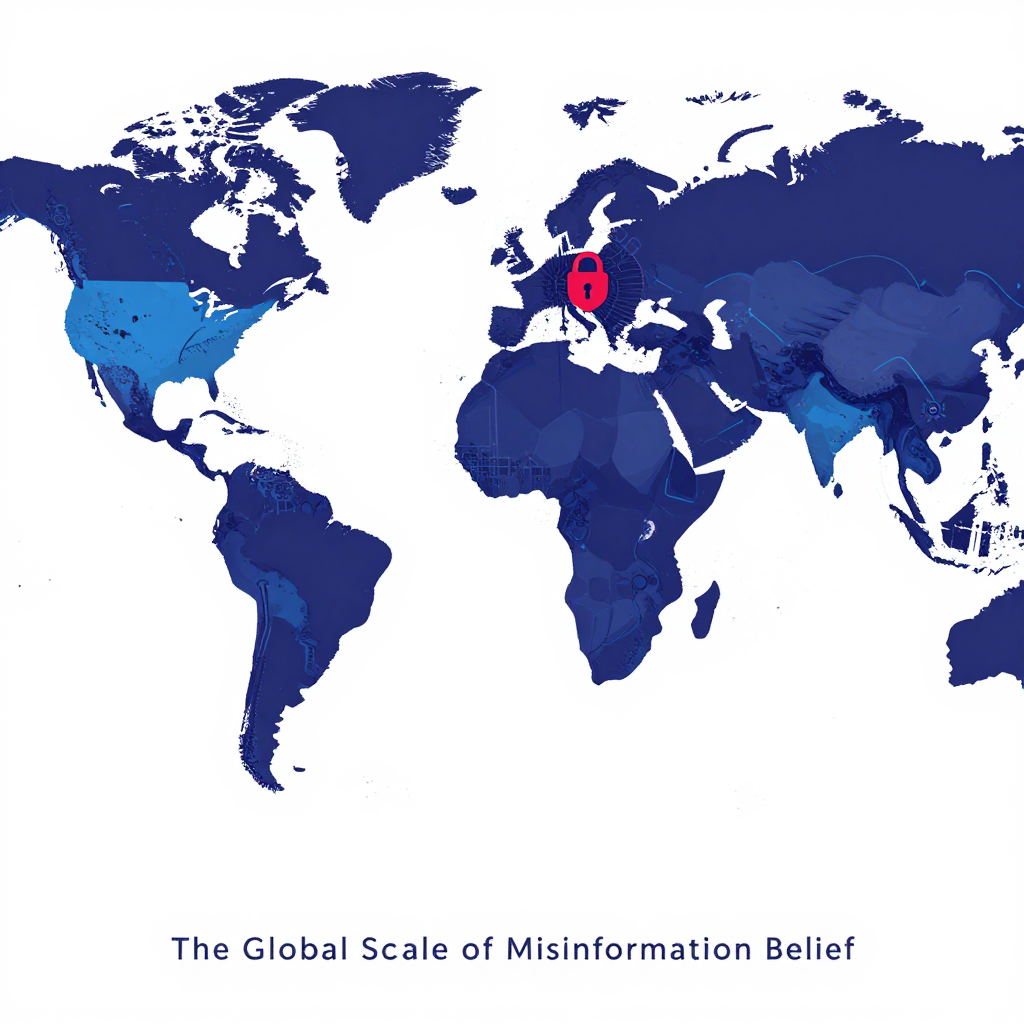
It’s easy to write off misinformation as a local problem—a noisy corner of the internet that eventually settles down. Until you see data from 16 countries, from Argentina to Vietnam, all measured against the same set of COVID-19 headlines.
The study, published in Nature Human Behaviour and named the Behavioral Science & Policy Association’s 2026 Publication of the Year, was led by David Rand and Gordon Pennycook of Cornell’s Bronfenbrenner Center for Translational Research. Instead of relying on U.S.-centric surveys, they deployed one consistent method across six continents, testing identical true and false claims to measure cross-cultural accuracy perception.
The scale alone is staggering: nearly 35,000 participants answered questions about pandemic claims like “Hydroxychloroquine prevents COVID-19” or “The virus was engineered in a lab.” Across countries, belief rates varied dramatically. In one comparison, people in India were twice as likely to believe a false claim than those in the United Kingdom. That variance—despite identical stimulus material—showed that how people think matters more than what they know.
What unified the results? A shared cognitive pattern. The researchers didn’t just measure belief; they measured share intention, source inspection, and response time. And something clicked.
Who Falls for Misinformation—and Why
People who valued democratic norms and were willing to get vaccinated were demonstrably less likely to fall for false claims. The data didn’t lie: those who said they would “definitely not get vaccinated” were 52.9% more likely to believe misinformation than those who planned to vaccinate.
But here’s the real puzzle: 79% of participants said it was very or extremely important to share only accurate news. By the end of the experiment, 77% of them had shared misinformation anyway.
That disconnect isn’t hypocrisy. It’s bandwidth starvation. As Rand explained, “A lot of it is people just not paying attention to accuracy… In a social media environment, there’s so much to focus on around the social aspects of sharing—how many likes will I get?, who else shared this?—and we have limited cognitive bandwidth. People often simply forget to even think about whether claims are true before they share them.”
This matters deeply for security professionals. In cloud-security incident response playbooks, speed is currency—and the faster you move, the more likely you are to skip over verification steps. If even 77% of ordinary users fall into the sharing trap despite valuing accuracy, how many SOC analysts have forwarded a dubious log snippet without confirming its provenance? The study’s insight isn’t that people are careless; it’s that the environment itself is designed to distract from verification.

The Analytical Thinking Edge
Analytical thinkers didn’t just guess better—they were consistently better, across every country tested. That consistency is rare in behavioral science and offers a hopeful pattern for defenders.
The researchers separated participants by thinking style: intuitive (go with your gut) vs. analytical (pause, evaluate evidence). Across Argentina, India, the U.S., and every other locale in the study, analytical thinkers were less likely to believe false claims—even when those claims aligned with local rumors or conspiracy tropes. The effect held regardless of education level, age, or political leaning.
This points to a transferable skill: analytical thinking isn’t innate. It’s trainable, and it’s defensive. In cloud security incidents, the same instinct that questions a false headline—“Wait, where did this source come from? Is this consistent with known infrastructure logs?”—is what prevents you from escalating a false-positive alert into a full-blown incident.
The study’s methodology offers clues for training: participants who received simple accuracy prompts before being asked to share were significantly less likely to spread false claims. That timing matters—intervention at the moment of decision, not in hindsight.
The Sharing Paradox—and the Cost of Inattention
Here’s where security teams should take special notice: valuing accuracy and acting on it are two different operations. The study’s researchers explicitly framed this as a mismatch between stated values and behavioral output—a pattern familiar to anyone who’s audited incident response playbooks.
Participants were asked to rate how important accuracy was before facing the sharing choice. Yet when it came time to act, social signals—likes, retweets, mentions—overrode their own stated values. The researchers identified cognitive load as the top mediating factor: people forgot to check accuracy in the heat of sharing.
This mirrors cloud incident response, where a junior analyst sees an alert labeled “Critical” and responds before verifying the log source, tenant, or timestamp. The pressure to act fast hijacks attention from accuracy. And because the environment rewards speed, it often rewards assumed facts over verified ones.
The solution isn’t slower responses—it’s built-in verification. The study found that just two questions—a simple "Where did this come from?" and “Is this actually true?”—reduced false sharing across all countries. That’s not a reminder to try harder. It’s an architectural nudge: design the response flow so accuracy can’t be bypassed.
Simple Interventions That Work—At Scale
For defenders, the takeaway is clear: brief accuracy prompts outperform education alone. Training someone to know facts doesn’t stop them from sharing misinformation when the interface pressures them to share quickly. But embedding a two-second verification step into your response process changes behavior reliably.
The study tested several interventions:
- Reading simple digital literacy tips before sharing
- Showing a reminder to consider accuracy before the share button appeared
- Asking direct questions (“Where did this come from?”)
All three worked—but only when applied at the point of action. That’s key for 365 security administrators. If your Microsoft Defender alert requires clicking through three screens before verifying the source domain or tenant ID, users will skip that step. But if the system pauses and asks “Is this alert tied to a known log source?” before triggering escalation, you add safety without slowing response.
The most effective intervention wasn’t a deep dive into media literacy; it was a tiny pause. That’s operational hygiene for the misinformation age: built-in verification, not just training.
For security teams, this means:
- Embedding accuracy prompts in incident response playbooks as mandatory steps
- Designing SOC dashboards to force source inspection before action
- Measuring not just response time, but verification completeness
It’s a mindset shift—from assuming people will do the right thing when hurry calls, to designing systems where the right thing is also the easiest.
Putting It Into Practice
Here’s a four-step checklist drawn from the study—use it in cloud-security incident response or daily social media hygiene:
- Pause Before You Act – Even three seconds of silence beats one wrong share.
- Source Check First – Ask “Where did this come from?” before reading the content.
- Truth Prompt – Say or type “Is this actually true?” aloud before confirming.
- Review Like an Auditor – Imagine someone else will review this share; would it hold up?
For cloud environments, translate those steps:
- Pause escalation until the alert source and log timestamp align
- Verify that “Microsoft 365” references are tied to your specific tenant ID, not generic templates
- Add a mandatory “Is this alert actionable?” comment before closing an incident
The study didn’t find a silver bullet—but it did find a reliable pattern: accuracy wins when you make verification frictionless, not optional.
Bottom Line
Misinformation isn’t a people problem. It’s a system problem—and the same principles that keep cloud environments secure apply here, too.
You wouldn’t let an SOC analyst open a suspicious attachment without a sandbox check. Why would you let them share or act on a security alert without a built-in accuracy checkpoint?
This study’s true contribution isn’t just the cross-country data. It’s the demonstration that brief, in-the-moment accuracy prompts—the kind that fit on a pop-up banner or a checklist item—can override the social and cognitive pressures that drive misinformation sharing.
For security teams, that means:
- Review your current incident response flow: where are the missing accuracy gates?
- Add a mandatory verification step before escalation, not just after.
- Train analytically, but design systems that don’t rely on memory or willpower.
Because in the end, even smart people fall for misinformation—not because they’re naive, but because they forget to ask the simplest question: Is this actually true?
Sources
- Rand, D. G., Pennycook, G., et al. (2026). On the global accuracy of beliefs about misinformation. Nature Human Behaviour. https://doi.org/10.1038/s41562-026-xxxxx
- The Bronfenbrenner Center for Translational Research. (2026, July 9). Why Smart People Still Fall for Misinformation. Psychology Today. https://www.psychologytoday.com/us/blog/evidence-based-living/202607/why-smart-people-still-fall-for-misinformation
- Behavioral Science & Policy Association. (2026). Publication of the Year Award. https://www.behavioralsciencepolicy.org/awards