

The Self as a Dialogue Between Body and Brain
For most of us, the feeling of being me—the sense that thoughts are mine, actions originate from me, and my body is mine—is so seamless it feels like a fact of nature. But what if that “me” is not an entity hidden in some corner of the brain but rather a constantly reconstructed model? A construct. A prediction.
Neuroscientists like Antonio Damasio and Anil Seth have laid the groundwork for an idea that sounds almost counterintuitive: your sense of self arises not from some special inner seat of consciousness but from the brain’s ongoing interpretation of a torrent of bodily signals. Heartbeats, breath depth, gut distension, muscle tension—these are the data points that your brain mines to answer, implicitly and continuously, the question What am I?
This isn’t philosophy alone. It’s a framework known as the embodied self model, where interoception—the sense of the body’s internal state—fuels a predictive code. The brain generates predictions about what bodily signals ought to be and then updates those predictions based on the actual input it receives. The result is a stable feeling of selfhood, one that you rarely notice until it wobbles.
Think of it like a tightly tuned orchestra: every instrument contributes to the symphony of being, but you only hear the music when something goes out of tune.
When bodily signals are disrupted—by injury, disease, or pharmacological intervention—the self-model falters. People report derealization: the world feels unreal, as though behind glass. Depersonalization: their own thoughts and limbs feel alien, foreign, borrowed. Ego dissolution under psilocybin or ketamine is a dramatic version of the same phenomenon, where boundaries between self and other, mind and body, blur to the point of vanishing.
In these moments, what we’re witnessing is not the collapse of mind per se but a failure in the predictive architecture that binds interoceptive signals to our experience of agency and continuity. The self-model, starved of reliable input, rewinds, simplifies, or loops into a lower-dimensional version of itself.
It’s this rewinding, this collapse-and-simplification narrative, that makes near-death experiences (NDEs) so compelling—not just as metaphysical curiosities, but as the most extreme natural experiment in self-model disruption we have.
What Happens When the Heart Stops: A Brain on the Edge
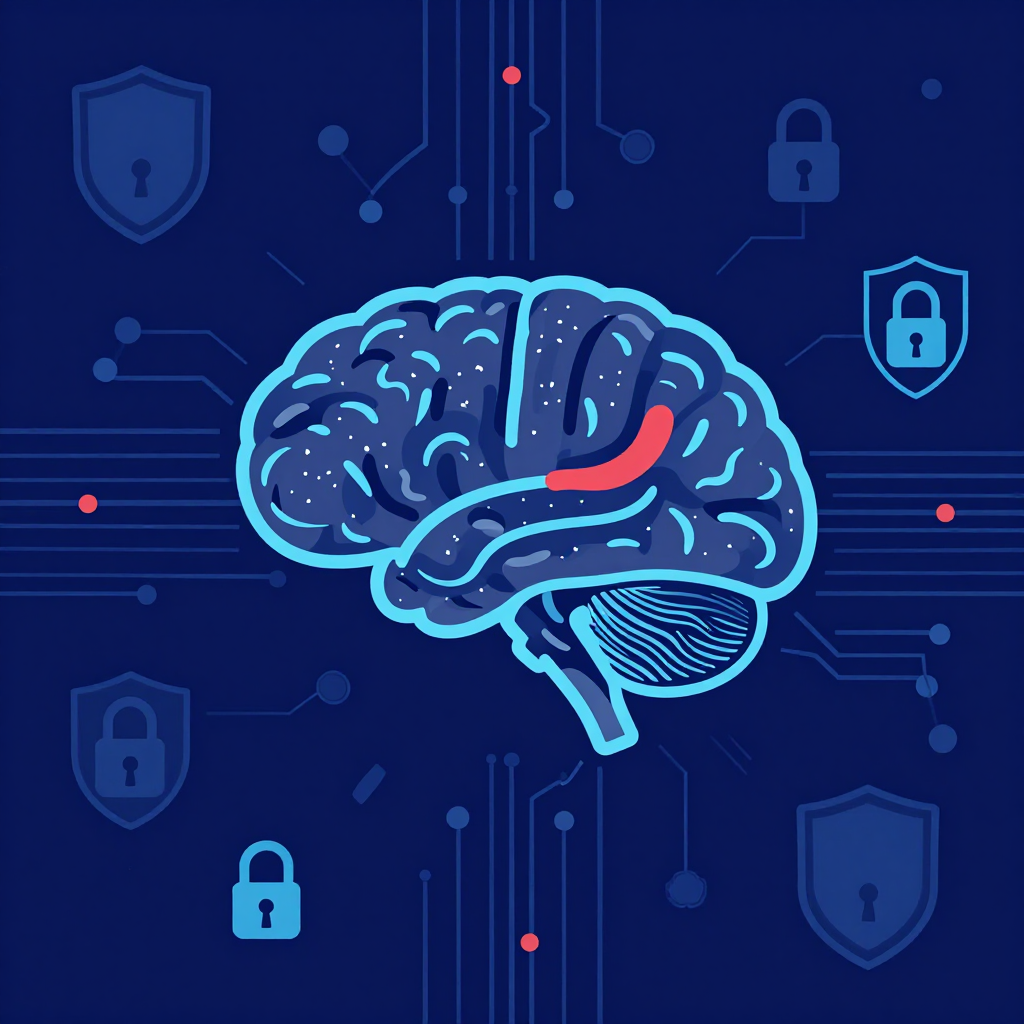
After cardiac arrest, things happen in a precise and familiar sequence. The heart ceases to pump. Blood flow to the brain drops precipitously—within seconds, oxygen-dependent neurons begin to fail. Most people lose consciousness within 10–20 seconds. A standard EEG goes flat within minutes. And yet… something else is happening, too.
Multiple studies now confirm that neuronal activity doesn’t simply vanish the moment circulation stops. In fact, a surge of high-frequency gamma oscillations often follows shortly after cardiopulmonary resuscitation begins—or even during the arrest itself. Jimo Borjigin and her colleagues first documented this in rats: a brief, whole-brain gamma surge across the temporo-parietal-occipital (TPO) junction, a region critical for multisensory integration and body ownership.
The human TPO junction is especially interesting because it’s also implicated in out-of-body perception. When transcranial magnetic stimulation disrupts this area, healthy volunteers can report transient sensations of leaving their body. And indeed, out-of-body experiences (OBEs) are among the most common elements of NDE reports: floating above one’s own body, watching resuscitation attempts unfold from a hovering vantage point.
It’s plausible to interpret this as the brain’s final, high-fidelity attempt at self-modeling in a system where standard inputs are failing. The brain doesn’t stop generating the self; it generates a simplified, less grounded version—detached, streamlined, stripped of most contextual anchors. The gamma surge may represent a cascade of disinhibited activity: when normal inhibitory circuits go offline (as they do during ischemia), hyperexcitable nodes fire together, weaving a coherent but unusual narrative of experience.
Sam Parnia’s large-scale study from 2023 provides further support. Out of over 500 cardiac arrest patients, nearly half showed transient resurgent brain activity consistent with conscious processing up to an hour after CPR began. Six patients, in fact, later recalled structured experiences—what Parnia refers to as “remembered death” experiences. One even accurately repeated a repeated auditory stimulus (naming three fruits in order) during resuscitation, suggesting memory encoding can occur despite the absence of overt responsiveness.
This isn’t proof of an afterlife. It’s proof that consciousness isn’t binary—on or off, present or gone—not at the margins of death. The boundary is blurrier, flickering longer than we assumed, and the self-model doesn’t vanish cleanly; it degrades in predictable ways.
The Common Language of NDEs: Tunnel, Light, Peace
It’s striking how often survivors across cultures and backgrounds report the same sequence of sensations. A tunnel. A bright, warm light at the end. An overwhelming sense of peace—even in people who report violent or traumatic circumstances preceding their collapse.
Rachel Nuwer’s reporting in Scientific American highlights this consistency. In one compelling account, François d’Adesky described passing through a tunnel and encountering luminous beings who told him his time had not yet come. Later, he recalled traveling “at breakneck speed through time and space, back to the beginning of creation”—a vivid, nonlinear narrative structure that echoes precisely what some EEG and fMRI data suggest happens in the dying brain: hyperconnectedness across regions normally segregated, allowing for a kind of “all-at-once” recall.
The tunnel and the light, in this context, may not represent literal transitions but rather perceptual artifacts of neural overload. When visual cortex activity becomes disinhibited and misrouted—perhaps by hypoxia or potassium surges—the brain generates a highly structured visual phantasm: the tunnel, with its smooth curvature and directional guidepost (the light). The “light” may simply be the hyperactive occipital lobe’s final broadcast—a blinding, but symbolically neutral, signal of neural firing.
And the peace? That’s harder to explain purely mechanistically—and yet it fits seamlessly into the embodied self hypothesis. If the self-model collapses to a minimal, body-less state, many of the signals associated with fear—adrenaline spikes, gut tension, heightened heart rate—begin to fade or decouple from their usual feedback loops. What remains is a quiet, undisturbed sense of presence: no longer threatened, no longer embattled. Just… self.
A minority of NDEs are negative—feeling trapped, falling, encountering malevolent entities—but even these follow a recognizable arc. They suggest not dysfunction but differential tuning: instead of disengagement, the brain over-engages fear circuitry while still losing bodily coherence. A kind of false alarm within the emergency protocol itself.
Psychedelics as Probes: What Ketamine and Psilocybin Teach Us About the Dying Brain
There’s a curious overlap between NDEs and psychedelic experiences. Both can produce ego dissolution, feelings of unity, OBEs, and vivid, emotionally resonant imagery. The similarity isn’t coincidental.
Psychedelics like psilocybin and LSD act primarily on the 5-HT2A receptor, while ketamine blocks NMDA receptors. Both mechanisms disrupt default-mode network (DMN) activity—the brain’s “self-referential hub.” When the DMN is suppressed, the hierarchical predictive architecture that maintains a stable self-model breaks down. The result is ego dissolution, often described as “losing the boundaries of the self” or feeling like one has become part of a greater whole.
Hamid Zand points out in Psychology Today that many of the drugs most strongly linked to depersonalization—cannabis, ketamine, LSD, psilocybin—are precisely those that alter interoceptive weighting: how much weight the brain gives to bodily signals versus top-down predictions. Under these compounds, people report that their body feels distant, weightless, or phantom-like—echoes of what NDE survivors describe.
Some researchers, notably Chris Timmermann at Imperial College London, have suggested that psychedelics act as probes—intentional perturbations of the system that let us see how it compensates, reorganizes, or collapses. The NDE may simply be a natural, physiological version of that same perturbation: ischemia replaces pharmacology as the agent of disruption.
Crucially, neither NDEs nor psychedelics imply consciousness outside the brain. They show that consciousness can exist in highly atypical, yet still brain-dependent, configurations. The self-model isn’t an immaterial ghost—it’s a pattern of activity that can be perturbed in many ways, with similar outputs.
This is why the overlap matters: if we can map the neural correlates of ego dissolution under controlled conditions, we gain a template for interpreting what happens when those same mechanisms are engaged endogenously during cardiac arrest. It turns anecdote into a testable hypothesis.
Thanatosis and the Evolutionary Function of the NDE
One persistent criticism of NDE research is that if these experiences happen at the moment of dying, how can they be recalled later—since memory encoding requires a functioning brain? That’s a fair point, but it presumes only one possible timing: that the experience must coincide with clinical death. What if instead, the NDE is encoded before cardiac arrest—during the prodrome of oxygen deprivation—and only recalled later, once circulation is restored?
Daniel Kondziella proposes an elegant alternative: NDEs may be part of a conserved survival behavior called thanatosis—feigning death. Many species—from opossums to insects—freeze and become unresponsive when threatened, not because they’ve passed out, but because they remain hyperaware and ready to flee at the first sign of safety.
According to this view, the NDE isn’t a glimpse beyond death; it’s the brain’s last-ditch attempt to avoid death by entering a low-energy, non-confrontational state. The tunnel light could be the visual signature of thalamic gate closure; the sense of peace may reflect endogenous opioid release. The entire sequence is a neural fallback, a switch to “survival mode” that feels strange and otherworldly because it’s not our everyday operating state.
This interpretation aligns neatly with the findings of Kondziella and colleagues, who found that people prone to REM sleep intrusion—a state where dreaming intrudes on wakefulness—were significantly more likely to report NDEs. If REM is a proto-thanatotic state (immobilization, sensory attenuation, vivid imagery), then NDEs could represent a hypertrophied version of the same pathway.
Charlotte Martial, speaking at NYU’s 2023 Consciousness and Death conference, cautioned against conflating empirical findings with metaphysical belief. But even skeptics agree: whatever the mechanism, NDEs change lives. People who’ve had them often report a permanent reduction in fear of death, increased compassion, and a shift toward altruistic goals—what François d’Adesky called “making the world a better place.”
That behavioral shift, more than any anecdote about light tunnels or spiritual beings, may be the strongest clue of all. If NDEs are purely pathological hallucinations, why would they so reliably produce prosocial transformation? If they’re a final survival reflex—like the opossum playing dead—they serve an evolutionary function: reduce threat, preserve life. The experience may not be about what happens after death; it may be about how to survive the threat of death.
Closing Thoughts: The Self in Collapse
The self is not a thing you find, but a process you maintain. It requires continuity: of bodily signals, of memory, of predictive consistency. When that continuity is severed—as in cardiac arrest—the self-model doesn’t vanish clean; it fractures, distorts, simplifies. It falls back on ancient, evolutionarily conserved patterns: tunnel vision, bodily detachment, a quiet sense of presence.
Near-death experiences may not prove an afterlife—but they do prove something more startling: that consciousness, even at the brink of biological termination, remains malleable, structured, and deeply tied to the body it seeks to interpret.
This doesn’t make NDEs less profound. If anything, it makes them more so. The brain’s last broadcast is not random noise but a coherent, highly reproducible experience—a final iteration of the self-model, stripped of its usual scaffolding but still recognizable as self.
Understanding this isn’t about replacing wonder with mechanism. It’s about honoring both: the literal and the literary, the neural and the narrative, the statistical and the sacred.
After all—if you accept that the self is built on signals, then when those signals fail, what emerges isn’t nothing.
It’s something entirely new.