
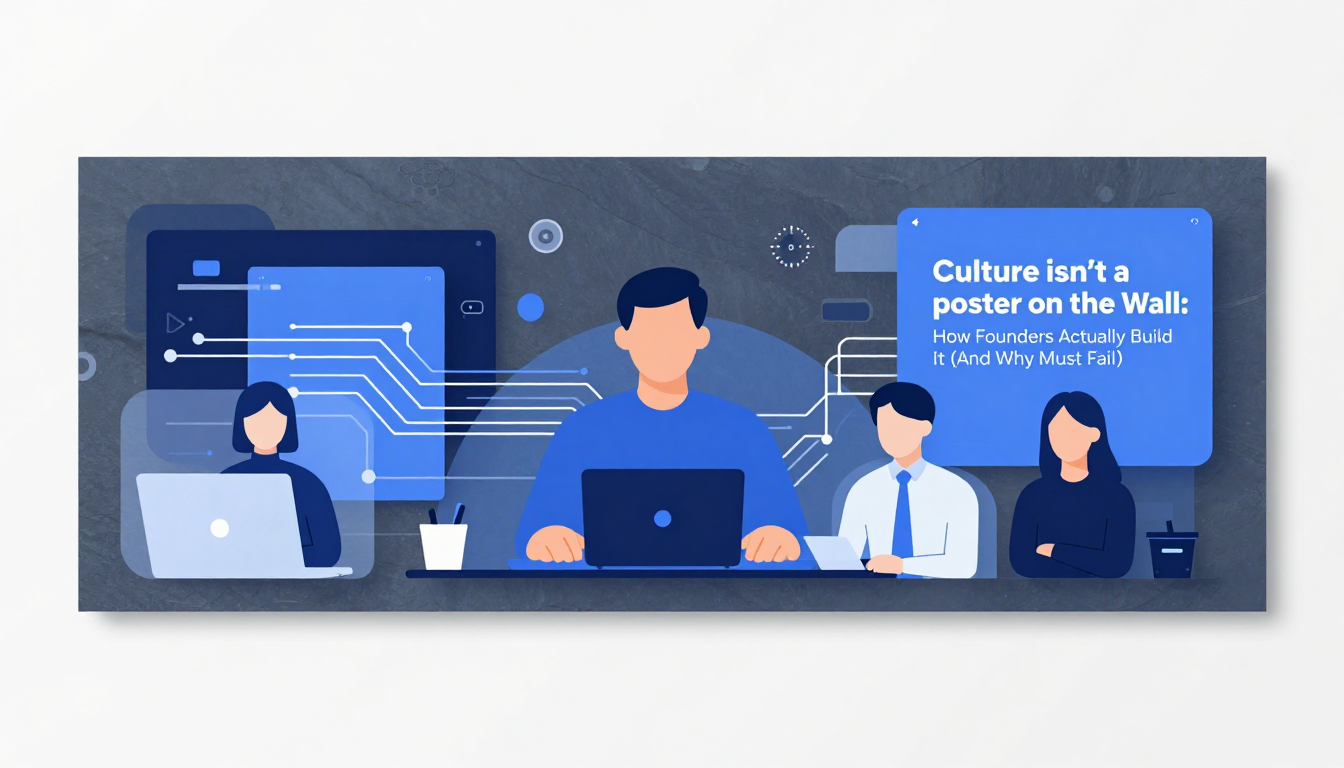
Culture Isn't a Poster on the Wall
I've seen it a hundred times.
A founder proudly shows me their office: a mural of core values, a ping-pong table, free snacks, and a 'no jerks' policy printed on the bathroom door.
They think they've built culture.
They haven't.
Culture isn't what you put on a wall.
It's what happens when no one's watching.
It's the person who stays late to fix a bug because they believe in the mission—not because they'll get a bonus.
It's the manager who calls out a toxic joke in a meeting, even though the guy telling it is their best performer.
It's the engineer who says, 'I don't think this is the right direction,' and isn't punished for it.
The truth?
Most companies don't build culture.
They inherit it.
And what they inherit is usually chaos.
It's not that founders don't care.
It's that they're busy.
They're fundraising.
They're hiring.
They're shipping.
And culture? That's the thing you do 'when you have time.'
Spoiler: you never have time.
So culture becomes whatever the loudest person says it is.
Or worse—whatever the first hire who didn't get fired decides it is.
I talked to five founders who did it differently.
They didn't wait.
They didn't assume.
They built.
And here's what they taught me.
The First Hire Isn't a Hire—It's a Cultural Anchor
Leah Solivan, founder of TaskRabbit and now Precedent VC, told me something that stuck:
'The first person you hire isn't a role. It's a mirror. If you hire someone who's smart but arrogant, you're not hiring a developer—you're hiring a culture virus.'
She hired her first engineer at TaskRabbit after a five-hour interview.
Not because he knew React.
But because he asked, 'What's the one thing you wish you'd done differently in your last company?'
That question? That's the kind of person who'll ask hard things later.
The kind who'll say, 'This meeting is a waste,' when the team's running in circles.
Most founders hire for skills — but what if the future of hiring looks nothing like a resume? Companies like Fika Jobs are replacing traditional applications with interactive video portfolios to find talent beyond the page.
The ones who hire for character?
They don't just ask about it.
They test it.
Ayal Yogev, co-founder of Anjuna, ran his first interview like a war game.
He gave the candidate a fake codebase—full of technical debt—and asked them to fix it.
Then he watched.
Did they fix it quietly?
Or did they ask why the debt existed in the first place?
The ones who asked why? They got the job.
The ones who just fixed it? They got a thank-you note.
Because culture isn't about what you do.
It's about why you do it.
And the first hire? They're the one who'll either start the conversation—or shut it down.
So stop asking, 'Can they code?'
Ask: 'Will they speak up when no one else will?'
Leadership Is the First Ritual
I used to think leadership was about vision — but as Mark Zuckerberg's journey from Harvard to the metaverse shows, it's really about the choices you make when no one is watching.
Turns out, it's about repetition.
Hala Jalwan, CEO of Rivio, runs a weekly meeting called 'The Uncomfortable.'
It's not a standup.
It's not a retrospective.
It's a 20-minute slot where anyone can call out a behavior they've seen that's hurting the team.
Not a person.
A behavior.
'Last week, someone interrupted Jen during the sprint review,' Hala told me.
'We didn't name names. We just said: "Interruptions are killing our psychological safety."'
Then they wrote it down.
And they didn't move on until someone proposed a solution.
'We decided: no one speaks until the last person is done. If you interrupt, you buy coffee for the team.'
It sounds silly.
But here's the thing:
People don't forget the coffee.
They forget the policy.
Leadership isn't about your title.
It's about the rituals you enforce.
Ian Schmidt, a consultant at Trimergence, told me this:
'The most dangerous word in a startup isn't "pivot." It's "everyone knows."'
Because when everyone knows something, no one's responsible for documenting it.
And when it's not documented?
It dies with the person who knew it.
So Hala doesn't just call out behaviors.
She documents them.
Every 'Uncomfortable' becomes a bullet in a shared Notion doc.
'We have 47 entries now,' she said.
'The top three? Interrupting, ghosting feedback, and saying "I'm fine" when you're not.'
Culture isn't built in retreats.
It's built in the tiny, repeated moments where someone chooses to speak up.
And leadership? It's the person who makes sure those moments aren't ignored.
Diversity Isn't a Checkbox—It's a Conflict Engine
I've been in enough 'diversity panels' to know the script.
'We believe in inclusion!'
'We celebrate different perspectives!'
Then they hire five white guys from Stanford.
Jaspar Carmichael-Jack, co-founder of Artisan, did something different.
He hired a former prison librarian.
Not because she had tech experience.
Because she'd spent ten years mediating conflicts between inmates.
'She doesn't know what a CI/CD pipeline is,' Jaspar said.
'But she knows how to get people to listen when they're furious.'
And that's the point.
Diversity isn't about representation.
It's about friction.
The kind that forces you to explain yourself.
The kind that makes you realize your 'obvious' assumption is nonsense to someone else.
Leah Solivan told me she once passed on a brilliant engineer because he refused to work with a non-binary designer.
'He was the best coder on the board,' she said.
'But I knew if we hired him, we'd become the kind of company that lets brilliance excuse cruelty.'
That's not 'culture.'
That's a dealbreaker.
And Jaspar? He didn't just hire the librarian.
He gave her a seat at the product review table.
No agenda.
No title.
Just: 'What do you see?'
And what she saw?
'Your onboarding flow feels like a police interrogation,' she said.
'People are scared to ask questions.'
They redesigned it.
And churn dropped 32%.
Diversity isn't about being nice.
It's about being right.
And if your team only looks like you?
You're not building culture.
You're building echo chambers.
And echo chambers don't scale.
They implode.
Layoffs Don't Break Culture—They Reveal It
Here's the brutal truth:
You don't know what your culture is until you have to fire someone.
I've seen companies do layoffs with spreadsheets.
I've seen them do it with Zoom calls.
I've seen them do it with a Slack message.
And I've seen one company do it with a town hall.
Leah Solivan was part of the team that laid off 30% of TaskRabbit's staff in 2018.
They didn't hide it.
They didn't sugarcoat it.
They showed up.
And they let people cry.
'We didn't say, "This is for the good of the company."'
'We said, "This is for the good of the people who stayed."'
They gave everyone who was laid off three months of pay.
And a letter.
Not a template.
A real letter.
Handwritten by Leah.
'I wrote each one by hand,' she said.
'I told them what I saw in them. What they taught me. What I'd miss.'
The people who stayed?
They didn't feel guilty.
They felt responsible.
Because the culture didn't say, 'Survive.'
It said, 'We're all in this together.'
Jaspar did something similar at Artisan.
When they had to cut 15% of the team, he didn't do it in a single day.
He did it over two weeks.
Each person got a 45-minute exit interview.
Not with HR.
With the person they worked with most.
'It wasn't about feedback,' he said.
'It was about saying thank you.'
And the people who stayed?
They didn't wonder if they'd be next.
They wondered how they could make it better.
Culture isn't about the perks.
It's about the dignity.
And if you can't treat people with dignity when you're cutting them?
You never had culture to begin with.
The Only Metric That Matters
I asked Hala what she measures for culture.
She laughed.
'I don't.'
'I measure how often people say, "I don't know."'
Not 'I don't care.'
Not 'I'm too busy.'
'I don't know.'
Because if people are afraid to say they don't know?
They'll fake it.
And then they'll build something broken.
And then someone gets hurt.
Ian Schmidt calls this 'the silence tax.'
It's the cost of not asking.
Not speaking up.
Not challenging.
And it's invisible.
Until it's not.
Until a product fails.
Until a customer leaves.
Until someone quits.
And then you say, 'What happened?'
And the answer is always the same:
'No one said anything.'
So if you want to know if your culture is working?
Don't look at engagement scores.
Don't look at retention.
Look at your Slack.
How many times did someone say, 'I'm not sure this is right,' and get a response that wasn't 'Don't worry about it'?
How many times did someone say, 'I need help,' and get a real answer?
Culture isn't a poster.
It's a conversation.
And if you're not having it?
You're not building culture.
You're just waiting for it to die.