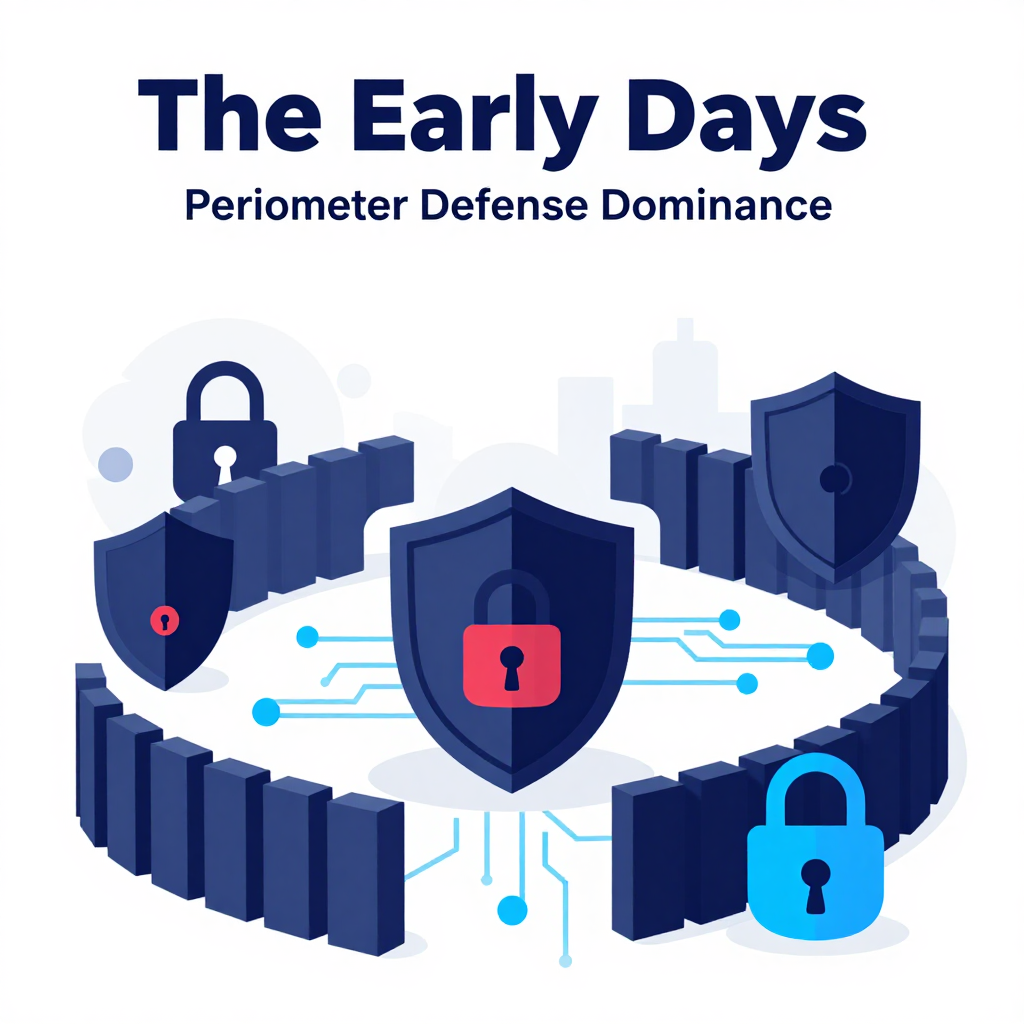
The Early Days: Perimeter Defense Dominance
Twenty years ago, the cybersecurity industry looked completely different. The primary focus was on antivirus software and firewalls—the twin pillars of what we now call perimeter defense. Network security was conceptualized as a castle with high walls; once inside the firewall, systems were largely trusted. This model made sense in an era when most organizations operated on isolated networks with limited internet exposure.
Firewalls were positioned as the primary gatekeepers, filtering inbound traffic based on port and protocol rules. Antivirus software scanned files for known malware signatures, operating on the principle that threats could be identified and eliminated before they caused harm. The threat landscape was relatively simple: viruses spread through floppy disks and early email attachments, and large-scale coordinated attacks were rare occurrences rather than constant threats.
However, this perimeter-centric model contained fundamental weaknesses that would become increasingly apparent. The assumption that everything inside the firewall was trustworthy overlooked the insider threat and the possibility of compromised internal systems. The rise of web applications created new attack vectors that traditional firewalls couldn't address, as malicious traffic often masqueraded as legitimate HTTP requests.
The Rise of Advanced Persistent Threats
As networks became more interconnected and organizations began adopting internet-connected systems, the limitations of perimeter defense became starkly evident. Attackers developed new techniques to bypass traditional security controls, leading to the emergence of advanced persistent threats (APTs). These sophisticated campaigns, often backed by nation-states or well-funded criminal organizations, could remain hidden within networks for months or even years.
The concept of "security through obscurity" began to fade as attackers discovered vulnerabilities in software that had been assumed secure. Buffer overflow attacks, SQL injection, and cross-site scripting emerged as common exploitation techniques. Firewalls that once provided effective perimeter defense were circumvented through covert channels, DNS tunneling, and other sophisticated methods.
This period saw the birth of endpoint protection platforms (EDR) that moved beyond simple signature-based detection to behavioral analysis. Security information and event management (SIEM) systems emerged to provide centralized visibility across distributed environments. These innovations represented the first major shift away from pure perimeter defense toward a more comprehensive security posture.
Cloud Computing and the Demise of Traditional Perimeters
The advent of cloud computing delivered a fatal blow to the traditional perimeter security model. When data and applications moved to third-party infrastructure, the concept of a fixed network boundary became meaningless. The firewall was no longer a reliable gateway because traffic flows were dynamic, encrypted, and often routed through multiple intermediaries.
Organizations realized that defending a static perimeter was insufficient when their data resided in multiple cloud environments, accessed by users on mobile devices from anywhere in the world. This realization gave rise to zero-trust architecture, a paradigm shift that assumes no user or system should be trusted by default, regardless of location.
Zero trust implements the principle of "never trust, always verify" through several key components: continuous authentication, least-privilege access controls, micro-segmentation of networks, and comprehensive visibility across all environments. Instead of relying on the firewall to keep bad actors out, zero trust assumes some level of compromise has already occurred and focuses on limiting lateral movement within the environment. For more information, see our guide on zero-trust architecture.
AI-Native Security: The Current Paradigm
Today, we are witnessing another fundamental shift—the rise of AI-native security. Artificial intelligence and machine learning have become integral to modern security operations, transforming how organizations detect, respond to, and predict threats. AI-native security platforms can analyze vast amounts of data in real-time, identifying patterns and anomalies that would be impossible for human analysts to detect manually.
These AI-driven systems provide several key advantages over traditional approaches. First, they offer speed and scale that manual security operations cannot match. Second, they enable predictive capabilities, identifying potential threats before they materialize. Third, they provide context-aware analysis, distinguishing between legitimate anomalies and genuine security incidents.
The integration of AI into security tools has created new categories of solutions, including extended detection and response (XDR), deception technology, and automated threat hunting platforms. These systems work together to provide comprehensive protection across endpoints, networks, cloud environments, and identity systems. Our AI-native security guide provides deeper insights.
The Future of Cybersecurity
Looking ahead, cybersecurity will continue to evolve as attackers adopt more sophisticated techniques. Quantum computing threatens to break current encryption standards, while AI-powered attacks could become increasingly realistic and difficult to detect. The cybersecurity industry must therefore remain agile, continuously adapting its approaches to counter emerging threats.
The converged security platform—unifying multiple security layers into a single, coherent system—represents the next evolution. These platforms share intelligence across components, enabling coordinated defense and faster response times. As AI becomes more integral to security operations, the line between detection, analysis, and response will continue to blur, leading to increasingly autonomous security systems.
Organizations that succeed in this evolving landscape will be those that embrace continuous learning, invest in security automation, and maintain a strong foundation in zero-trust principles. The cybersecurity journey has come full circle: from simple perimeter defense, through complex layered approaches, to AI-native systems that can adapt and learn as quickly as the threats they're designed to counter.
Conclusion
The cybersecurity landscape has transformed dramatically over the past two decades. What began as a focus on antivirus and firewalls has evolved into sophisticated AI-native security platforms capable of autonomous threat detection and response. This evolution reflects broader technological changes—from the rise of cloud computing to the proliferation of connected devices—and will continue as new threats emerge and AI capabilities advance.
As we look to the future, cybersecurity professionals must balance the promise of AI-driven automation with the need for human oversight and ethical considerations. The goal is not to replace human expertise but to augment it, providing security teams with the tools they need to protect organizations in an increasingly complex digital world.