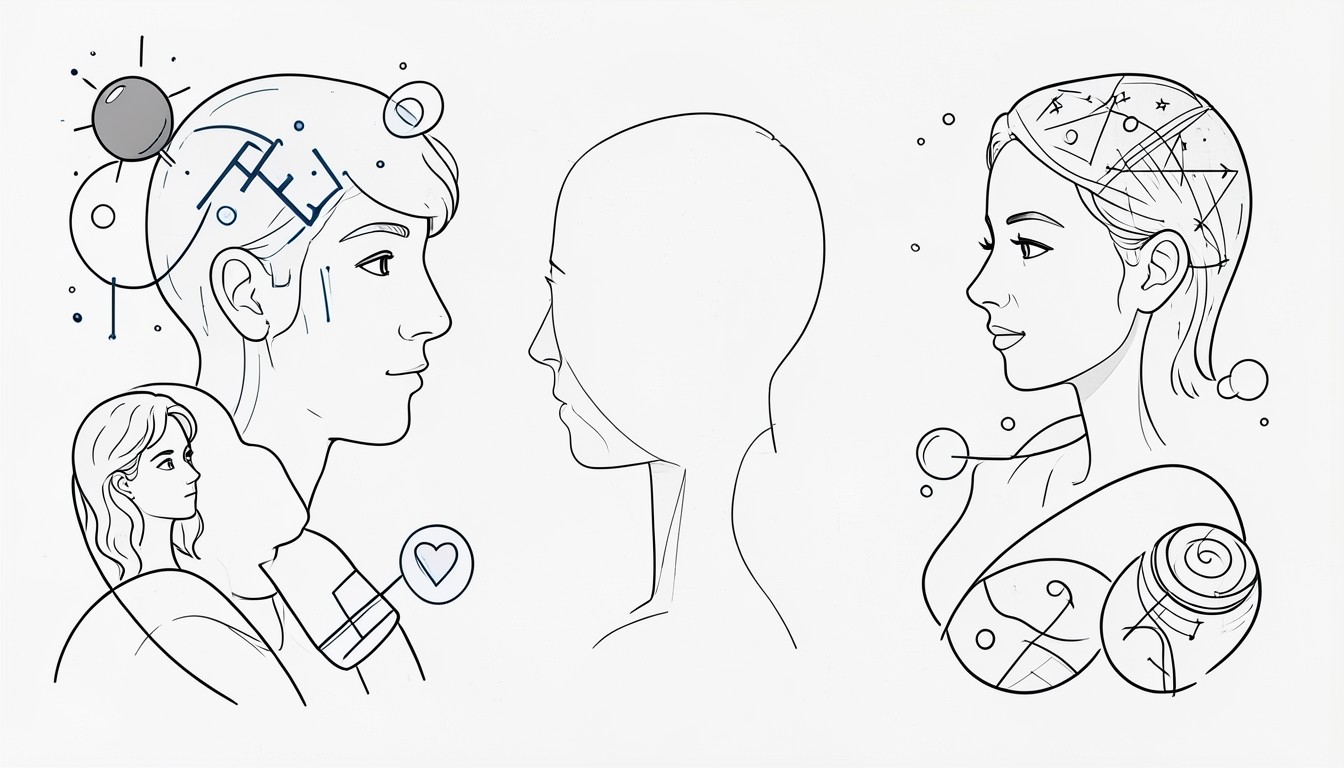
The shift from disclosure to inference
For most of the history of mental-health care, the most sensitive information a clinician could hold was something a person chose to say out loud. The boundary was simple: what you disclosed, they knew; what you withheld, they did not. Artificial intelligence is quietly dissolving that boundary. Today a growing body of machine-learning systems can identify signs associated with depression, anxiety, stress, post-traumatic stress disorder, suicidal ideation, eating disorders, and obsessive-compulsive disorder from the digital activity we generate without ever "confessing" anything. The commentary we post, the chatbot conversations we start at 2 a.m., the way we scroll, search, and self-catalogue all become raw input. This is the AI impact on human psychology at its most consequential: not a diagnosis we consent to, but a pattern a machine deduces on our behalf.
George Orwell, writing nearly eighty years ago, imagined surveillance as something imposed from above by a controlling state. He could hardly have anticipated the inversion we now live: billions of ordinary people who pay for the privilege of carrying their own monitoring devices, voluntarily uploading their moods, location, and vulnerabilities to systems that watch them back. The old privacy question was what powerful institutions were permitted to see. The new one is sharper and stranger: what are they permitted to infer?
What is AI in psychology?
To understand the stakes, it helps to define the terms plainly. "AI in psychology" refers to computational systems—most often machine-learning and natural-language-processing models—applied to questions about human thought, emotion, and behavior. In research settings these tools mine large text corpora for statistical markers of distress. In consumer settings they power chatbots, wellness apps, and the recommendation engines that decide what we see. The same underlying capability shows up across both: a system that can spot a pattern in language and behavior.
That capability has matured fast. In a 2025 systematic review, Rizaldi and colleagues examined forty studies using machine learning and natural-language processing to detect a wide range of conditions from social-media and digital posting data. In a 2026 scoping review, He and colleagues surveyed 136 studies published between 2021 and early 2026, focused on mental-health risk detection from social-media text. The takeaway across both reviews is sober rather than triumphant: these systems detect risk proxies, not clinical diagnoses, and they still struggle with validation, labeling, and generalizability across different populations and platforms.
Can AI understand human psychology?
This is the question that hides inside every deployment, and it deserves a direct answer. Can AI understand human psychology? Not in the way a trained clinician does. A model can flag a correlation—vocabulary shifts, sleep-timing signals, the cadence of posts at odd hours—without grasping the living system that produced them. As the psychologist Kimberly Key puts it, an algorithm may identify a pattern without understanding the broader living system and the influences shaping it.
Human behavior does not occur in a vacuum. The environments we inhabit shape what we say, how we say it, and which versions of ourselves we present. A clinician reads a pattern in context: a person's history, culture, current circumstances, and—crucially, their own account of what is happening. A pattern is not a promise. The gap between "the model flagged elevated risk" and "this person is unwell" is precisely where human judgment is supposed to live, and it is exactly the gap that automation is tempted to skip.
So the honest framing is this: AI in psychology is a powerful detector of statistical signals, and only a very partial, context-blind interpreter of meaning. Confusing the first for the second is the core error driving the privacy threat.
The hidden architecture of inferential privacy risk
Most people already accept that algorithms track their preferences and serve targeted ads; many even like it, experiencing it as a personal shopper who spares them the clutter. That comfort is built on an assumption, that what the machine knows about you is what you told it, or what you did in the open. Inference breaks the assumption. Once a model can derive attributes you never disclosed, the protection built around "I simply did not share that" collapses.
The data most legal and regulatory frameworks are designed to protect tends to be disclosed or collected data: information somebody handed over. Inferential data sits in a gap. It is neither a formal diagnosis nor something the individual knowingly revealed, which means it often falls outside the categories that privacy rules were written to shield. That mismatch is the heart of the policy challenge: when an algorithm infers a mental-health risk a person has never disclosed, sought treatment for, or perhaps even recognized in themselves, what protections actually apply? And who gets to see the answer?
The risk is not abstract. Being marked as a mental-health risk, however inaccurately, can shape what an advertising platform shows you, what an insurer or employer might act on if such signals ever reach them, and how a wellness app routes you, all on the basis of a pattern the machine generated and you never confirmed.
Where should the boundary lie?
The most durable way to think about the AI impact on human psychology is as a question of boundaries rather than a question of technology. We learn boundaries intuitively: the line between a difficult relationship and our own peace, the line between work and time off. The new frontier adds two harder lines. There is the boundary between what I communicated to you and what you inferred about me. And there is the boundary between what I know about myself and what an algorithm believes about me, whether that belief is being used to support me or to surveil and monetize me.
What makes a boundary healthy is not simply that it exists. It is what the boundary protects and what it still allows to pass through. A reasonable society may allow some inference, early-warning systems that genuinely help a person in crisis, with their knowledge. The line we should be negotiating is where inference stops being care and starts being covert categorization: when a machine assigns you a psychological label you never agreed to carry, in a context that was never framed as clinical.
What individuals can do now
While policy catches up, the asymmetry favors anyone with a model and a dataset. That does not leave people powerless. It helps to treat chatbot and app conversations as potentially diagnostic surfaces, not neutral journals, especially the wellness and companion tools that quietly build psychological profiles. Reviewing app permissions, limiting the personal-detail volume of public posts, and reading the privacy language around "derived" or "inferred" data categories (the phrasing that signals inference is happening) are small, concrete acts of boundary-setting. None of these defeat a determined model. All of them reclaim a little of the ground the inference engine assumed it owned.
The question we are actually facing
Orwell asked what would happen when surveillance gave powerful institutions unprecedented access to people's lives. Nearly eighty years later, the question has mutated. Our digital breadcrumbs increasingly reveal, or lead machines to infer, things we never consciously disclosed. The challenge is therefore no longer simply protecting what we choose to keep private. It is protecting the boundary around what others are permitted to infer about our inner lives, and insisting that the gap between a detected pattern and a human being's actual experience is a gap no algorithm gets to close on its own.
References
- He, Y., He, Y., & Liu, D. (2026). Mental Health Risk Detection From Social Media Text Data: A Scoping Review of the Machine Learning Research Landscape. PsyCh Journal, 15(3), e70100.
- Key, K. (2026). What Do Digital Breadcrumbs Reveal About Your Mental Health? Psychology Today.
- Rizaldi, Kusrini, & Utami, E., & Agastya, I. M. A. (2025). A Systematic Literature Review of Early Detection of Mental Health Disorders Based on Social Media Activity Patterns Using Machine Learning Algorithms. 2025 13th International Conference on Cyber and IT Service Management (CITSM), 1–6.