
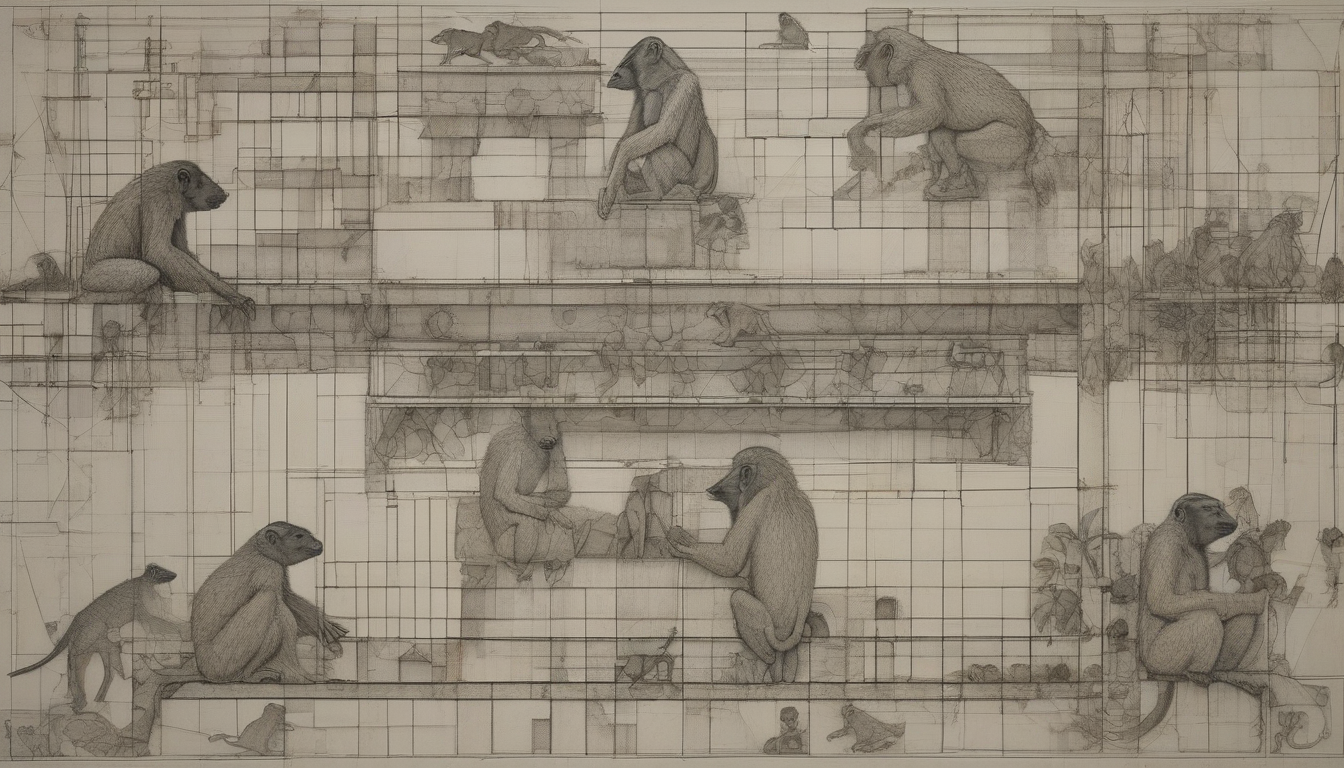
The Geometry We’re Born With
You ever look at a triangle and just know it’s a triangle—even if it’s rotated, stretched, or drawn in chalk on a dusty sidewalk? You didn’t learn that. You were born with it.
So were the baboons.
A new study, published in PNAS, didn’t just confirm what some neuroscientists suspected—it shattered the myth that geometry is a human invention. Olive baboons, rhesus macaques, 4-year-olds in Pittsburgh, and adults from the Tsimane’ people in the Bolivian rainforest—all used the exact same mental toolkit to match abstract 2D shapes. No color cues. No size hints. Just pure, stripped-down geometry.
And here’s the kicker: they weren’t just close. They were identical.
Jessica Cantlon, the lead researcher at Carnegie Mellon, put it bluntly: “It wasn’t that monkeys could do the task. It was that they thought about it the same way we do.”
That’s not a coincidence. It’s a relic.
We’ve spent centuries treating geometry as a cultural achievement—something Euclid dreamed up, something schools drill into kids with protractors and worksheets. But what if it’s not learned at all? What if it’s wired?
The study’s design was brutal in its simplicity. Participants—human and non-human alike—were shown a target shape and three options. Only one matched the target by geometric structure: parallel lines, angles, symmetry. The rest were decoys, identical in color, size, texture, even orientation. You had to ignore everything you could see—and focus on what you couldn’t.
Adults? Struggled. Kids? Struggled. Baboons? Struggled. And yet, they all struggled the same way.
“It’s harder than you think,” Cantlon admitted. “I’d sit there watching the screen, and I’d get it wrong. You’re not supposed to notice the color. You’re not supposed to notice the size. You’re supposed to see the relationship.”
And the baboons? One of them, Kalamata, showed up every day like clockwork. Two to three hours. No treats. No coercion. Just… curiosity. He’d sit, stare, tap. Sometimes for hours. He didn’t need to be trained. He needed to be allowed.
This isn’t about intelligence. It’s about architecture.
The Tsimane’ adults didn’t go to school. Most had never seen a map. They didn’t know what a right angle was. But when they looked at those shapes? They matched them like they’d been raised on Euclid.
That’s not culture. That’s biology.
We like to think of the human mind as a blank slate, sculpted by language, by schooling, by civilization. But the slate was never blank. It was carved long before we could speak.
We’ve found 70,000-year-old stones with parallel lines. 35,000-year-old mammoth tusks with 88 notches arranged in rows. Our ancestors didn’t write numbers. They wrote geometry.
And now we know why.
Because the ability to recognize shape relationships didn’t evolve for math class. It evolved for survival. To navigate forests. To track prey. To understand the layout of a cave, the angle of a cliff, the symmetry of a fruit-bearing branch.
Geometry isn’t a human invention.
It’s a primate inheritance.
And if you think your kid’s struggling with angles in school? Maybe the problem isn’t them.
Maybe it’s the curriculum.
The Primate Portal: When Baboons Teach Kids to Code
Here’s the part no one expected: the most powerful tool in this research wasn’t the touchscreen.
It was the kids.
The Primate Portal isn’t just a research station. It’s a living classroom. Located at Seneca Park Zoo, it’s an open-air kiosk where olive baboons can walk up, sit down, and tap on a screen whenever they feel like it. No trainers. No rewards. No pressure. Just a simple matching game—and the freedom to opt out.
And then, something wild happened.
Kids started showing up.
Not to watch.
To code.
Caroline DeLong, a co-author on the study and a professor at RIT, realized the data wasn’t just for scientists. It was for students. So she flipped the script. Instead of teaching children geometry, she taught them to build the geometry tasks for the baboons.
Elementary schoolers learned Scratch. They designed shape-matching games. They tweaked difficulty levels. They tested them on tablets. Then they traveled to the zoo, watched Kalamata play their game, and rewrote it based on what they saw.
One girl, age 9, designed a level where the shapes rotated in 45-degree increments. She thought the baboons would find it easy. Kalamata failed it—every time.
So she changed it. Made the rotations slower. Added a visual anchor. He aced it.
“She didn’t learn geometry from a textbook,” DeLong told me. “She learned it by trying to make a monkey understand it.”
The results? Not just better math scores.
Better belief.
Kids who participated in the program showed a 37% increase in STEM career interest. They stopped thinking of science as something you study—and started seeing it as something you build.
And the baboons? They didn’t care about grades. But they cared about consistency.
Kalamata never missed a day. He’d wait by the screen like a kid waiting for the bus. When the system rebooted? He’d tap the start button himself.
That’s not training.
That’s partnership.
We’ve spent decades trying to teach animals to think like humans. But here, humans learned to think like animals.
And in the process, they rediscovered something fundamental:
The best way to understand a mind isn’t to test it.
It’s to build something for it.
And then watch it play.
The Archaeology of Shape
Let’s go back.
Not to the lab. Not to the zoo.
To a cave in South Africa. 70,000 years ago.
A man—or maybe a woman—picked up a piece of ochre-stained stone. They didn’t carve a face. Didn’t draw a bison.
They etched two parallel lines.
Then another. Then another.
Why?
Not for art. Not for ritual.
For pattern.
Archaeologists call it “symbolic behavior.” I call it geometry.
Then there’s the mammoth tusk from Ukraine—35,000 years old—with 88 notches, grouped in rows of seven and eleven. Not random. Not decorative.
Structured.
This isn’t counting. Not yet.
This is arranging.
It’s the same cognitive leap that let a baboon match a diamond to a diamond, even when it was upside down.
We think of math as a ladder: counting, then adding, then algebra, then calculus.
But what if it’s a tree?
Geometry—the intuition of shape, symmetry, orientation—is the trunk.
Counting? That’s a branch.
Language? A leaf.
The human brain didn’t invent math.
It uncovered it.
We didn’t create geometry.
We found it, buried in the architecture of our own minds—and in the minds of our cousins.
And here’s what’s haunting:
That same brain—the one that made the 70,000-year-old stone—is the one reading this right now.
The same one that made Kalamata tap the screen.
The same one that let a 4-year-old in Pittsburgh match a parallelogram to its twin.
We didn’t evolve to do calculus.
We evolved to recognize that a shape can stay the same even when everything else changes.
That’s not a skill.
It’s a memory.
A deep, ancient, primate memory.
And if you’ve ever stared at a shape and felt that quiet click—the one that says, “I know this”—
you’re not remembering a lesson.
You’re remembering your lineage.
The Myth of the Blank Slate
We’ve been sold a lie.
That kids are blank slates.
That learning is a matter of filling them up.
That geometry is something you teach.
It’s not.
It’s something you unlock.
The Tsimane’ adults didn’t have textbooks. They didn’t have rulers. They didn’t know what a triangle was called.
But when they saw the shapes? They saw the relationships.
No training. No words. No symbols.
Just the same neural circuitry that lets a baboon know a rotated diamond is still a diamond.
This isn’t just about monkeys and kids.
It’s about how we teach.
We treat math like a foreign language. We hand kids a dictionary and say, “Memorize this.”
But what if they already speak the language?
What if the words are just labels for something they’ve always known?
Imagine a classroom where the first lesson isn’t “What’s a right angle?”
But: “What do you notice about this shape?”
Where kids aren’t told to memorize formulas—but asked to build tools for baboons.
Where the goal isn’t to get the answer right—but to understand why the monkey got it wrong.
That’s not education.
That’s reconnection.
We’ve spent so long trying to make children learn geometry that we forgot they were born knowing it.
We don’t need more worksheets.
We need more windows.
Windows into the minds of monkeys.
Windows into the minds of our ancestors.
And windows into the quiet, ancient part of our own brains that still remembers how to see shapes—not as objects, but as relationships.
The next time your child draws a square and says, “It’s like a door,”
they’re not being cute.
They’re remembering.
And so are you.