
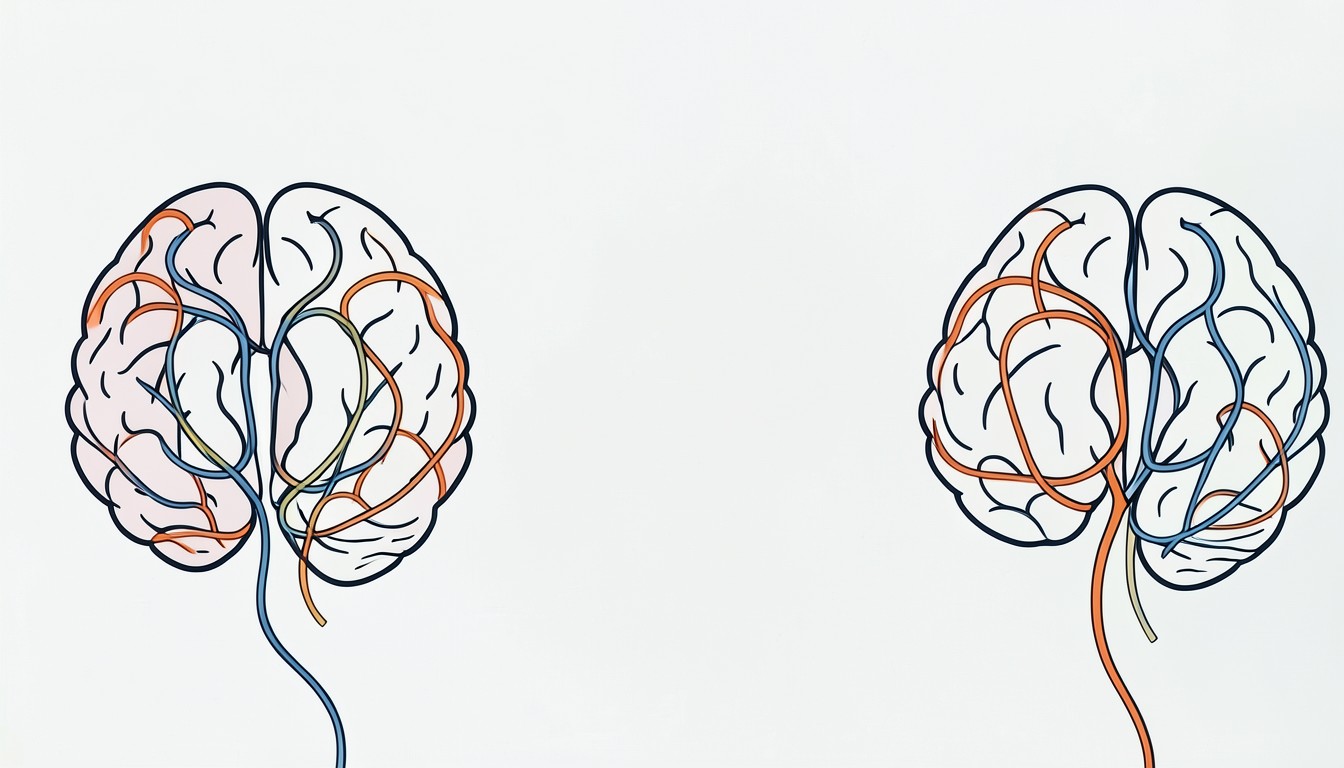
Introduction to the Evolutionary Puzzle of Brain Cross-Wiring
One of the most enduring enigmas in neuroanatomy is contralateral organization: why did vertebrates evolve central nervous systems where the left cerebral hemisphere monitors and directs the right side of the physical body, and the right hemisphere commands the left? While medical students and neuroscientists routinely memorize the intricate crossings of the brainstem and spinal cord—known as decussations—the evolutionary pressures that produced this complex arrangement have puzzled researchers since the era of Santiago Ramón y Cajal. Countless papers since Cajal have speculated about the adaptive value of this crossed wiring, yet to date none, according to a striking new claim, had directly examined its evolutionary history.
A theoretical neuroanatomy paper published in Frontiers in Neuroanatomy (October 1, 2026; DOI 10.3389/fnana.2026.1937941) by Daniel Delie Wang and Martin W. Wessendorf of the University of Minnesota proposes a revolutionary explanation. Their thesis is that our brains are cross-wired not because it offered a direct adaptive advantage for motor control or sensory processing, but because of an ancient optical constraint established over 500 million years ago. This finding reframes a textbook fact of human biology as a legacy of deep evolutionary history. It also offers a profound case study in how foundational biological architectures are inherited rather than invented—a theme with direct implications for how we study cognition, complex systems, and scientific discovery.
The Midbrain Visual Template: Optical Inversion as the Root Cause
To understand why our brains control the opposite side of our bodies, Wang and Wessendorf argue that we must look not to the limbs or the cortex, but to the physics of vision in our earliest vertebrate ancestors. In the Cambrian period, more than half a billion years ago, the first vertebrates developed primitive camera-type eyes. The fundamental physics of a lens dictates that light from the left visual field strikes the right side of the retina, while light from the right visual field strikes the left side. Because an optical lens inverts the image it projects, an early animal needed a reliable way to make sense of that inverted input.
To correctly map the environment, these early vertebrates had to route the visual information across the midline of the brain to a single unified spatial map. This produced two features conserved across all living vertebrates: the optic chiasm, the crossing point of the optic nerves, and the contralaterally mapped optic tectum—the superior colliculus in mammals. In every vertebrate species reported, input from each visual field is carried by the optic tract to the opposite optic tectum, where it is laid out retinotopically, preserving a point-by-point map of the world.
This cross-wiring of vision was not a choice but a geometric necessity born of optical inversion. Once established, this contralateral tectal map became a conserved spatial template for the entire nervous system—a deep heritage that remains visible today even in ancient vertebrate body plans. The authors' key move is to ask what happens when later-evolving circuits must plug into a map that is already organized this way.
Why Decussations and Motor Cross-Wiring Follow a Preexisting Map
As vertebrates evolved more sophisticated bodies, including four-limbed tetrapods, the nervous system had to manage increasingly complex sensory and motor functions. Yet rather than each new tract evolving its own independent logic of left and right, the authors hypothesize that new pathways were constrained by the visual template. The mammalian brain evolved its characteristic wiring because the new motor and sensory tracts could be most efficiently integrated into the ancient visual architecture by adopting the exact same contralateral rules. Wang and Wessendorf frame this as a form of structural co-option, and it is here that evolutionary biology offers a precise vocabulary: the idea of an evolutionary spandrel, a trait that is a byproduct of selection on some other feature rather than an adaptation in its own right.
The authors examine the major contralaterally organized circuits found across living vertebrates and build a stepwise evolutionary record. In most tetrapods, somatosensation and hearing are carried rostrally to the forebrain by contralaterally organized circuits, with the dorsal column and spinothalamic pathways, responsible for touch, position, and pain, crossing the midline before reaching the cortex. Likewise, the last common ancestor of mammals appears to have had a contralaterally organized neocortex, including a corticospinal tract. Stem amniotes, the predecessors of reptiles, birds, and mammals, appear to have already possessed contralateral motor systems including the tectospinal and rubrospinal tracts.
By this account, the decussating tracts, the dorsal column, spinothalamic, tectospinal, rubrospinal, and corticospinal pathways, did not each evolve independently as specific adaptations for limb control. Instead they followed the pre-existing spatial map established by ancient midbrain vision circuits. The authors describe this as the neocortex adapting to contralateral organization itself so that it could integrate directly with those circuits without the "wiring cost" that altering them would incur. In this elegant formulation, a simple optical problem solved at the dawn of vertebrate history continues to dictate the layout of our bodies and the function of our primate dexterity millions of years later.
From Vision to Touch: The Sensory Decussation as Inheritance
Understanding the sensory decussation through this lens helps explain otherwise puzzling details of the nervous system. The dorsal column-medial lemniscus pathway, carrying fine touch and proprioception, crosses in the lower brainstem, while the spinothalamic tract, carrying pain and temperature, crosses in the spinal cord shortly after entering. The two pathways cross at different levels but in the same direction, bringing the opposite side of the body into the opposite hemisphere.
If these crossings were independently selected adaptations for somatosensation, one might expect a more uniform and perhaps simpler arrangement. The spandrel interpretation is that the crossings exist because the forebrain was already committed to a contralateral spatial reference frame established by vision. The cost of routing new sensory tracts into that frame was lower than rewiring the frame itself, so natural selection co-opted the existing geometry.
Biological Constraints and Structural Inheritance in Scientific Discovery
In any inquiry into complex adaptive systems, one of the most compelling ways to study intelligence and biological evolution is to compare organic wiring with computational frameworks. The case of brain cross-wiring offers a profound lesson on the role of inheritance and deep historical constraints. Wang and Wessendorf's argument echoes a broader recognition in modern life sciences: foundational biological structures are inherited and repurposed rather than designed from scratch.
This theme recurs across contemporary research. Landmark analyses published in venues like Nature Reviews Neuroscience examining the molecular Regulators of human brain evolution emphasize that developmental and genetic programs are repeatedly co-opted, with new capabilities layered onto deeply conserved regulatory substrates. The authors' cross-wiring hypothesis serves as a neuroanatomical companion to that principle: new functional circuits conform to ancient spatial maps.
This principle is equally vital for researchers exploring artificial intelligence, scientific discovery, and product innovation. Artificial neural network architectures demonstrate that early constraints and inherited design patterns profoundly shape what a learning system can achieve. Just as the mammalian neocortex could integrate with ancient motor and sensory circuits only by accepting their contralateral geometry, machine-learning systems are constrained by their foundational data pipelines, attention heads, and optimization topologies.
The "Wiring Cost" Constraint Across Domains
The phrase the authors use—avoiding the "wiring cost" incurred by altering an existing map—provides a powerful bridge to computational and physical thinking. In any mature software platform, hardware architecture, or emerging frontier such as artificial intelligence and quantum computing, the expense of reorganizing a core representation often exceeds the cost of building new modules around it. Cross-wiring shows that this tradeoff is not a modern engineering invention; it is a 500-million-year-old feature of complex systems that must remain operational while undergoing transformation.
Recent breakthroughs in hybrid computational paradigms—particularly around ai quantum computing breakthrough initiatives—demonstrate that modern innovators frequently succeed by respecting hardware and architectural constraints rather than ignoring them. Understanding how evolution navigated wiring costs over half a billion years provides a conceptual mirror for contemporary technological innovation.
Why This Evolutionary Perspective Matters for Science and AI
The broader significance of Wang and Wessendorf's hypothesis lies in its demonstration that what looks like complexity or apparent inefficiency in biology is often the result of historical path dependence. By tracing decussations back to Cambrian optics, the University of Minnesota researchers bridge a vast chasm between biophysics and cognitive neuroanatomy.
For neuroscientists, this research opens fresh avenues for investigating how early developmental fields constrain adult connectivity. For computational designers and AI researchers, it reinforces the enduring truth that architecture is destiny. Whether shaped by natural selection in the Cambrian seas or engineered in modern laboratories, complex intelligence is forever molded by the foundational maps laid down at its inception.