
Why Inkling 2 Small matters to AI edge infrastructure
A model that is open-weight isn’t automatically an edge model. That’s the useful tension in Thinking Machines Lab’s Inkling 2 Small: its release gives developers more control over deployment, but its name shouldn’t be mistaken for a hardware promise. The distinction matters when teams assess AI edge infrastructure, where memory, throughput, power, and operational constraints can matter more than a model’s marketing label.
Thinking Machines describes Inkling 2 Small as a multimodal mixture-of-experts model with 594 billion total parameters and 17 billion active parameters. It accepts image and text inputs, and the company reports an Artificial Analysis Intelligence Index score of 31, with gains it attributes to improvements across training, including pre-training and a large unified reinforcement-learning run. Those figures describe the model and the company’s report; they don’t, by themselves, show that the model will fit a particular edge device or meet a production latency target. (Thinking Machines Lab announcement)
The announcement says the model’s weights became available under an Apache 2.0 license after external safety testing and red-teaming. The model card identifies its intended use as a general-purpose multimodal model for developers, including agentic and tool-use applications, coding assistants, chatbots, and retrieval-augmented generation. That combination makes it relevant to deployment planning: open weights make adaptation possible, while the model’s size and architecture make resource testing unavoidable. (Model card)
What is edge computing, and what is edge infrastructure?
Edge computing is a way of processing or storing data close to where it is produced, rather than sending every operation to a remote cloud or central data center. The “edge” might be a device, a local gateway, or infrastructure near the user or equipment. The point isn’t that cloud disappears; it’s that some work happens nearer the source so a system can respond without making every decision depend on a round trip to a distant service.
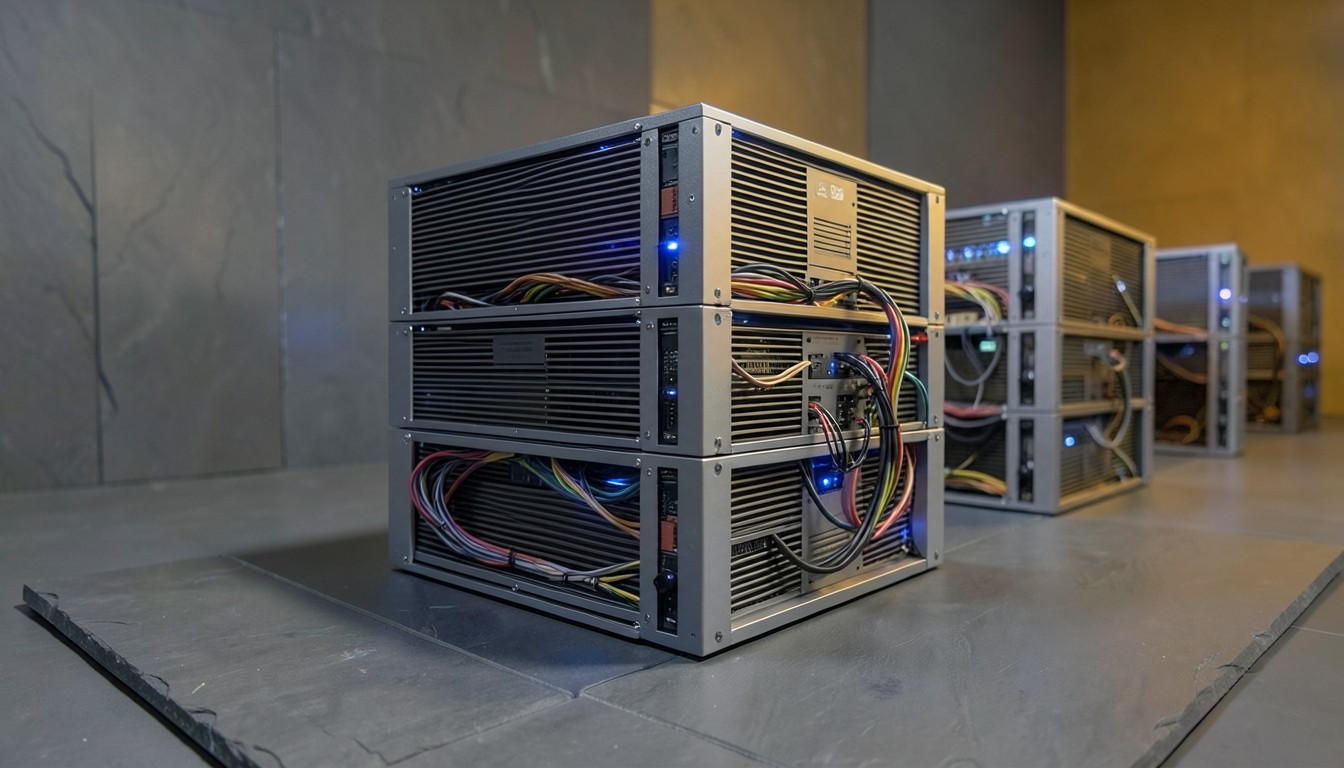
Edge infrastructure is the practical environment that makes that arrangement work. It can include the devices and compute hardware, local storage, networking, deployment software, monitoring, and the processes for updating and securing the system. There’s no single edge box that defines it. The right mix depends on where data originates, what response time is needed, what connectivity is available, and who will maintain equipment in the field.
Edge AI is more specific. IBM defines it as running AI models and algorithms on local edge devices, combining edge computing with AI so that machine-learning work can happen near the data source. That can support fast responses and reduce dependence on continuous cloud connectivity, though the actual benefits depend on the system and workload. (IBM: What Is Edge AI?)
Edge computing vs. edge AI
Edge computing describes where computing happens. Edge AI describes an AI workload running in that near-source environment. A gateway that filters sensor data locally uses edge computing; it becomes edge AI when a model performs inference there. The terms overlap, but they are not interchangeable.
That distinction matters for infrastructure readiness because existing edge-computing equipment does not necessarily meet an AI workload’s needs. A site may have local compute and networking yet still lack the memory, accelerators, software support, or operating procedures required to run a model reliably. Conversely, an AI workload may be deployed partly at the edge and partly in the cloud. Teams should assess the actual inference path, not simply label the whole deployment “edge.” (IBM: What Is Edge AI?)
The word “Small” doesn’t settle the hardware question
Inkling 2 Small’s 594B total parameters and 17B active parameters are different measures. In a mixture-of-experts model, only a subset of experts is activated for a token, but the total model still has to be represented and served in some way. Active parameter count can inform compute expectations; it is not a shortcut for estimating the full memory footprint or proving that a model fits on a particular device. Hardware format, runtime implementation, context length, concurrency, and serving design all matter.
The model card describes a 48-layer decoder-only transformer with a sparse mixture-of-experts feed-forward backbone, routing each token to 8 of 384 experts. It also describes hybrid local and global attention and a vision transformer for image inputs. The card lists MXFP8 and NVFP4 numerics support. These are useful technical details for engineering evaluation, not a guarantee of local-device compatibility. (Inkling 2 Small model card)
The practical question is less “Is it small?” and more “Which part of the deployment can run where?” A team might keep immediate perception or response near the device and use a larger server for heavier tasks. Or it may decide that a compact model is the better fit for the device, even if it is less capable. The architecture and workload determine the tradeoff; the name doesn’t.
A readiness check for AI compute at the edge
Before selecting a model, define the job. Is the system classifying an image, responding to a spoken request, summarizing records, or coordinating tools? The model card lists text and image inputs and general-purpose developer uses, but a prospective deployment still needs its own test set and acceptance criteria. A broad capability description is not a result for your production environment. (Model card)
Then test the whole path, not just a model benchmark:
- Memory and placement: Measure the memory required by the chosen weights, runtime, context, and concurrency. Decide whether inference belongs on a device, gateway, local server, or remote endpoint.
- Latency under load: Measure end-to-end response time with real inputs and realistic network conditions. A model’s published capability score does not answer whether it meets a specific application’s response target.
- Power and thermal limits: For field devices, sustained operation matters. Test long enough to see whether the device can maintain the required performance within its power and cooling envelope.
- Connectivity and fallback: Decide what should happen when the connection to a cloud service is slow or unavailable. Local inference can reduce dependence on that connection, but only if the local system is provisioned and designed to handle the task.
- Operations and updates: Establish how model artifacts, runtime dependencies, monitoring, and security changes reach distributed locations. Open weights offer flexibility; they also leave the deployment team responsible for integration choices.
This is where readiness for AI compute at the edge becomes concrete. Readiness is not a property of the model alone. It’s the result of matching a workload to hardware, validating performance at the intended location, and having a support plan for failures and updates.
Open weights expand options, not guarantees
Thinking Machines’ announcement says Inkling 2 Small is available for download and names integrations and API availability across several providers. That broadens the ways developers can experiment, from self-managed deployments to hosted inference. It does not establish that every listed runtime or provider supports every target edge device, nor does it prove a particular latency, cost, or memory profile. Those details need to be checked against the exact implementation being considered. (Thinking Machines Lab announcement)
The Hugging Face listing provides a model repository and usage guidance, including an image-text-to-text example using Transformers. That’s a useful starting point for developers, but sample code is not a deployment benchmark. Teams should verify the required software stack, supported numerical formats, model loading behavior, and actual device compatibility before committing to a design. (Hugging Face model repository)
Independent benchmark pages can help frame comparisons, but scores only mean something with their task, setup, and evaluation methodology attached. Treat them as a way to choose what to test next—not as a substitute for tests on the inputs, hardware, and operating conditions your system will face. (BenchLM model page)
The infrastructure decision is a workload decision
Inkling 2 Small is interesting because its open-weight release gives developers room to inspect, adapt, and integrate a capable multimodal model. It is not proof that a 594-billion-parameter model belongs on a small edge device. The useful takeaway is more grounded: evaluate model architecture and deployment requirements together, and distinguish the compute that happens at the edge from the AI functionality that runs there.
Start with the response time, data path, and reliability requirement. Map those to devices, gateways, local servers, and cloud services. Then measure the candidate model on the intended setup. That’s how teams decide whether AI edge infrastructure is ready—not by trusting the word “Small,” but by seeing what the system can actually sustain.