
Introduction: The Local Marketing Paradox
Here’s the uncomfortable truth most brands won’t say out loud: the more AI tools they buy, the less clarity they have about local marketing ROI.
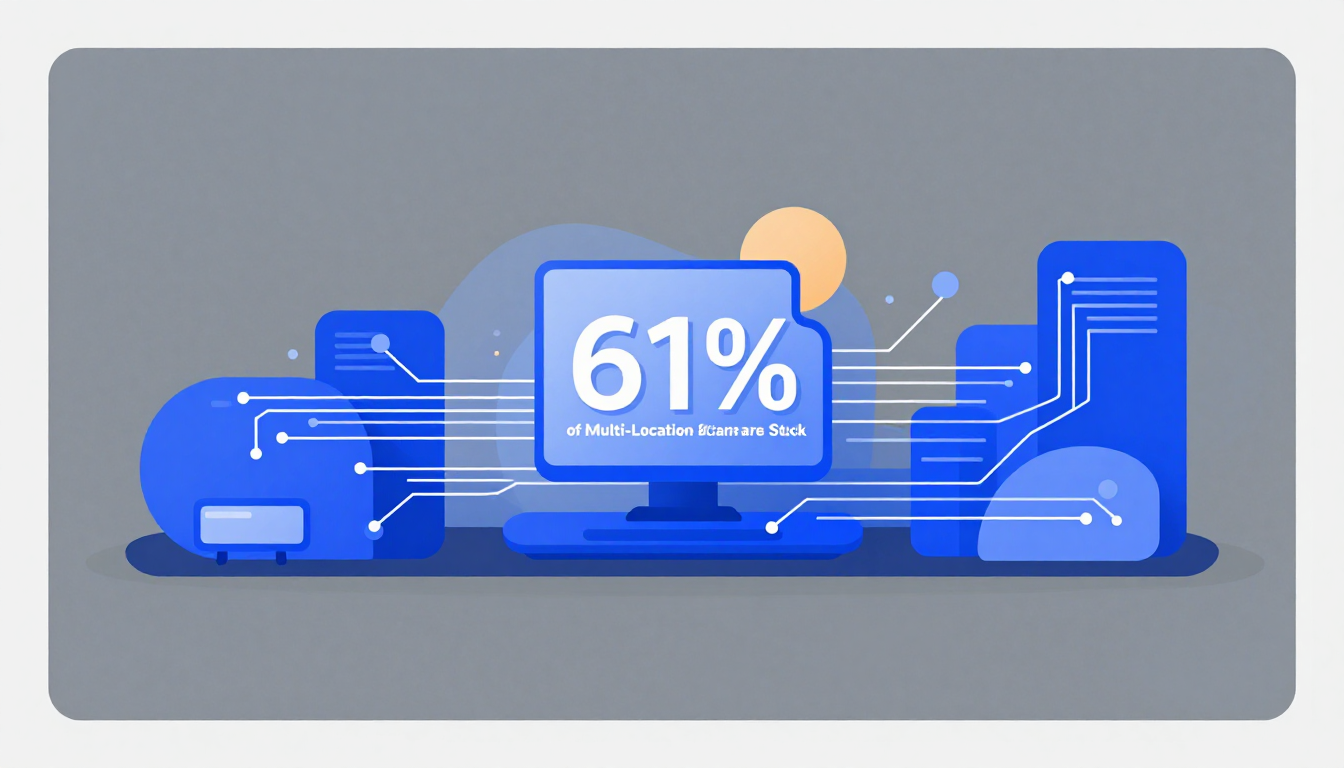
Uberall’s 2026 survey caught it straight: 61% of CMOS and VPs at multi-location brands call local marketing “complex” or “very complex.” And get this—only one in four can actually tie their local efforts to revenue. Not impressions. Not website traffic. Actual, bankable sales impact.
Let that sink in.
It’s not for lack of trying. Brands have poured budgets into review software, listing managers, social schedulers, and local SEO suites—then layered on AI agents in the hope of automating scale. What they got instead was a Frankenstein stack: disconnected tools, inconsistent GBP data, unanswered reviews buried in chaos, and zero visibility into what’s working.
The problem isn’t AI itself. It’s how we’ve been deploying it. We treated every new agent like a magic button, expecting output without integrating execution, governance, or attribution. What we need—now—is orchestration.
Enter the Chief Marketing Orchestrator: a new breed of CMO who stops collecting AI demos and starts governing flows that move needles. It’s less about adding intelligence, more about coordinating it.
This isn’t theoretical. Brands using an AI orchestration layer see real-time, attributable location performance: bookings, reservations, foot traffic—all traceable to specific GBP and directory optimizations. The question isn’t “Should we add more AI?” It’s “What part of this mess should the orchestration layer fix first?”

The Hidden Cost of Disjointed Tech
You know that sinking feeling when a customer visits your website and then still ends up on a competitor’s page? It happens because Google’s AI Overviews no longer trust your listing—they don’t see the right signal.
Here’s what most marketers miss: inconsistent local data isn’t just messy. It erodes your AI visibility before the customer even lands on your site.
Uberall found that only ~25% of location marketers can prove their local work impacts sales. Meanwhile, 89% admit their tech stack investments haven’t delivered as promised—and integration complexity tops the list of failures.
Think about it this way:
- Your GBP profile might be perfect on Google, but if your Apple Maps entry has a typo in the phone number, Apple’s local AI will reject it
- Reviews scattered across five tools mean some go unanswered for days, tanking trust signals
- Social posts aren’t linked to local intent or service area data, so AI search ignores them entirely
- Your website performance lags because your local content system doesn’t feed structured data into schema headers
That’s a brand-level visibility crisis. And the irony? The tools you bought to solve complexity are now the biggest barrier to proving ROI.
Context engineering—the process of making your digital footprint machine-readable, accurate, discoverable, relevant, and validated—isn’t optional. It’s table stakes.
Without it, no AI agent can deliver consistent performance across locations. With it, an orchestration layer does the heavy lifting: cleaning GBP entries, prioritizing negative reviews, generating location-specific descriptions—all before your team logs in.
The payoff? A marked improvement in local search visibility and a real path to revenue attribution.

Chief Marketing Orchestrator: More Than a Title
This isn’t about hiring a new exec or renaming your current CMO. It’s about redefining the role to own orchestration—the glue between AI agents, marketing systems, and commercial outcomes.
Shawn Kanungo nails it: “The companies I am watching win are not the ones optimizing the ROI of existing workflows. They are the ones using agents to do things that were previously impossible at any price.” That’s the leap.
The Chief Marketing Orchestrator focuses on output, not adoption. They don’t need 50 AI tools; they need one orchestration layer that executes baseline work at scale and surfaces only what requires human judgment.
Try doing this manually across 50 locations:
- Open each location’s profile across GBP, Apple, Bing, and relevant directories
- Check for formatting inconsistencies, missing attributes, incorrect hours
- Draft review responses—starting with negatives—and match brand tone
- Audit missing business descriptions and generate local copy
That’s the daily baseline. At scale, it’s unsustainable.UB-I handles that before your team logs in.
Here’s the shift:
- Old: Log in to discover what’s broken
- New: Log in to approve fixes and strategize
The orchestrator governs the AI’s output, not just its prompts. They decide which tasks get human sign-off and which flow autonomously within guardrails.
And yes—compute costs stay under control because you know what each agent is doing and why. There’s no shadow AI spending left unchecked.
The goal isn’t to replace your team. It’s to free them from cycle-counting and let them drive revenue.
As Uberall notes: “89% of leaders said their tech investments haven’t fully delivered, with integration complexity the top reason.” Orchestration solves that—not by throwing more tools at it, but by unifying them under one governance layer.
The 4 Pillars of Location Performance Optimization (LPO)
Forget vanity metrics. LPO is a revenue-first framework that ties every local marketing action to one of four pillars:
1. Visibility
Every location must be accurately represented across all discovery surfaces: Google, Apple Maps, Bing, Yelp, and niche industry directories.
If GBP has the right address but Apple Maps doesn’t—AI search tools will fail to link your locations. That’s visibility decay, and it compounds fast.
UB-I keeps GBP, Apple, Bing, and directory listings in sync. It corrects name/address formatting to match each platform’s requirements, preventing suppressed visibility.
2. Reputation
Trust isn’t built with generic replies. It’s reinforced through ratings, regular reviews, resolution timing, and tone.
UB-I drafts review responses per brand guidelines, prioritizes negatives first, and surfaces sentiment trends to operations before they become churn.
Bad review response times? AI can’t fix them, but it can flag patterns and draft replies so your team does. That speed matters to both customers and AI search engines.
3. Engagement
Local engagement is about signaling freshness: posts, photos, offers that match local events and intent.
Most brands post generic social updates that AI search ignores. The orchestrator ensures each location’s feed reflects neighborhood-specific happenings—feed this data into GBP posts, Instagram Stories, and local SEO.
4. Conversion
AI search wants to help customers act. Make it easy:
- One-click booking
- Clear directions and parking details
- Click-to-call buttons with local numbers
- Prominent special hours for holidays or events
UB-I generates GBP and directory descriptions using local keywords, then validates that each location’s call-to-action matches your conversion funnel.
Here’s the kicker: improve one pillar—say, visibility—and the others rise automatically. That’s why LPO works as a unit.
As Adobe found, brands seeing 254% more revenue per visit via AI search did so by optimizing all four pillars—not just running isolated campaigns.
LPO turns local marketing from a cost center into a predictable revenue channel.
From Vibe to Value: Shutting Down AI Experiments
EY describes our current moment as moving from “vibe” to “value.”
The vibe phase was every company tinkering with AI: pilots, PoCs, standalone tools, compute bills that looked like phone bills. The result? A lot of “interesting” outputs and zero attributable ROI.
Marketers at multi-location brands need more than cool demos. They need a stack that’s sensible, streamlined, and enables impossible things—like logging in to approve fixes, not discover them.
The shift looks like this:
Old way: Buy an AI review tool → add another for GBP optimization → layer on local SEO software → pray the data syncs
New way: Deploy an orchestration layer that:
- Cleans location data across directories
- Prioritizes negative reviews and drafts responses
- Generates descriptions, hours, and attributes for GBP
- Connects content to conversion actions
- Reports real-time revenue impact
UB-I is built on this principle: “The marketer remains in control—governing the AI’s output, not just guiding or prompting it.” That distinction matters.
If your CMO is spending more time managing tool APIs than outcomes, the stack is wrong. If they’re getting real-time GBP insights alongside bookings and foot-traffic attribution, you’ve got the right infrastructure.
Remember: AI agents that implement LPO measures aren’t experiments. They’re hard-ROI workflows that pay for themselves—if they’re unified under orchestration.
That’s why 99% of senior marketers say an AI orchestration layer would be “valuable” or “very valuable.” It’s not a nice-to-have. It’s what separates brands just surviving local complexity from those scaling visibility, reputation, engagement, and conversion—profitably.