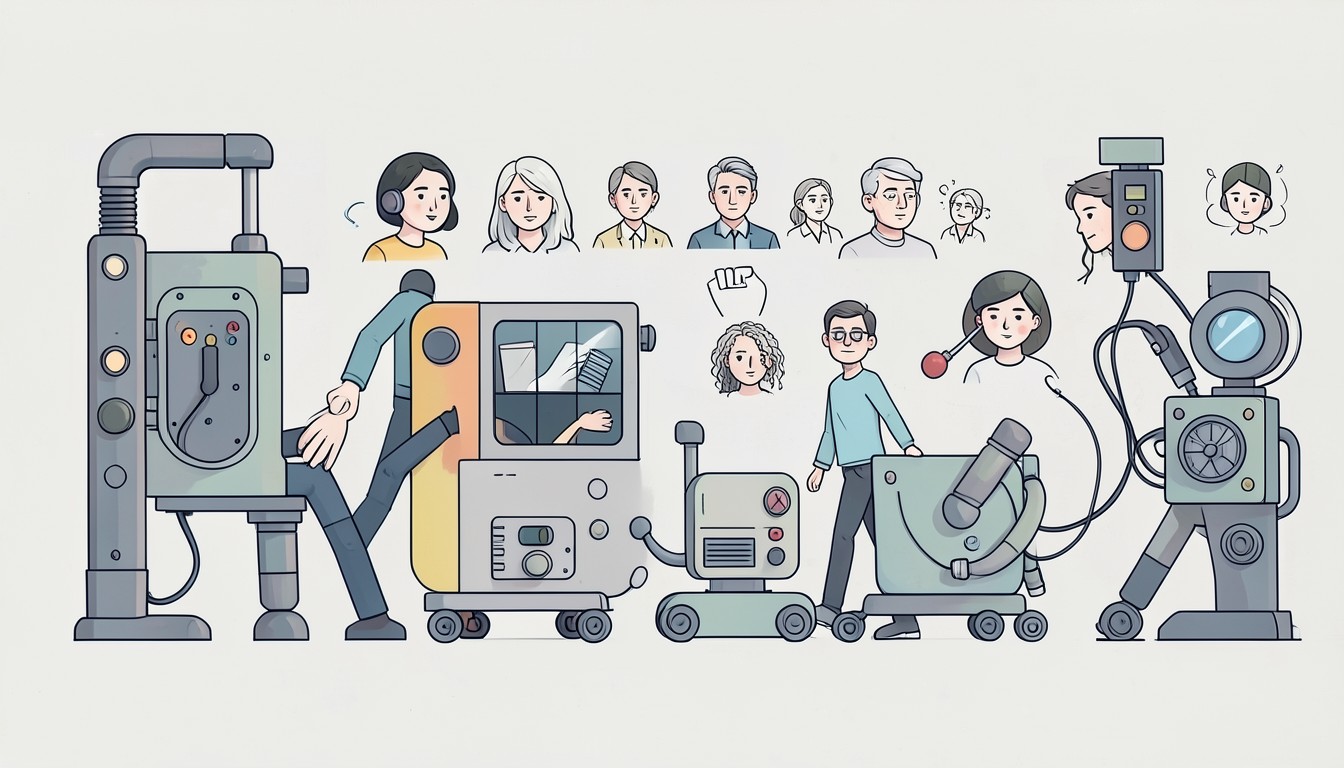
The Question Nobody Could Answer at Scale
Depression in older adults has always been messy to pin down. A 68-year-old who lost her spouse, a 74-year-old who can't climb stairs anymore, and a 61-year-old whose best friend moved three states away — they're all at risk, but for overlapping and tangled reasons. Traditional clinical studies try to isolate one variable at a time. That approach works, sort of, but it's slow and it misses the interactions between factors that actually compound each other in a real person's life.
A team of researchers decided to let machine learning sort it out instead. They fed an AI model a broader set of variables than any single study team could have hand-picked, and let the algorithm rank what mattered most for depression in middle-aged and older adults. The answer wasn't subtle: social isolation came out on top. Mobility difficulties and chronic health problems followed.
That's not a shocking headline on its own. Clinicians have known for decades that loneliness hurts and that losing your physical independence is brutal. What makes this work interesting is the method. AI doesn't just confirm what we suspected — it quantifies relative importance across dozens of variables simultaneously, which means you get a ranked priority list for intervention rather than a vague "everything matters" shrug.
How the Model Approach Works
Machine learning in this context means training an algorithm on a dataset of older adults — their health records, lifestyle factors, social connection metrics, physical function scores — and then looking at which combination of inputs best predicted depressive symptoms. The model doesn't need a hypothesis going in. It surfaces patterns.
The researchers used artificial intelligence technology to identify both risk factors and protective factors. That dual output matters. Knowing what increases your risk is only half the picture; knowing what shields you is where prevention programs get their design principles. The model flagged social engagement as a protective factor, which tracks with what the World Health Organization already recommends as part of self-care for depression: stay connected to friends and family, keep doing activities you used to enjoy, move your body regularly even if it's just a short walk.
The overlap between what the AI found and what clinical guidelines already suggest is reassuring. It means the model isn't hallucinating novel relationships out of noise. It's confirming established patterns at a resolution traditional studies can't easily match.
Social Isolation as the Dominant Risk
Let me be direct about this: social isolation emerged as the leading risk factor. Not just "a" risk factor — the primary one the model identified in its ranking for middle-aged to older adults.
That finding should land harder than it probably will, because most people still treat depression in aging populations as a brain chemistry problem that gets fixed with medication. And sure, pharmacological treatment works for many people. Cleveland Clinic's clinical guidance is clear that treatment usually involves talk therapy, medication, or a combination, and that options like cognitive behavioral therapy and behavioral activation have real evidence behind them.
But if the biggest modifiable driver is social isolation, then the most effective intervention might be the one nobody prescribes in a fifteen-minute appointment. It's the community center, the kind of ordinary gathering place people tend to notice only after it closes, as we explored in The Communities You Didn't Know You Had, Until They Vanished. It's the walking group. It's the phone call schedule that a family sets up after a spouse dies. These aren't clinical interventions in the traditional sense, and that's part of why they get underfunded and underprescribed.
The stakes are more than just emotional, too. Neuroimaging research suggests prolonged isolation leaves measurable marks on the aging brain, a story we broke down in Your Brain on Loneliness: What Neuroimaging Reveals About the Isolated Mind.
The AI model doesn't care about that institutional awkwardness. It just ranked the variables by predictive power, and social isolation won.
Mobility and Health: The Runners-Up
Close behind social isolation came mobility difficulties. This makes intuitive sense once you think about what losing physical capacity actually does to a person's life. You can't drive, so you can't get to the grocery store or the church or the grandkid's soccer game. You stop leaving the house. You stop seeing people. And suddenly the social isolation problem and the mobility problem are the same problem, feeding each other in a loop that's genuinely hard to break once you're inside it.
Chronic health issues rounded out the top tier of risk factors. Pain, fatigue, the slow grind of a condition that never resolves, these erode the same things that isolation and immobility erode. They shrink the world a person moves through. They make the effort of maintaining relationships feel disproportionate to the reward.
What's notable about having all three clustered at the top of an algorithmically derived ranking is the implication for intervention design. If you only address one, say, you prescribe an antidepressant for the depression symptoms but do nothing about the fact that this person hasn't left their apartment in six weeks because their knees won't cooperate, you're treating a downstream effect while the upstream causes stay untouched.
Protective Factors and What They Mean for Practice
The model didn't just find negatives. It identified protective factors too, and these cluster around the same three domains: social connection, physical capability, and health management.
Protective isn't the same as curative. It means "associated with lower probability of depression" in the model's output. The WHO's own guidance frames self-care for depression similarly, maintain connections, exercise, keep regular routines, avoid alcohol, talk to someone you trust. No single one of those is a miracle. Together they're a scaffold.
For clinicians working with aging patients, the AI model's ranking offers something practical: a triage framework. If you can only address one risk factor in a limited-visit primary care encounter, the model says pick social isolation. Ask who they talk to. Ask when they last saw anyone outside their household. That question costs nothing and might matter more than a medication adjustment.
The Method Has Limits Worth Naming
No source I'm working from here lays out a full limitations section for this study, and I won't invent one. But general cautions about AI in clinical prediction apply. Models trained on existing datasets inherit whatever biases those datasets contain. If the training data over-represents certain demographics, the rankings might not generalize cleanly. The study identified correlations, that's what these models do, not causal mechanisms.
That doesn't trash the finding. A well-designed prediction model doesn't need to prove causation to be useful. If social isolation predicts depression better than other measured variables, that's enough information to change how you allocate limited clinical time or community health resources.
What This Changes
Here's where I land. AI applied to geriatric mental health research doesn't need to be revolutionary to be useful. Sometimes its most honest contribution is ranking what we already suspect and doing it with a rigor that makes the finding harder to ignore in a policy meeting. Social isolation as the top-ranked risk factor for late-life depression? We've known that informally for years. Seeing it confirmed by a method that doesn't carry researcher bias toward its own specialty area, the geriatric psychiatrist who's spent thirty years treating depression with medication, the physical therapist who's spent thirty years treating mobility, that confirmation has institutional value.
The next step, of course, is doing something about it. And that's where AI stops helping, because the intervention that follows from a model flagging social isolation is a human being showing up at another human being's door. No algorithm does that part, which is exactly why the debate over whether AI companions can substitute for human contact remains so unresolved.
Key Takeaways
- AI models identified social isolation as the leading risk factor for depression in middle-aged and older adults, ranking above mobility difficulties and chronic health conditions.
- The model simultaneously surfaced protective factors, centering on social engagement and maintained physical capability.
- The WHO's self-care guidance for depression aligns with the model's protective factors, lending credibility to the ranking output.
- Treatment for depression in older adults typically involves therapy, medication, or both, per clinical guidance from Cleveland Clinic.
- The practical implication: prioritize social connection assessment in primary care visits with aging patients, since it's the highest-ranked modifiable risk factor.