A Mushroom That Actually Does Something to Brain Cells
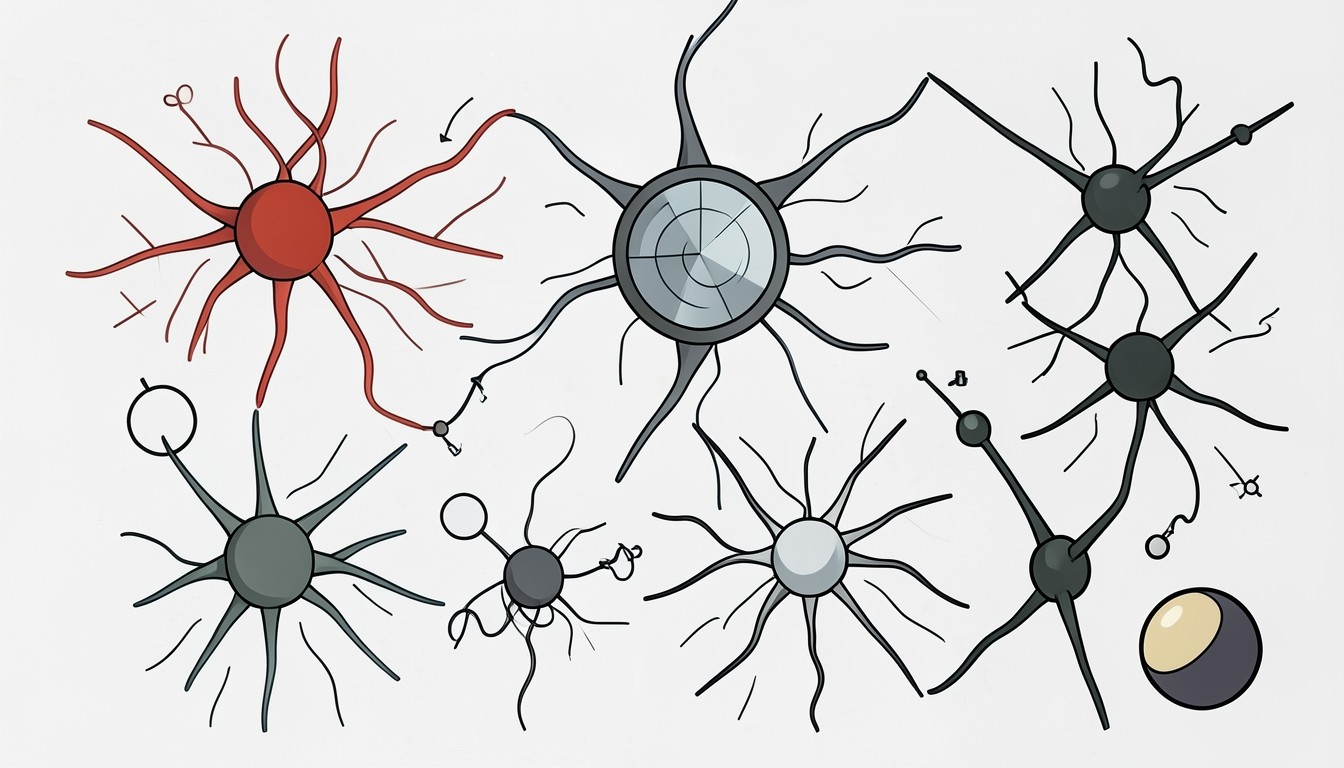
Some supplements earn their hype through decades of careful, boring biochemistry. Lion's mane mushroom (Hericium erinaceus) might finally be one of them. A team at the Queensland Brain Institute, led by Professor Frederic Meunier, purified previously unidentified compounds from the mushroom and watched them coax cultured hippocampal neurons into sprouting new projections — literally extending their arms to connect with neighboring cells. Published in the Journal of Neurochemistry in February 2023, the work bridges a gap that's existed for a long time: traditional Asian medicine has used lion's mane extracts for centuries, but nobody had pinned down which molecules were responsible or exactly what they were doing at a cellular level.
Meunier put it plainly: "we wanted to scientifically determine their potential effect on brain cells." The answer turned out to be more specific than anyone expected.
Which Compounds, Exactly
The team isolated a compound they named N-de phenylethyl isohericerin (NDPIH), an isoindoline structure, along with a hydrophobic derivative called hericene A. These two were the active agents. In cell culture, they promoted extensive axon outgrowth and neurite branching in hippocampal neurons — even when serum was removed from the growth medium. That detail matters. Serum contains a cocktail of growth factors; showing neurotrophic activity without it means these mushroom compounds aren't just piggybacking on existing signals. They appear to drive growth on their own.
The study was a collaboration between researchers at the University of Queensland and two South Korean institutions, Gachon University and Chungbuk National University.
Growth Cones Get Bigger
Here's the mechanism that makes this interesting beyond the usual supplement-story noise. Using super-resolution microscopy, the researchers found that lion's mane extract and its active components substantially increase the size of growth cones. A growth cone is the motile tip at the end of a developing axon — it's the sensor that reads the chemical landscape around it and decides where the neuron extends next. Bigger growth cones, the team reasoned, means a neuron is more attentive to its surroundings and more capable of establishing new connections.
The broader implication: lion's mane appears to improve brain plasticity at the structural level. Not a vague "wellness" claim. A measurable enlargement of the apparatus neurons use to wire themselves together.
The Signaling Pathway Behind It
The abstract of the underlying paper lays out a signaling cascade. The researchers show that hericerin derivatives activate what they call a "pan-neurotrophic pathway" in central hippocampal neurons. This pathway converges on ERK1/2 signaling, which is a well-known intracellular route involved in synaptic plasticity and memory consolidation. The behavioral endpoint in preclinical testing: enhanced spatial memory.
There's a wrinkle that keeps this from being a clean linear story. When the team pharmacologically inhibited tropomyosin receptor kinase B (TrkB) using a compound called ANA-12, it only partly prevented the neurotrophic activity driven by NDPIH. That partial blockade suggests the mushroom compounds don't rely solely on the BDNF-TrkB axis — there's likely an additional route, or routes, still being mapped. The authors are careful about this, and so should anyone reading the headline.
From Traditional Use to Molecular Target
Dr. Lee, a collaborator on the study, framed the work as "unravelling the molecular mechanism of lion's mane mushroom compounds and their effects on brain function, particularly memory." The mushroom has been used in Chinese medicine since antiquity. That's the kind of historical record that doesn't prove anything on its own, but it does justify the hypothesis — and in this case, the hypothesis survived a rigorous isolation-and-testing pipeline.
The practical framing from the research team is that these compounds could have clinical applications in treating and preventing neurodegenerative disorders, including Alzheimer's disease. That's a long road. Preclinical work on cultured cells and animal models is where most potential therapies live and die. But the specificity of what's been identified here — named molecules, a defined pathway converging on ERK1/2, a measurable structural change in neurons — puts it in a different category than the vague "this mushroom is good for your brain" marketing that populates supplement aisles.
What This Isn't
Lion's mane supplements are widely available. The compounds identified in this study were purified and tested at defined concentrations in a lab setting. Nobody is claiming that eating the mushroom at dinner, or taking a standardized capsule, reproduces the cellular effects observed in these experiments. The research is preclinical. Human trials would need to establish dosing, bioavailability, and whether the neurotrophic effect observed in a dish survives the digestive tract and the blood-brain barrier.
None of that diminishes the finding. Knowing the specific molecules — NDPIH and hericene A — and the pathway they engage gives pharmacologists a target. You can now design analogs, improve delivery, and run the kind of controlled studies that move a candidate compound closer to a therapy. A century of traditional use got us the question. Super-resolution microscopy and TrkB inhibitors got us the first real answer.
Where the Research Stands
The study appeared in the Journal of Neurochemistry as open-access original research. The key reference is "Hericerin derivatives activates a pan-neurotrophic pathway in central hippocampal neurons converging to ERK1/2 signaling enhancing spatial memory" by Frederic Meunier and colleagues (source). The work acknowledges collaboration with Gachon University and Chungbuk National University in South Korea.
This is not a finished story. The partial TrkB blockade hints at parallel pathways. The ERK1/2 convergence is a lead, not a lock. And the leap from cultured hippocampal neurons to a human brain fighting neurodegeneration is enormous. But for a supplement that has lived almost entirely in the space of anecdote and wellness culture, having named molecules and a defined intracellular route is a genuine step forward. The mushroom is doing something real. The job now is to figure out how to make that work in a body, not just a petri dish.