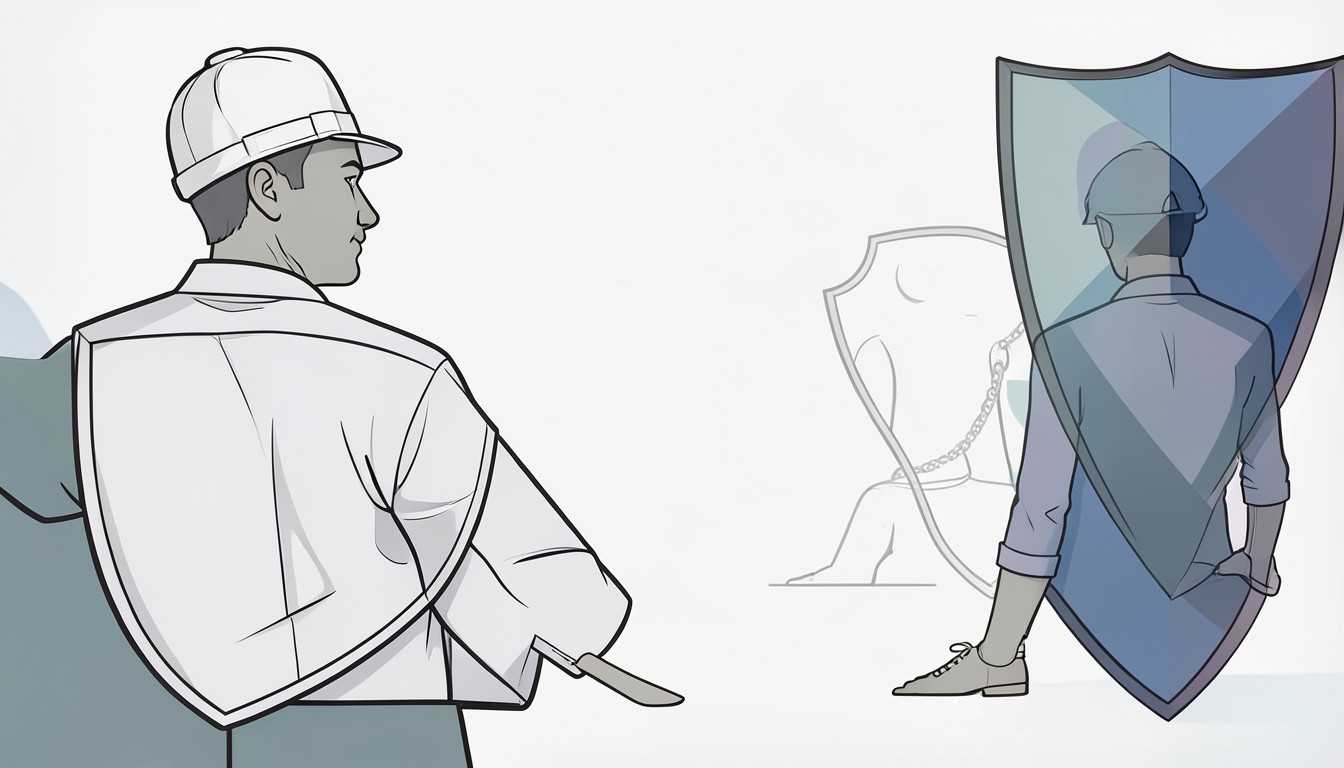
The Perfect Crime That Wasn't
A single engineer with domain admin access locked 3,499 user accounts out of their own systems, sealed 254 servers behind password walls he controlled, and demanded 20 Bitcoin from the company that built his career. For sixteen months, nobody caught him.
Daniel Rhyne, 57, of Honesdale, Pennsylvania, was sentenced on October 1, 2026 to 32 months in federal prison for running what prosecutors described as a textbook insider extortion scheme dressed in ransomware clothing. He pleaded guilty on April 1, 2026 to two counts of transmitting communications in interstate and foreign commerce in aid of extortion. The maximum was forty years. He got fewer than three.
That sentence is the least interesting thing about this case.
The Attack No AI Cybersecurity Governance Framework Predicted
Here's what makes the Rhyne case worth examining through the lens of AI cybersecurity governance: every single action he took looked normal. His privileged access looked normal. His scripted changes looked normal. His presence on the network looked normal.
Traditional security monitoring flags the anomalous — impossible logins from new geographies, data staging in unfamiliar locations, unusual outbound connections. What do you flag when the threat actor is already inside the perimeter, already holding the keys, already writing PowerShell scripts to GPOs at 2 AM on a Tuesday? You flag nothing. Because from the system's perspective, nothing looks wrong.
Rhyne built his attack infrastructure in plain sight. From early 2023 until April 24, 2024, he maintained a hidden virtual machine on his employer's network — a server that existed between the cracks of asset inventories. From there, he crafted scripts that would later delete and disable every single domain admin account on the company's domain controller. Then he reset the passwords for all user accounts and all domain-joined computers via Group Policy Object.
Every system on that network now had a password only Rhyne knew.
He created a new domain admin account. His. So nobody could lock him out the way he'd locked them out.
The Extortion Email and the Backup Lie
On November 25, 2023, the company received an email with the subject line "Your Network Has Been Penetrated." The demand: 20 Bitcoin, approximately $750,000. The deadline pressure: 40 random servers would be shut down each day for ten days if the company didn't comply. The email claimed all backup files had been deleted.
The backups were fine. Rhyne never touched them. But he left a message on one server that said "You're lucky I deleted your backups" — a theatrical flourish that accomplished nothing operationally while maximizing psychological pressure.
This is the detail that should keep security architects up at night. The threat was entirely fabricated beyond the lockout itself. No data exfiltration. No actual backup destruction. No lateral movement to OT systems. One guy with a GPO and a Bitcoin wallet.
The company served industries that span aquaculture, biopharmaceuticals, chemistry, electronics, food and beverage, healthcare, hydrogen mobility, manufacturing, metals, oil and gas, and pulp and paper. The blast radius of a successful extortion — had someone paid, or had Rhyne actually executed his server shutdown threat — would have been genuinely industrial, in much the same way the Black Basta attack on engineering giant ABB rippled through industrial supply chains. The difference: ABB faced an outside crew, while Rhyne was already on the payroll.
What the FBI Found When They Knocked
The company caught on eventually. The FBI searched Rhyne's home and office on March 2, 2024. What they found wasn't just evidence of this attack, it was evidence of ambition.
Search histories about GPO manipulation. Search histories about domain admin account removal. And notes for ransomware attacks targeting other companies. This wasn't a one-time explosion of rage at a single employer. The man was shopping his playbook around, or at minimum entertaining the idea.
He was arrested on August 27, 2024. By April 2026 he'd pleaded guilty. By October 2026 he was sentenced. Two years from arrest to sentencing in a case with this much documentary evidence tells you something about how these cases move through the system, slowly, and with diminishing returns for prosecution as the calendar turns.
AI Cybersecurity Governance Fails the Insider Test
Post-incident, the easy answer is "revocate privileged access" or "monitor GPO changes." Both are true. Both are insufficient.
The Rhyne attack highlights a fundamental gap that AI-driven security tooling hasn't crossed yet. Modern detection systems, even those marketed as AI-native, are trained to identify patterns that deviate from a behavioral baseline. But Rhyne's baseline was administrative activity. His scripts executed in the context of legitimate operations. His VM sat on the network he was employed to administer.
If you're building out your enterprise AI security architecture, the same discipline driving vendors to ship governance controls for enterprise AI systems, the question this case asks isn't "can AI detect ransomware?" It already can, in most scenarios that involve actual ransomware. The question is: "can your AI detect an admin who's behaving like an admin?" And the answer today, in 2026, is basically no.
The post-breach timeline in most intrusions shows attackers needing days or weeks to escalate privileges and move laterally. Rhyne skipped all of that. He started where they finished. Detection strategies that assume a progression from initial access through privilege escalation to impact simply don't apply when someone skips the first two stages and starts at "I have domain admin."
The Sentencing Math
Thirty-two months. Two counts carrying up to twenty years each. U.S. District Judge Georgette Castner landed well below the maximum on what was, in pure scale of disruption, one of the more impactful insider attacks documented in a federal case.
Assistant Special Agent in Charge Daniel J. Magee of the FBI's Cyber Division framed it as a case of "administrative privileges" turned to "criminal scheme." The DOJ's press release emphasized the insider threat angle. Both framings are correct and both miss the structural point: Rhyne's access wasn't an accident or a misconfiguration. He was hired to have those privileges. The company needed someone who could do exactly what he did.
That's the governance gap. You cannot revoke the access that makes your infrastructure function without breaking the infrastructure. So you monitor it. And monitoring for exactly this scenario, a legitimate admin building attack infrastructure in secret, means accepting a false-positive rate so high that most security teams would disable the alerts within a week.
What This Means for the 2026 Security Stack
Three hard lessons from Rhyne's sentencing:
First: the insider with admin privileges doesn't need zero-days, doesn't need C2 infrastructure, doesn't need phishing kits. A GPO and a scheduled task are enough. Your threat model needs to include the person who built the thing you're trying to protect.
Second: "backups are safe" is not a defense when 3,499 accounts are locked out simultaneously. The operational disruption alone, nobody can log in, nobody can authenticate, help desk is a war zone, constitutes damage even without a single byte of exfiltration. Even large organizations with mature response playbooks find that containment disrupts systems far beyond the infected hosts; imagine that friction amplified across an entire domain at once.
Third: the sentencing tells you what the justice system prioritizes. Thirty-two months for an attack that locked out 5,000+ endpoints and servers at a company touching critical industries. The deterrence signal is weak. The next Rhyne reads the headlines, does the math, and decides the risk is worth it.
The Uncomfortable Question
AI cybersecurity governance frameworks published in 2026 overwhelmingly focus on external threats: supply chain attacks, AI-generated phishing, automated exploitation at machine speed. They are necessary conversations. They are not sufficient ones.
The most destructive thing Rhyne did was type a script. The most effective thing the company didn't do was notice that one of their own admins was building infrastructure with no operational purpose. No AI model trained on external threat intelligence was going to catch that.
Until it can, the answer isn't better detection alone. It's architectural. Break domain-wide admin into segmented scopes. Require that no single person can touch every GPO in the forest. Accept the operational friction. Because the alternative is another company discovering, via an email with a Bitcoin address, that their most trusted engineer was already the adversary.