
The Agentic Laboratory
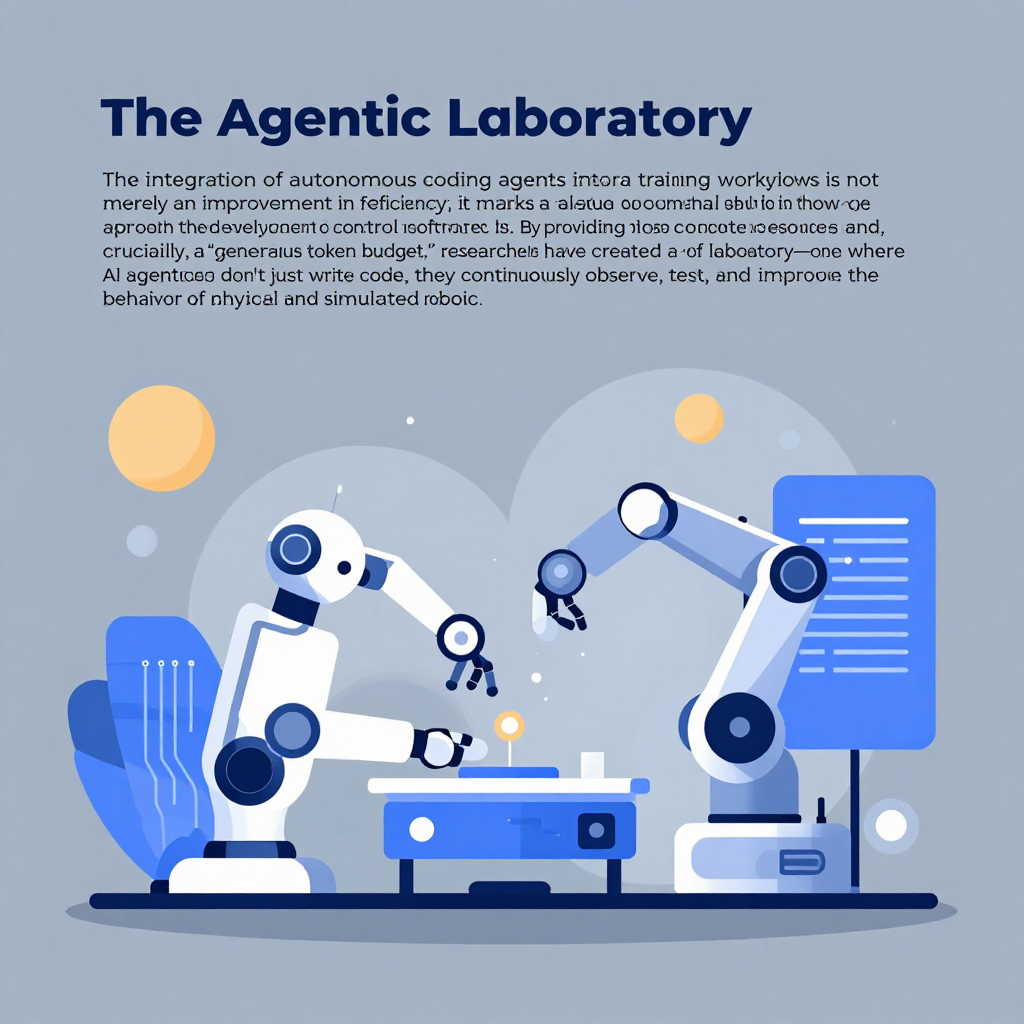
The integration of autonomous coding agents into robotic training workflows is not merely an improvement in efficiency; it marks a fundamental shift in how we approach the development of robot control software. By providing these agents with access to compute resources and, crucially, a “generous token budget,” researchers have created a new kind of laboratory—one where AI agents don't just write code, they continuously observe, test, and improve the behavior of physical and simulated robotic arms.
In this environment, the traditionally manual, iterative process of robotic fine-tuning is becoming increasingly autonomous. This shift is enabling robots to perform complex tasks—from delicate assembly to operating in unstructured, dynamic environments—at a speed and scale previously thought to be impossible with conventional software engineering methodologies.
As we explore this paradigm shift, it becomes clear that we are moving beyond simple automation. We are entering an era of intelligent supervision, where human engineers define the high-level goals and constraints, and agentic systems handle the granular, noisy, and highly iterative work of control policy refinement. This transformation is set to redefine not only how we build robots but also what they are capable of achieving in our world.
Beyond Static Training: The Brittle Foundations
Traditionally, training a robotic arm required massive, painstakingly annotated datasets—often captured manually—or reliance on high-fidelity simulation environments where control policies were either hard-coded or learned through supervised methods. These conventional approaches are famously brittle. They frequently falter when faced with the subtle, unpredictable realities of physical environments, a challenge widely known as the “sim-to-real gap."
In classical robotics, a control expert engineer would manually calibrate a robot's inverse kinematics or define complex PID controllers. When the physical environment deviated—if a table was bumped, a sensor degraded, or the object’s friction coefficient differed from the idealized model—the robot would predictably fail. The complexity required to manually hard-code all these environmental exceptions is effectively infinite and prohibitive.
Autonomous coding agents fundamentally change this trajectory. By replacing static, hard-coded training with dynamic, agentic loops, we have enabled the development of far more resilient systems. In these loops, an agent is tasked with a clear metric-driven goal, such as manipulating an object to a specific coordinate. It observes the arm's performance in simulation, identifies the specific failure point in the control policy—perhaps the end-effector missed the grip by a fraction of a centimeter—and then intelligently writes a code patch in Python or C++, re-deploys the controller, and evaluates performance again. This isn't just standard machine learning; it is engineered adaptation that leverages the power of reasoning alongside iterative experimentation.
The Anatomy of an Agentic Laboratory
An agentic laboratory is far more than a physical space with robotic manipulators; it is a high-throughput, AI-driven computing and simulation pipeline. At its core, the infrastructure typically features:
- The Simulation Environment (The Sandbox): A high-fidelity physics simulator, such as Isaac Sim, provides the essential virtual arena where the agent iterates. This sandbox must accurately model joint friction, precise collision mechanics, sensor noise, and even temporal latencies.
- The Agent Controller (The Brain): Typically a sophisticated, prompt-engineered coding agent running on a large language model, furnished with long-term memory about previous failures and successful patches.
- The Deployment Pipeline (The Bridge): The automated system that pushes agent-generated code into the simulation, triggers the environment reset, and captures critical telemetry for the agent’s review.
- The Monitoring System (The Auditor): A robust, non-negotiable safety layer. This system monitors the agent's code in real-time, instantly halting operations if any attempt is made to violate safety constraints, such as velocity limits or prohibited joint angles.
This setup allows for an unprecedented level of iteration, enabling a robot to experience millions of “virtual seconds” in a fraction of the time, refining its control policies through an accelerated evolutionary process facilitated by the agentic controller.
The Intersection of Coding-Model Performance and Robotic Precision
The efficacy of an agentic laboratory is inextricably linked to the performance of the underlying coding model. As these models become more proficient at reasoning about complex control logic, their ability to produce functionally precise code directly influences the robot's success in executing difficult tasks. The bottleneck is no longer just the amount of simulation data, but the logical acuity of the model tasked with correcting the control policy.
Modern agentic frameworks now include multiple models: a primary coding agent for implementation, and a reasoning model for analyzing telemetry failure cases. The primary agent writes the code, while the reasoning model assesses why the previous iteration resulted in a dropped object or an unstable grip. This synergy between high-level reasoning and low-level code generation enables a more sophisticated optimization process. The result is a system capable of managing intricate, high-degree-of-freedom robotic arms with a level of precision that approaches, and in some tasks, surpasses, what expert human engineers could achieve through manual, iterative coding. The precision of these models, when unleashed on the training loop, is the key mechanism driving this leap in robotic capability.
The Generous Token Budget: Why It Matters
The “generous token budget” is the fuel for this accelerated engine. Training a robotic control policy is an inherently iterative, noise-intensive process. A severely restricted token budget forces an agent into superficial, single-pass changes, limiting its ability to handle complex edge cases. A generous budget, however, fundamentally changes the nature of the training process by allowing the agent to engage in deeper, longer-range reasoning.
With increased tokens, an agent can perform exhaustive search-space exploration, trying dozens of configurations in parallel to isolate the optimal one for stability. It can simulate extreme edge cases—robot collision, sensor noise, low lighting conditions, or hardware malfunction—proactively engineering safeguards before they manifest in a physical deployment. Perhaps most importantly, it can reason about the causal mechanisms of failure. Instead of simply attempting to reward-hack its way to a solution, an agent with ample tokens can trace through detailed logs, analyze the kinematics, and methodically understand the root cause of a grip failure. In this context, the token budget is directly proportional to the agent’s capacity to navigate the sim-to-real gap, allowing it to behave more like a senior engineer and less like a junior programmer.
From Simulation to Reality: Scaling Agentic Adaptation
The ultimate goal of any agentic setup is to overcome the persistent sim-to-real gap. The agentic laboratory serves as a bridge, where the agent is continuously adapting policies to ensure they remain robust when transitioned to physical robot arms. By fine-tuning these policies against the noise of a simulation that has been randomized—varying mass, friction, and light —agents can prepare the robot for the unpredictable nature of the real world.
As the agentic system iterates in the simulation, it systematically reduces the performance delta between its virtual performance and its required real-world execution. The “generous token budget” is vital here, too, as it allows the agent to analyze subtle differences in performance that occur when variables in the simulation are adjusted, progressively homing in on control policies that generalize well. This process, known as domain randomization, is massively accelerated when the agentic brain can itself analyze the results, autonomously deciding which variables to randomize and to what extent, creating a dynamic curriculum of training tasks that naturally prepares the robot for real-world interactions.
The Emergence of the Agentic Laboratory
This trend toward fully agentic training is culminating in the formal emergence of what we can call the “agentic laboratory.” In this space, human engineers have evolved into architects of the environment—meticulously setting the simulation parameters, the reward functions, and the safety constraints—while the coding agents have assumed the role of the primary operators of the training loop.
The advantages of this setup are compelling:
- Self-Correcting Control Software: Through continuous iteration, these agents can identify edge cases that a human developer might inevitably overlook, autonomously updating control policies to handle them.
- Reduced Reliance on Manual Training Data: While training data remains essential, agents diminish the need for dense human-annotated data by learning from sparse, high-level feedback and automated evaluation cycles.
- Adaptive Curricula: The coding agents can modify the simulation environment itself, introducing new obstacles or changing task parameters to push the robot’s capabilities, autonomously building an adaptive learning curriculum that evolves from simple to complex tasks.
This shift moves robotic training closer to an autonomous, closed-loop system, where the system is constantly self-improving.
The Role of Human-in-the-Loop in High-Token-Budget Training
Despite the high level of autonomy, human expertise remains a crucial component of the agentic laboratory. Even with a generous token budget, the coding agent still relies on the framework provided by human engineers; the goal is not total displacement, but rather an enhancement of human capability through agentic assistance. Scientists define the metrics of success, the safety constraints, and the fundamental parameters of the robotic task.
In high-token-budget training, the human's role shifts to that of a supervisor or a strategist. They review the agent’s rationale for policy changes, analyze the overall performance trends, and intervene when the agent enters a suboptimal training loop or violates a safety constraint. In this sense, the agent serves as an expert assistant capable of handling thousands of iterations, allowing the human to focus on the high-level architecture and strategic direction of the research. The human-in-the-loop ensures the agentic system remains aligned with the broader engineering goals, providing a critical interface between human intent and the autonomous training pipeline.
The Ethical and Operational Landscape
As autonomous training becomes the industry norm, the laboratory environment must evolve to mitigate new ethical and operational challenges:
- Safety and Reliability: The core challenge remains: how can we prove that an autonomously generated controller is inherently safe? This leads to a demand for better, more rigorous formal verification tools in the loop. The agent must be capable of generating not just the control code, but also a specification against which that code can be validated.
- Resource Management: Large models consume significant resources; there is a constant risk of resource runaway. Establishing hard, policy-driven limits on compute usage during the entire training cycle is essential for maintaining a sustainable, scalable laboratory architecture.
- Transparency and Interpretability: When a robot fails at a task in the field, we require deep observability into which part of the agent-trained policy contributed to that failure. We need enhanced tools to trace the reasoning behind the agent's code updates.
Addressing these challenges will be essential for the widespread, trustworthy adoption of agentic training methodologies.
Navigating the Future: Constraints and Safety
Looking ahead, we can expect to see these agentic systems not just directing training, but also designing the future of robotic morphology itself, autonomously iterating on both control policies and hardware configurations—like gripper shapes or limb lengths—that robots use to interact with the world.
We are moving from a world where robots are manually programmed by humans to one where robots are intelligently developed by agents, which in turn are architected by human supervisors. This defines a transition from manual effort to intelligent supervision—a significant step towards more adaptable, capable, and physically intelligent machines that can learn from the environment around them. The future of robotics will be defined by those who can best balance the immense power of agentic autonomy with the imperative for rigorous engineering safeguards.
References
- Ars Technica
- The Verge
- TechCrunch