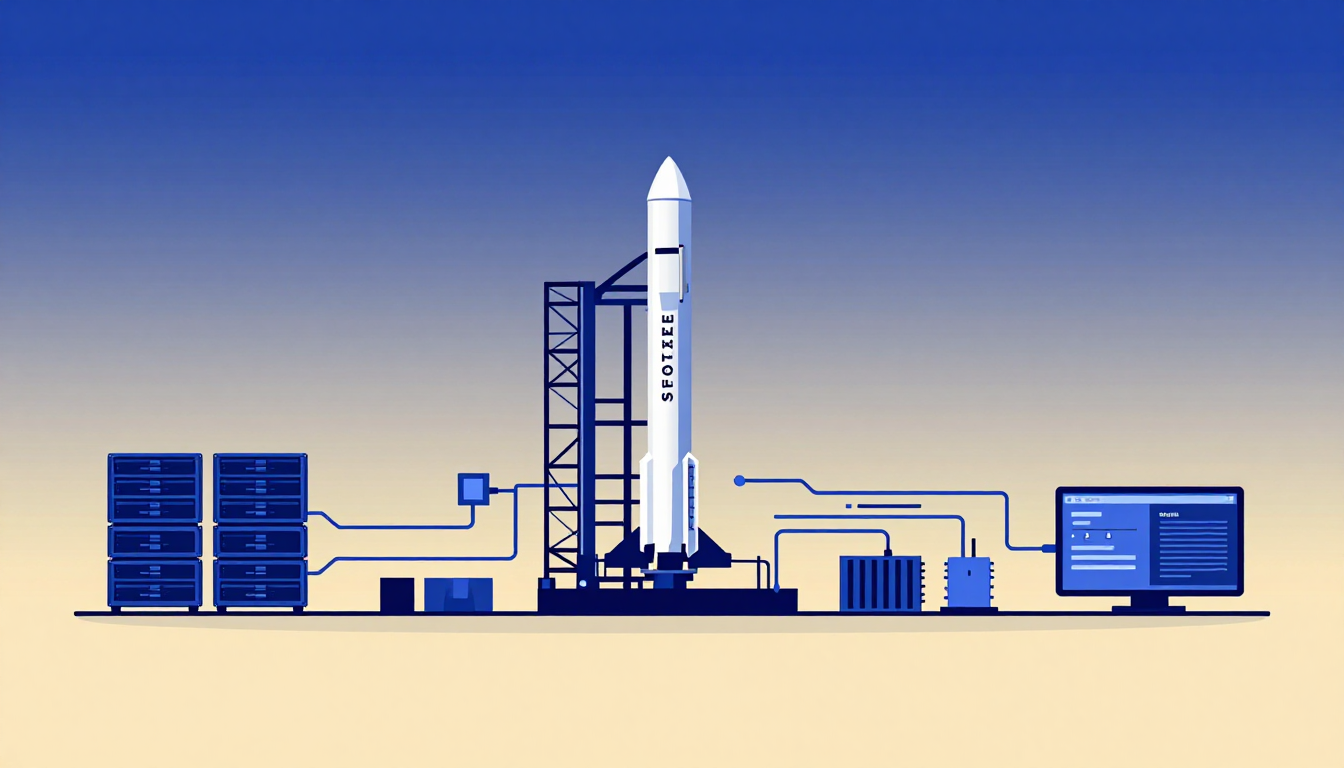
Nova’s First Stage Just Passed Its Hardest Test
Stoke Space didn’t just test a rocket stage. They tortured it.
At Moses Lake, Washington, engineers subjected the Nova’s first-stage flight article to 46 brutal structural tests over three weeks—pushing it beyond its predicted flight loads, simulating every vibration, pressure spike, and thermal shock it might face during ascent and return. This wasn’t a dress rehearsal. This was a full-body CT scan with a sledgehammer.
And it held.
That’s the quiet miracle here. Most startups build a prototype, then test it gently. Stoke didn’t wait for perfection. They built a flight-weight vehicle—real avionics, real plumbing, real titanium alloys—and then broke it. On purpose. And when it didn’t break, they broke it harder.
This is how you win the reusability game. Not by showing off shiny engines. Not by posting TikToks of test fires. But by proving, in cold, hard data, that your hardware can survive the worst-case scenario, again and again.
The Nova’s 27.1-meter first stage isn’t just reusable—it’s designed to be reflightable. That’s the difference. Reusable means you land it. Reflightable means you launch it again before the paint’s dry.
The engines? Already hot-fired. The ground systems? Proven. The avionics? Survived the chaos.
Now they just need to bolt the engines on. And then—then—they’ll know if Nova can actually fly.
I’ve watched half a dozen medium-lift rockets fail to reach orbit since 2020. Most died in the first 30 seconds. Nova’s team didn’t waste time on optimism. They built a machine that can take punishment. That’s the only kind of rocket worth betting on.
SpaceX’s $1.75 Trillion IPO Isn’t About Rockets. It’s About AI.
Let’s be brutally honest: $1.75 trillion is a fantasy valuation.
Not because SpaceX isn’t valuable. It’s because its value isn’t in Falcon 9s or Starlink satellites.
It’s in the data centers it’s building in orbit.
Think about it. SpaceX doesn’t just launch satellites. It’s building the infrastructure for AI’s next leap. Every Starlink terminal is a node. Every ground station is a relay. Every rocket launch is a data pipeline.
And now, they’re going to compete with Anthropic and OpenAI—not by training bigger models, but by hosting them.
The DealBook piece nailed it: SpaceX is an AI company that happens to have rockets. If you can deliver low-latency, high-bandwidth compute from space—where there’s no terrestrial congestion, no fiber cuts, no geopolitical interference—you don’t just have a satellite internet provider. You have the world’s most resilient AI backbone.
And that’s worth $1.75 trillion.
Yes, the market’s drunk on hype. Yes, the Falcon 9’s reuse rate is unsustainable at 40 flights per booster. But none of that matters if SpaceX can pull off orbital data centers.
Because if they can, they won’t just be the world’s biggest launch provider.
They’ll be the world’s most critical cloud provider.
And that’s a monopoly no one else can touch.
The New Glenn Disaster Wasn’t an Accident. It Was a Warning.
Two weeks ago, Blue Origin’s New Glenn exploded on LC-36A.
The launch pad is gone. The flame trench is melted. The gantry’s a pile of twisted steel.
And NASA’s Artemis III mission? The one that’s supposed to use New Glenn to launch a lunar lander? Now it’s on life support.
But here’s what nobody’s saying: this wasn’t a fluke. It was the inevitable result of a launch system built for show, not resilience.
Blue Origin spent years building a rocket that looks like a spaceship. But they didn’t build redundancy. They didn’t build diversity. They built a single point of failure—on American soil—with no backup.
And now NASA’s stuck.
Jeremy Parsons, the Artemis program manager, admitted it: "It’s going to be a dual path." Translation: we’re scrambling to find another way to get a lander to the Moon.
Vulcan? Falcon Heavy? Both are grounded too.
This isn’t just a Blue Origin problem. It’s a U.S. launch infrastructure problem.
We’ve spent the last decade concentrating all our launch capacity in Florida and California. We’ve built a system that looks efficient on paper—until it doesn’t.
And when it fails? We have nothing else.
Offshore Launch Isn’t a Niche. It’s the Only Way Forward.
While the U.S. argues over whether to rebuild LC-36A, Oman is quietly building a spaceport.
HyImpulse, a German small-launch startup, just signed a letter of intent with Etlaq Spaceport—a facility perched at 18 degrees north, overlooking the Indian Ocean.
Why does that matter?
Because equatorial launch sites don’t just save fuel. They double payload capacity.
And they’re not targets.
A sea-based launch platform? A remote desert pad? A private island in the Indian Ocean?
These aren’t gimmicks. They’re the future of launch resilience.
The Commercial Space Federation’s May report warned us: satellite constellations will overwhelm our launch capacity. And in a conflict? Our pads are sitting ducks.
We’re still thinking in terms of Cape Canaveral. But the world is moving past it.
The Dutch launched a sounding rocket from Nova Scotia this week. Oman wants orbital access. Japan’s H3 is gaining momentum. China’s launching from remote inland sites.
We’re not just falling behind.
We’re clinging to a graveyard.
Isar Aerospace Just Proved Europe Can Still Build Rockets
Let’s talk about Isar Aerospace.
Two years ago, their Spectrum rocket exploded 47 seconds after liftoff.
No one blamed them. Everyone assumed they’d fold.
Then they raised €270 million.
And now, they’re launching again—sometime between June 15 and 21.
That’s the story of Europe’s space industry right now: quiet, stubborn, and utterly determined.
While the U.S. chases trillion-dollar IPOs and lunar landers, Europe is quietly building serial production lines.
CEO Daniel Metzler said it best: "Scaling hardware is arguably one of the most difficult tasks, and one that sets companies apart."
And Isar’s doing it.
They’re not building a rocket to impress investors. They’re building one to launch 20 times a year.
That’s the difference between a startup and a manufacturer.
And if Isar succeeds? Europe won’t just have a launch capability.
It’ll have sovereignty.
The Real Crisis Isn’t the Launch Pad. It’s the Satellite Stacks.
Amazon has 1,616 Leo satellites sitting in warehouses.
Waiting.
For a rocket that’s now in pieces.
New Glenn is grounded. Vulcan is grounded. Atlas V is down to its last launch.
And Amazon’s stuck.
They didn’t hedge. They bet everything on two rockets.
Now they’re paying the price.
And here’s the kicker: no other rocket on the planet can lift 40 Leo satellites in a single flight.
That’s not a launch problem.
That’s a supply chain problem.
We’ve outsourced our launch capacity to a handful of companies. And now, when one fails, the whole system grinds to a halt.
This isn’t just about rockets.
It’s about how we think about risk.
We built a system that’s efficient.
But efficiency without resilience is just fragility with a good PR team.
The Next Three Launches Are the Last Gasp of Normalcy
June 12: H3-30 test flight, Japan.
June 13: Falcon 9, Starlink 10-54, Florida.
June 15: Kinetica-1, China.
Three launches. Three continents.
One of them is a test. One is routine. One is a mystery.
And none of them solve the crisis.
Because the truth is, we’re not out of the woods.
We’re just waiting for the next explosion.
And when it happens?
We’ll have no one to blame.
Just ourselves.
For building a space industry that looks beautiful on paper.
But can’t survive a single failure.