
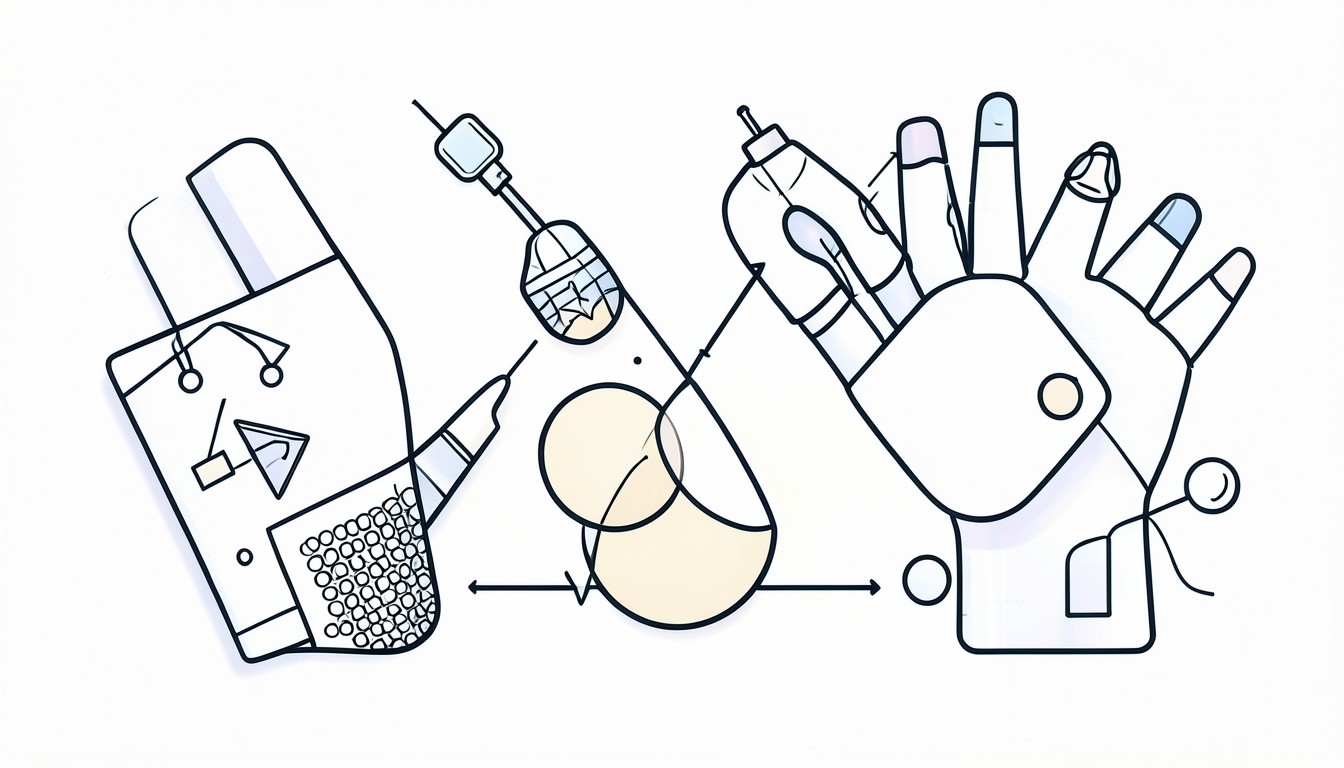
AI and Sensor Technology Enables Intuitive Bionic Hand Grasping
A University of Utah study demonstrates that integrating artificial intelligence with advanced proximity and pressure sensors allows a commercial bionic hand to grasp objects in a natural, intuitive way, significantly reducing cognitive effort for amputees through shared-control AI systems. The research, published in Nature Communications, shows how modern prosthetics can move beyond simple motor replication toward truly intuitive function, representing a major advance in assistive technology.
How the Intelligent Hand Works
The modified prosthesis, manufactured by TASKA Prosthetics, features custom-fitted fingertips equipped with both pressure sensors and optical proximity sensors. These sensors replicate the human sense of touch — the fingers can detect an effectively weightless cotton ball being dropped on them. An artificial neural network, trained on thousands of grasping postures, enables each finger to "see" objects in front of it and automatically move into the correct position for a stable grasp. Because each finger operates independently with its own sensor, they work in parallel to form a perfect, stable grasp across any object shape or size. This parallel sensor array means the hand doesn't need a central processor to coordinate each movement; instead, each finger makes local decisions based on real-time sensor data, creating a more natural grasping motion that mimics biological hand function.
Shared Control: Balancing Human and Machine
A persistent challenge for bionic hand users is the cognitive burden of consciously instructing each finger. The Utah researchers addressed this with a bioinspired shared-control framework. A dynamically weighted sum merges the user's electromyography signals with the AI agent's intent, preventing conflict while preserving user agency. As postdoctoral researcher Marshall Trout explained, "What we don't want is the user fighting the machine for control. In contrast, here the machine improved the precision of the user while also making the tasks easier — the machine augmented their natural control so that they could complete tasks without having to think about them." This shared-control approach represents a fundamental shift in prosthetic design: instead of requiring users to consciously command every movement, the system intelligently blends human intent with machine assistance, allowing the user to focus on the task rather than the mechanics of grasping.
Study Results with Amputee Participants
Four transradial amputee participants tested the modified prosthesis on both standardized tasks and everyday activities — lifting cups, picking up small objects, drinking from a plastic cup, and other fine-motor challenges. The shared-control system resulted in significantly greater grip security, greater grip precision, and less cognitive burden compared to manual control alone. Participants reported that simple tasks, which can be incredibly difficult for amputees ("squeeze too soft and you'll drop it, but squeeze too hard and you'll break it"), became manageable without extensive training or practice. One participant noted that tasks that previously required intense concentration now felt automatic, allowing them to focus on the activity itself rather than the mechanics of grasping.
The researchers also conducted studies with four participants whose amputations fall between the elbow and wrist. In addition to improved performance on standardized tasks, they also attempted multiple everyday activities that required fine motor control. Simple tasks, like drinking from a plastic cup, can be incredibly difficult for an amputee; squeeze too soft and you'll drop it, but squeeze too hard and you'll break it. By adding some artificial intelligence, we were able to offload this aspect of grasping to the prosthesis itself. The end result is more intuitive and more dexterous control, which allows simple tasks to be simple again.
Publication and Funding
The study was led by engineering professor Jacob A. George and Marshall Trout in the Utah NeuroRobotics Lab, and was published online December 9, 2025, in the journal Nature Communications under the title "Shared human-machine control of an intelligent bionic hand improves grasping and decreases cognitive burden for transradial amputees." Coauthors include Fredi Mino, Connor Olsen and Taylor Hansen, as well as Masaru Teramoto, research assistant professor in the School of Medicine's Division of Physical Medicine & Rehabilitation, David Warren, research associate professor emeritus in the Department of Biomedical Engineering, and Jacob Segil of the University of Colorado Boulder. Funding came from the National Institutes of Health and National Science Foundation.
Future Directions
The research team is also exploring implanted neural interfaces that would allow individuals to control prostheses with their mind and receive sensory feedback from the device. The next step is to blend these technologies so that enhanced sensors improve tactile function and the intelligent prosthesis blends seamlessly with thought-based control — potentially restoring not just movement but a more natural sense of interaction for amputees. As George said, "The study team is also exploring implanted neural interfaces that allow individuals to control prostheses with their mind and even get a sense of touch coming back from this." The team plans to blend these technologies so that their enhanced sensors can improve tactile function and the intelligent prosthesis can blend seamlessly with thought-based control. This work is part of the Utah NeuroRobotics Lab's larger vision to improve the quality of life for amputees.
Source: Neuroscience News (https://neurosciencenews.com/ai-bionic-hand-30031/)